Stickney Township Property Tax Appeal: Residential & Commercial
Stickney Township is being reassessed in 2026, the year that sets your assessed value for the next three years. Whether you own a home in Stickney, Burbank, Bridgeview, or Forest View, or a warehouse in the Bedford Park industrial corridor, this is the highest-leverage moment to challenge a value that looks too high. Here's the deadline, what actually wins an appeal — for residential and commercial alike — and how to file.
- Stickney is reassessed in 2026. Stickney's notices went out with the Assessor's window, June 29 to August 12, 2026; the deadline is also printed on your notice and posted on the Assessor's Assessment & Appeal Calendar.
- The value set this year drives your bill until the next reassessment in 2029, so catching a too-high assessment now matters for three years, not one.
- Appealing is free to file and an appeal cannot raise your assessment — the realistic downside is none.
- Residential appeals are usually won on comparable homes. Commercial and industrial appeals turn on the income approach — your rent roll, leases, and operating statements.
Why 2026 matters in Stickney
Cook County reassesses every property on a three-year triennial cycle. Stickney Township — in the south/west suburban triad covering Stickney, Burbank, Bridgeview, Forest View, and Bedford Park — is being reassessed in 2026, its first fresh valuation since 2023. The number set this year becomes the baseline that drives your tax bill until the next reassessment in 2029.
An assessment that's even modestly too high doesn't quietly correct itself — it compounds across three tax years. That's true for a single-family home and even more true for commercial property, where the dollars are larger. Stickney is unusually commercial for its size: the northern part of the township is heavily industrial along the Stevenson Expressway, and Bedford Park is one of the region's significant warehouse, distribution, and logistics hubs.
One important point for homeowners: the notice is not a tax bill. It states the Assessor's estimate of market value and the assessed value derived from it (10% of market value for residential property in Cook County). A higher value doesn't automatically mean a proportionally higher bill — but if your value rose more than comparable properties around you, your share of the local levy can climb, and that's exactly what an appeal addresses.
The Stickney appeal deadline
Cook County doesn't use a single county-wide deadline. Each township opens on its own schedule, and the dates shift year to year. The reliable way to find yours is the Assessor's Assessment & Appeal Calendar, which lists when Stickney "opens" and the "last file date" — and in a reassessment year, the deadline is also printed on the last page of your reassessment notice. The same calendar governs residential and commercial parcels.
- Spring–summer 2026 Your Stickney reassessment notice mails Stickney's Assessor window ran June 29 to August 12, 2026. Your filing deadline is also on the notice itself.
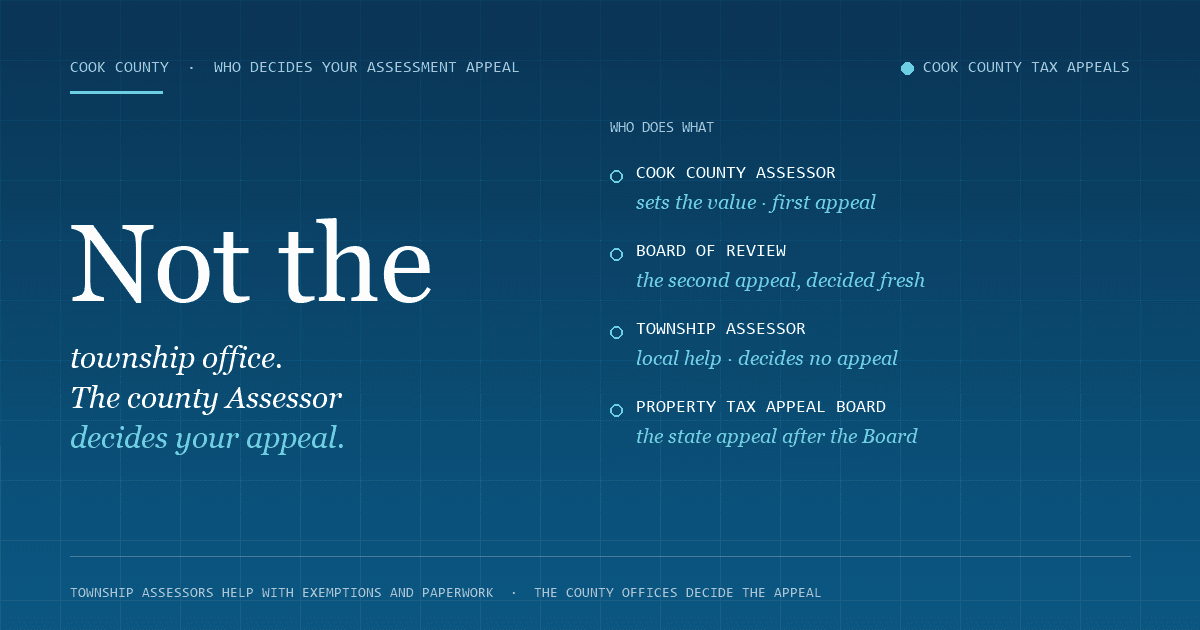
- Several weeks from the mail date Cook County Assessor (CCAO) window The first and fastest path to a correction. For commercial parcels, this is where income-and-expense evidence does the most work. File before the last-file date.
- Later in 2026 Cook County Board of Review (BoR) An independent body that opens after the Assessor's window. You can appeal here even if the Assessor denied or only partly reduced you — or if you skipped the Assessor entirely.
- If still over-assessed PTAB or Circuit Court For larger commercial and industrial disputes, the Illinois Property Tax Appeal Board or the courts remain available after the Board of Review.
The window is short — several weeks (42 to 47 days in 2026) from the notice's mail date, and the date is printed on the notice. Treat the notice arrival as your signal to act, not the deadline. Filing early also means a calmer, better-supported evidence package.
If you own a home in Stickney, Burbank, Bridgeview, or Forest View, this section is for you. Commercial and industrial owners can skip ahead to Part 2.
What actually wins a residential appeal
A higher number is frustrating, but frustration isn't grounds for an appeal. The Assessor and Board of Review reduce assessments for specific, evidence-backed reasons. For homeowners, three carry the most weight:
1. Lack of uniformity (the strongest residential argument)
If comparable homes near you — similar size, age, style, and lot — are assessed for less per square foot than yours, your assessment is "non-uniform" and should be brought in line. In Stickney's established single-family neighborhoods, like Central Stickney and the Nottingham Park area, strong comparables are often available.
2. Overvaluation
If recent sales of similar nearby homes — or a recent purchase or appraisal of your own home — come in below the Assessor's implied market value, you can argue the assessment overstates what your property is worth.
3. Factual error in your property record
The Assessor's description of your home may be wrong: too much square footage, a finished basement that isn't finished, an incorrect bathroom count. Correcting the record can lower the assessment on its own.
| Evidence that wins | Evidence that rarely helps |
|---|---|
| Assessed values of comparable neighbors | "My taxes went up too much" |
| Recent comparable sales below your value | Your personal budget or hardship |
| A recent appraisal or purchase price | The condition of local roads |
| Photos/records correcting a factual error | Comparison to a different township |
How to file your residential appeal, step by step
- Find your PIN and read the notice. Your Property Index Number is on the reassessment notice. Note the proposed assessed value and the deadline on the last page.
- Pull your comparables. Identify similar homes near you and compare their assessed values to yours. This is where most of the work — and most of the win — lives.
- Choose your grounds. Usually lack of uniformity, overvaluation, or a factual correction (often a combination).
- File with the Assessor before the last-file date. The CCAO accepts appeals online; attach your comparables and supporting documents.
- If needed, file with the Board of Review when its window opens — a separate, independent second chance.
- Wait for the decision. Any reduction carries through to your tax bill automatically.
Most successful single-family appeals produce a meaningful but not dramatic reduction, sustained across the three-year cycle. The cost to file is your time, or a contingency fee if you use a firm. The downside is essentially zero: an appeal cannot raise your assessment.
If you own a warehouse, industrial building, retail center, or other income property — especially in the Bedford Park corridor — the valuation method and the evidence that wins are different. Here's how.
How Stickney commercial property is valued
Residential property is valued mostly on comparable sales. Commercial and industrial property is different: Cook County generally uses an income approach. The Assessor estimates what the property earns — based on its use, market rent, vacancy, collection loss, and operating expenses — then applies a capitalization rate to convert that income into a value.
Every one of those inputs is an assumption, and every assumption is a place an assessment can go wrong:
| Input the Assessor uses | How it can overstate your value |
|---|---|
| Market rent (per sq ft) | Assumed rent is higher than your actual leases |
| Vacancy / occupancy | Assumes fuller occupancy than the building runs |
| Operating expenses | Understates costs, inflating net income |
| Capitalization rate | A cap rate set too low inflates the value |
The practical takeaway: a Stickney commercial appeal usually isn't an argument that "the market went down." It's a demonstration that the Assessor's income assumptions for your specific property don't match its actual performance.
Commercial and industrial assessments are far larger than residential ones, so even a modest percentage reduction can translate into a substantial dollar figure — and it compounds across the full three-year cycle until 2029.
What actually wins a commercial appeal
1. Income approach evidence (the centerpiece)
Your actual rent roll, leases, and operating statements. If the Assessor assumed market rents and full occupancy but your building runs below that, the income supporting the assessed value is overstated — and your financials prove it.
2. Lack of uniformity
If comparable commercial or industrial properties nearby are assessed at a lower level relative to income or square footage, your assessment is non-uniform and should be brought in line.
3. Overvaluation vs. market
A recent purchase, a current appraisal, or comparable commercial sales below the Assessor's implied market value.
4. Factual and classification errors
Wrong square footage, an incorrect property class, or characteristics that don't match the actual building. For industrial property, classification and measurement errors are common and correcting them can move the assessment on its own.
Residential appeals can win on comparables alone. Commercial appeals usually require your financials. The owners who assemble a clean rent roll, current leases, and an income-and-expense statement early tend to fare best.
How to file your commercial appeal
- Find your PIN and pull your assessment. Confirm the proposed value and the property characteristics on record with the Assessor.
- Check the calendar / your notice. Confirm Stickney's current open and last-file dates — in 2026 the deadline is also on your reassessment notice.
- Assemble income documentation. Rent roll, current leases, and a recent income-and-expense statement. This is the heart of a commercial appeal.
- File with the Assessor before the last-file date, with your financials attached.
- File with the Board of Review when its window opens — a separate, independent second chance.
- Escalate if warranted. For large disputes, PTAB or the courts remain available after the Board of Review.
Working with us on a Stickney appeal
For homes, appeals are won case by case on the strength of the comparables. What experience buys you is judgment: which Stickney homes are genuinely over-assessed and which aren't, which comparables the Assessor and Board of Review respond to, and how to package a filing so it isn't dismissed on a technicality.
For commercial and industrial property, the work rewards experience with the income approach and with how the Assessor and Board of Review weigh financial evidence. We review your rent roll and operating statements against the Assessor's assumptions, build the comparable and cap-rate case, and file at both the Assessor and the Board of Review — then escalate if the numbers justify it.
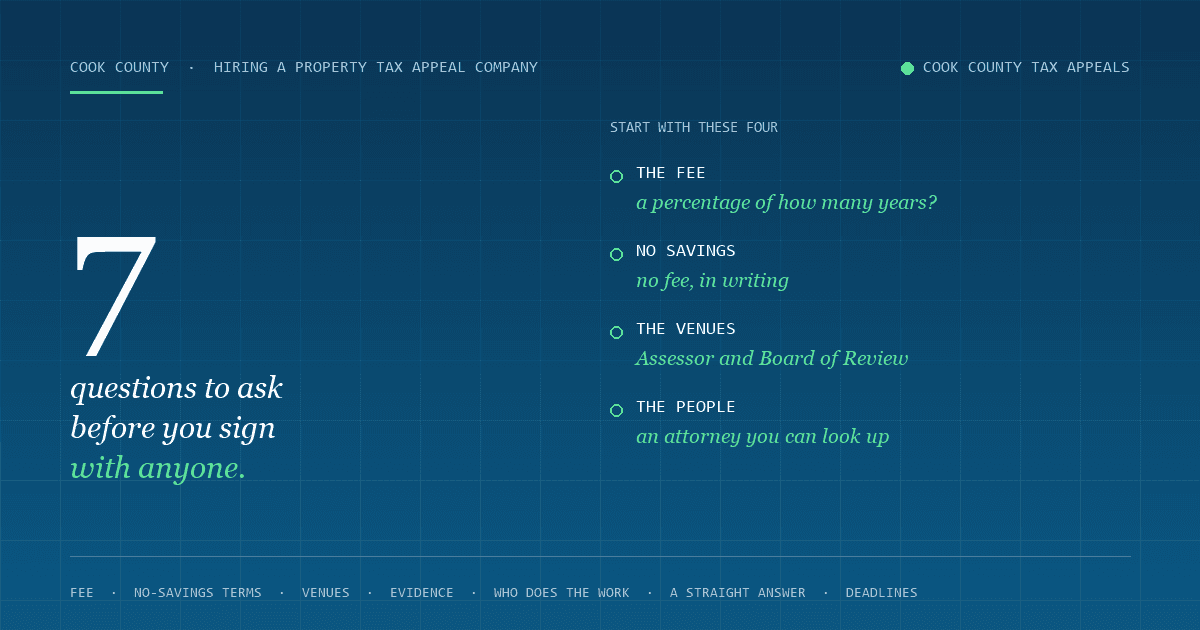
Either way, we charge nothing upfront. We work on contingency — paid a share of the savings only if your appeal actually reduces your bill. If there is no reduction, there is no fee. And if your property isn't over-assessed, the honest answer is to tell you so.
See if your Stickney property is over-assessed
Send us your address or PIN and we'll check your 2026 assessment — comparable homes for residential, the income approach for commercial — free, no obligation, and no upfront cost to file.
Check my assessment →Stickney Township appeal FAQ
When is the Stickney appeal deadline in 2026?
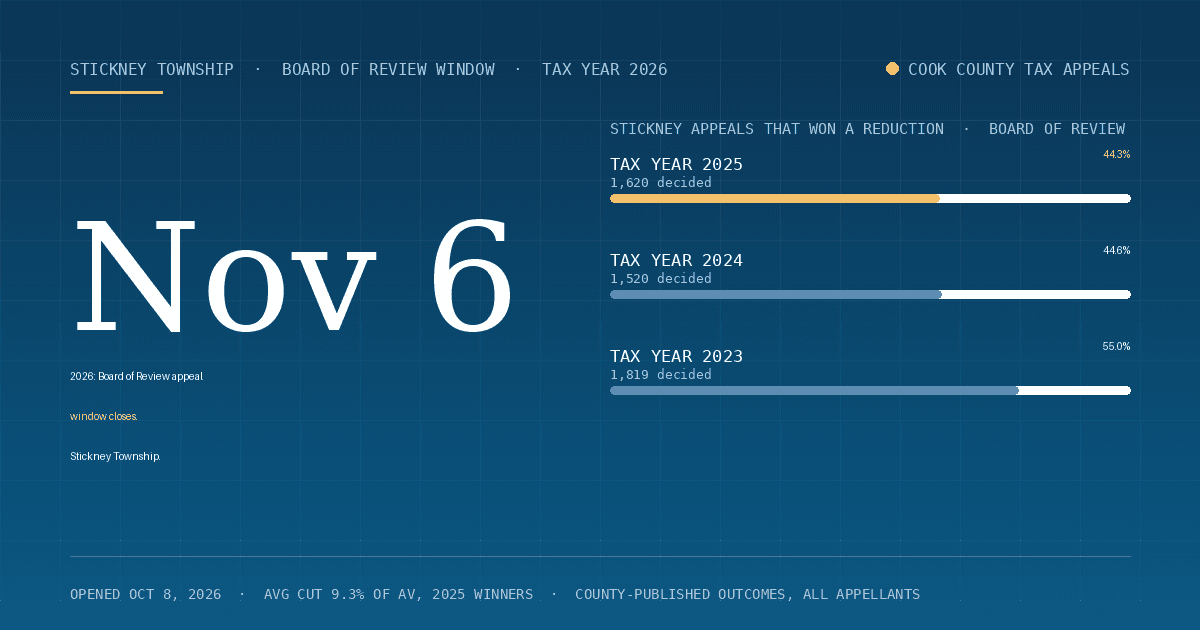
Stickney is reassessed in 2026, so the deadline is printed on the last page of your reassessment notice and posted on the Assessor's Assessment & Appeal Calendar. Stickney's 2026 Assessor window ran June 29 to August 12, 2026; the Board of Review's Stickney window is open October 8 to November 6, 2026. The same calendar governs residential and commercial parcels.
How is residential property assessed and appealed?
Residential property is valued mostly on comparable sales, and appeals are usually won on comparable homes: similar nearby properties assessed for less, recent sales below your value, or factual errors in your property record. Assessed value is 10% of market value for residential property in Cook County.
How is commercial and industrial property assessed?
Generally on an income approach: the Assessor estimates income from use, market rent, vacancy, collection loss, and expenses, then applies a capitalization rate. Because the value is driven by those assumptions, your actual financials are the strongest evidence in an appeal.
What documents do I need for a commercial appeal?
Typically your rent roll, current leases, and a recent income-and-expense statement, plus anything that corrects the property record (square footage, class, condition). Comparable commercial assessments or sales and a market-supported cap rate strengthen the case.
Can I appeal to both the Assessor and the Board of Review?
Yes. They're two separate bodies. You can file with the Assessor during its window and, regardless of that outcome, file again with the independent Board of Review. You can also skip the Assessor and go straight to the Board. For larger disputes, PTAB and the courts remain available afterward.
Will appealing raise my assessment?
Rarely. Across 2021-2025, about 1 in 1,000 decided Cook County appeals ended in a higher assessment; the rest resulted in a reduction or no change.
What does it cost to appeal?
Filing yourself with the county is free. Working with our firm, there's no upfront cost — we work on contingency and are paid only a share of the savings if the appeal succeeds. If there is no reduction, there is no fee.