Cook County Property Tax Guide: Bills, Exemptions, Appeals
Cook County property taxes start with one number: the market value the Cook County Assessor gives your property. This guide follows that number from the reassessment notice to the tax bill, and shows the two ways to lower it: exemptions, and an appeal at the Assessor or the Board of Review.
10% of market value
at 25% of market
(3.0300 in 2025)
cycle
The 60-Second Version
- Your bill is built from four parts: assessed value × state equalizer × local tax rate, minus exemptions.
- Homes are assessed at 10% of market value (commercial at 25%), and every property is reassessed once every three years.
- Exemptions lower the taxable value — the Homeowner Exemption alone cuts equalized assessed value by $10,000.
- You pay in two installments: the first is 55% of last year's total; the second is the balance once the year's numbers are final.
- If your assessment looks too high, you can appeal — every year, not just in reassessment years.
01 · The basicsWhat property tax is, and who pays it
Cook County property tax is a tax on real estate — land and buildings — within the county. It's paid by property owners: homeowners, landlords, and businesses. It isn't a federal or state tax; it's collected locally to fund public schools, police and fire, parks, libraries, roads, and other local services. Schools are typically the largest single piece. How much you pay depends mainly on the value of your property and where it sits.
02 · The formulaHow your bill is calculated
Every Cook County tax bill comes from the same formula:
Four parts drive it:
- Assessed value. The Cook County Assessor sets your property's value for tax purposes. Homes are assessed at 10% of market value; commercial and industrial property at 25%. A $300,000 home has an assessed value of about $30,000.
- State equalization factor (the "multiplier"). Illinois applies a countywide factor so assessment levels are uniform statewide. It's been around 3.0 (3.0300 for 2025). Multiplying assessed value by the equalizer gives your equalized assessed value (EAV).
- Local tax rate. Your schools, municipality, and other taxing bodies set budgets that combine into a composite rate, applied to your EAV. Rates commonly run around 7–10%, and higher in some south-suburban areas.
- Exemptions. Reductions in EAV for those who qualify (more below). They lower the taxable base before the rate is applied.
03 · A worked examplePutting it together: a $300,000 home
Without the Homeowner Exemption the same bill would be about $6,300 — so that one exemption saves roughly $700 a year. Figures are illustrative; the actual equalizer (3.0300 in 2025) and your local rate vary by tax code.
04 · PayingWhen and how you pay
Cook County bills property tax in two installments:
- First installment — exactly 55% of the prior year's total tax. It's mailed near the end of the prior year and due in the early part of the year. The exact due date is set annually (recently around early March), so confirm it on your bill or with the Treasurer.
- Second installment — the balance, calculated once the current year's assessments, exemptions, and tax rates are final. It's due later in the year (historically summer, sometimes pushed to fall).
If you have a mortgage, your lender often pays the taxes from an escrow account; if not, you pay the Cook County Treasurer directly. Under Illinois law you owe the tax — and any late interest — even if a bill never reaches you, so it's worth confirming your bill arrives each installment.
- Pay Cook County Property Taxes: Six Ways, the Fees and Late Charges
- How Cook County Property Tax Bills Work
05 · ExemptionsThe exemptions that lower your bill
Exemptions reduce your taxable EAV. The most common ones:
| Exemption | Who qualifies | EAV reduction |
|---|---|---|
| Homeowner | Owner-occupant, primary residence | $10,000 |
| Senior Citizen (65+) | Age 65+, on top of Homeowner | $8,000 |
| Senior Freeze | 65+, income at/under the limit | Freezes EAV |
| Persons with Disabilities | Qualifying disability | $2,000 |
| Disabled Veterans | Service-connected disability (by rating) | $2,500 / $5,000 / full |
The Homeowner and Senior exemptions generally renew automatically once you're enrolled. For the full list, amounts, and how to apply, see our Cook County homestead exemption guide.
- Cook County Homestead Exemption Guide 2026
- Cook County Senior Exemption: $8,000 Off, Plus the Freeze
- Cook County Senior Freeze Exemption 2026: Who Qualifies
06 · ReassessmentThe three-year reassessment cycle
Cook County doesn't reassess everything at once. It's split into three groups — "triads" — and each is reassessed once every three years on a rotating schedule:
- City of Chicago — reassessed 2024, next in 2027.
- North and northwest suburbs — reassessed 2025, next in 2028.
- South and west suburbs — reassessed 2023, next in 2026.
In your township's reassessment year, the Assessor mails a new value that generally carries forward for the next three years — which makes that the most important year to check your assessment. But it's not the only year you can act.
07 · AppealsAppealing an assessment that's too high
If your property is assessed for more than it's worth, or more than comparable properties nearby, you can appeal to lower the assessed value — which lowers your tax. The key points for beginners:
- You can appeal every year, not just in your reassessment year.
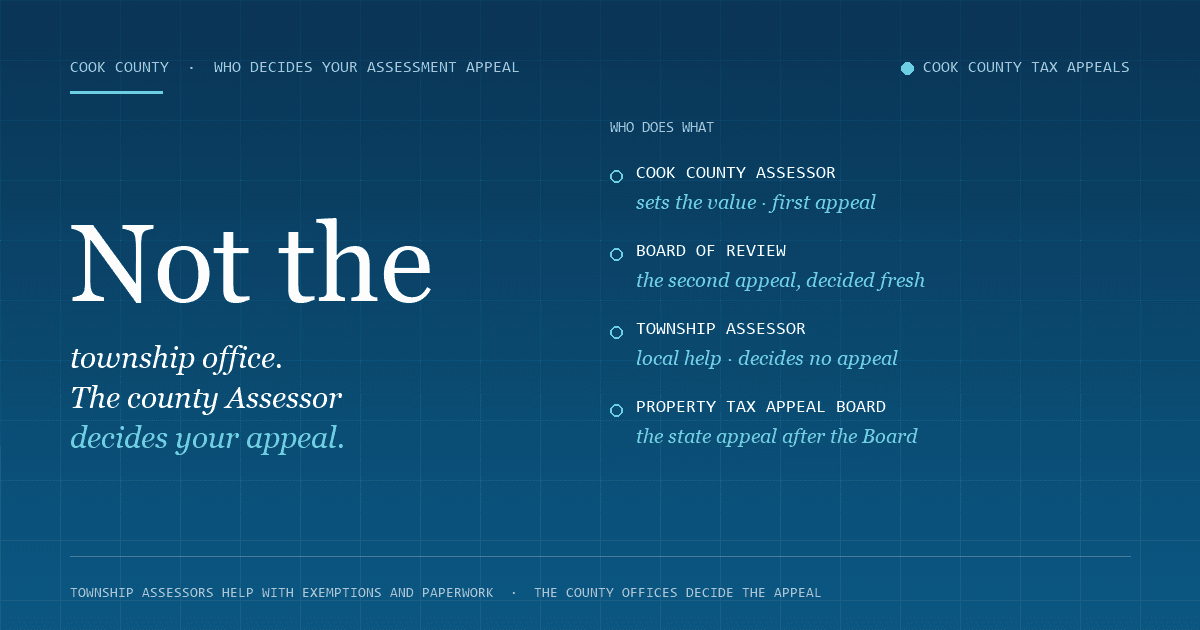
- There are two levels: first the Cook County Assessor, then the independent Board of Review — each with its own filing window by township.
- Evidence wins. For homes, that's comparable sales and accurate property details; for commercial property, it's income-and-expense data.
- An appeal won't raise your assessment — if it isn't reduced, your value simply stays the same.
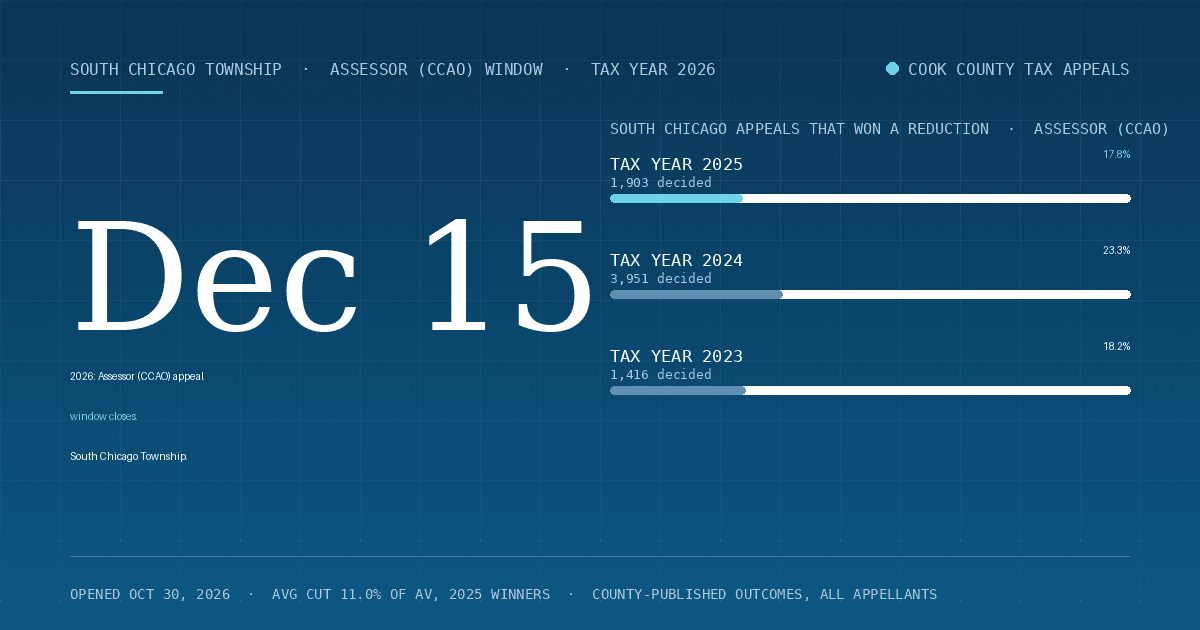
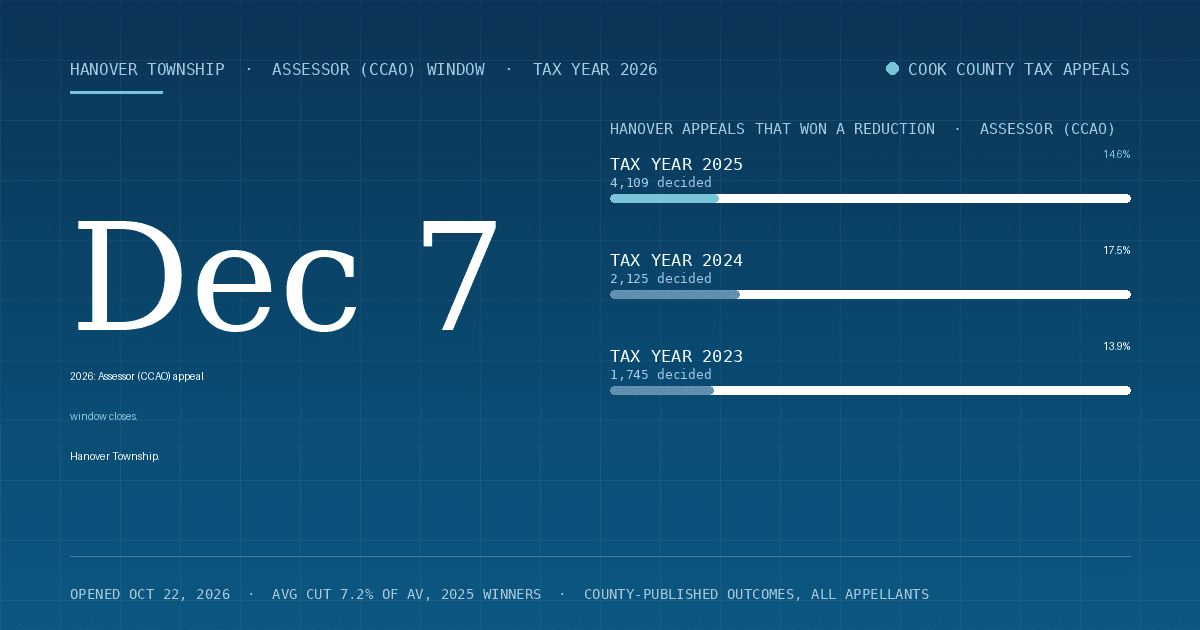
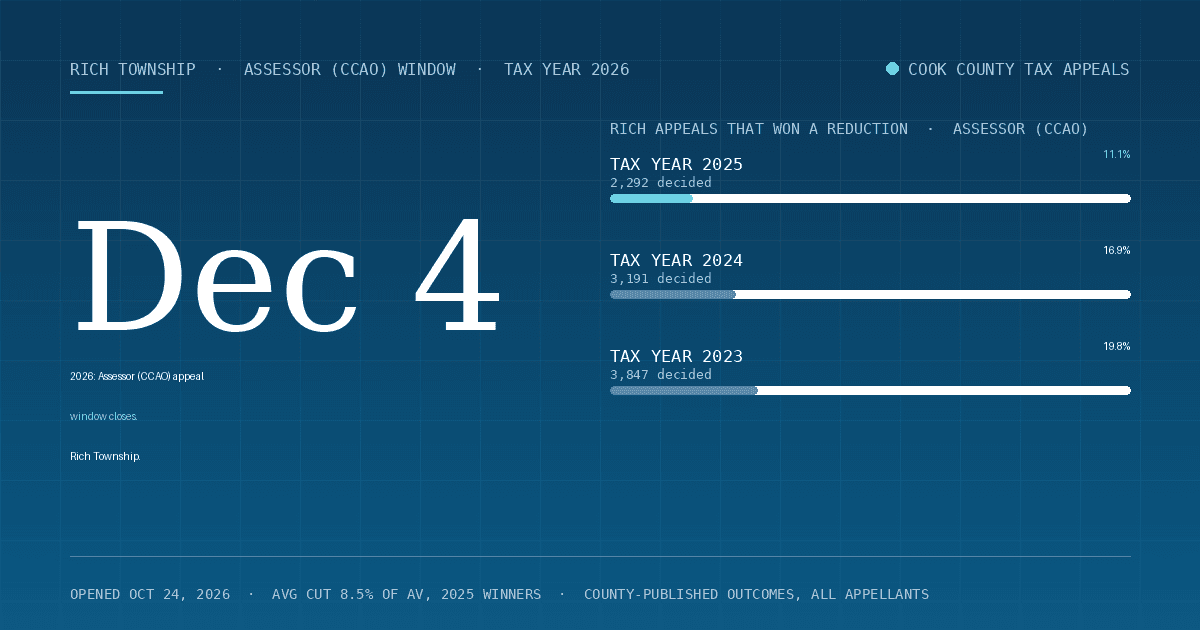
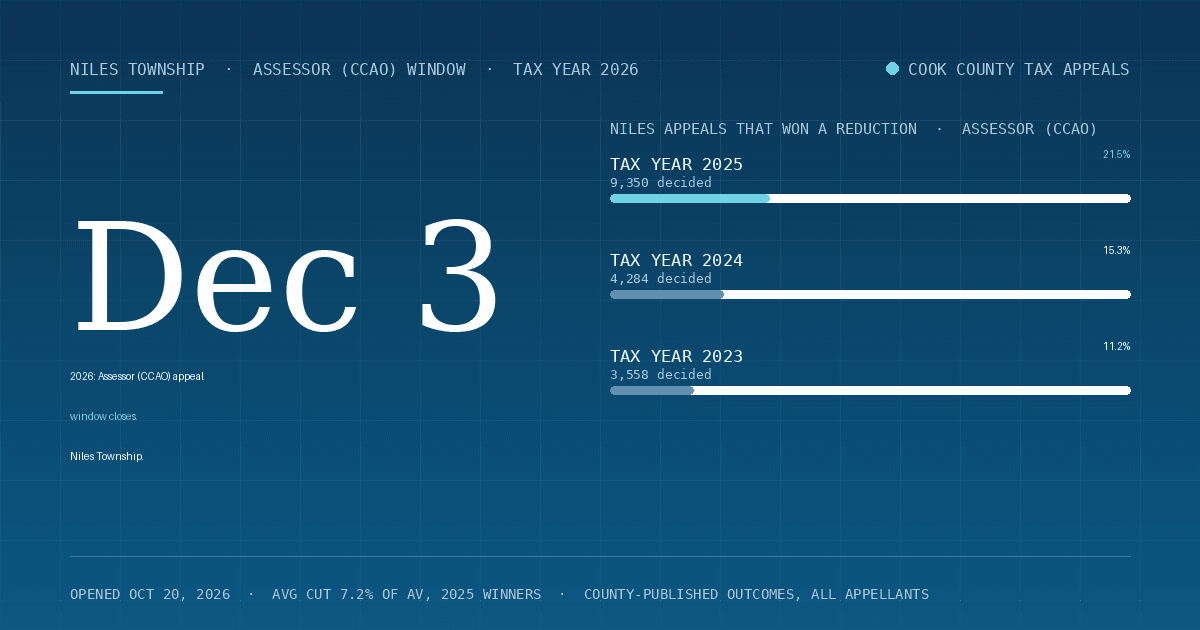
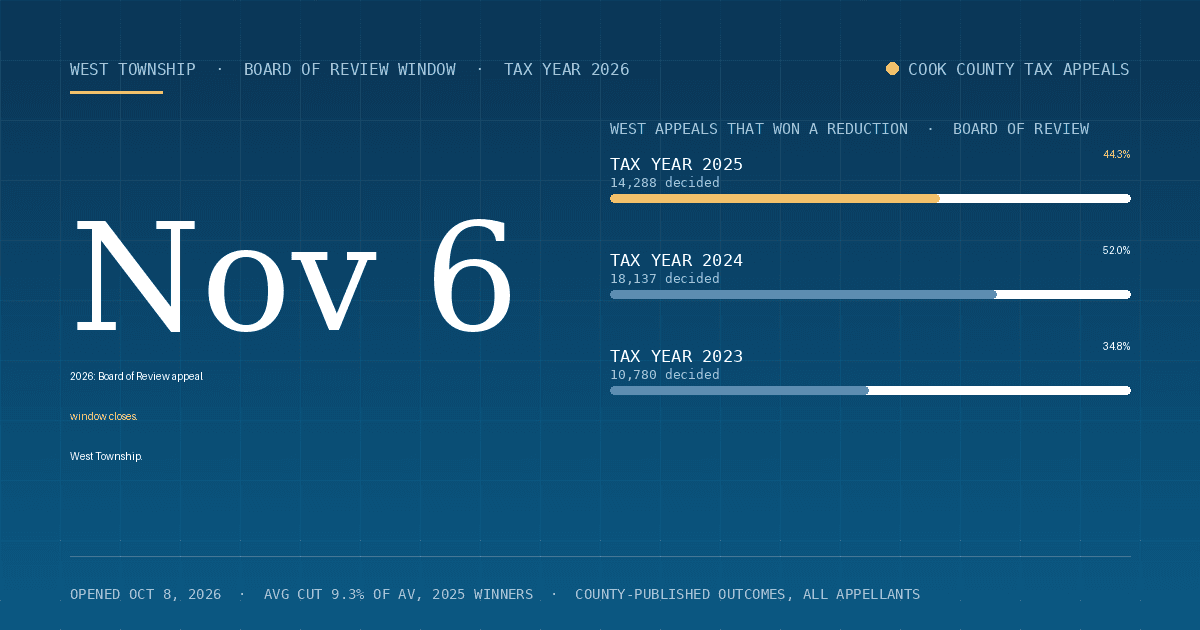
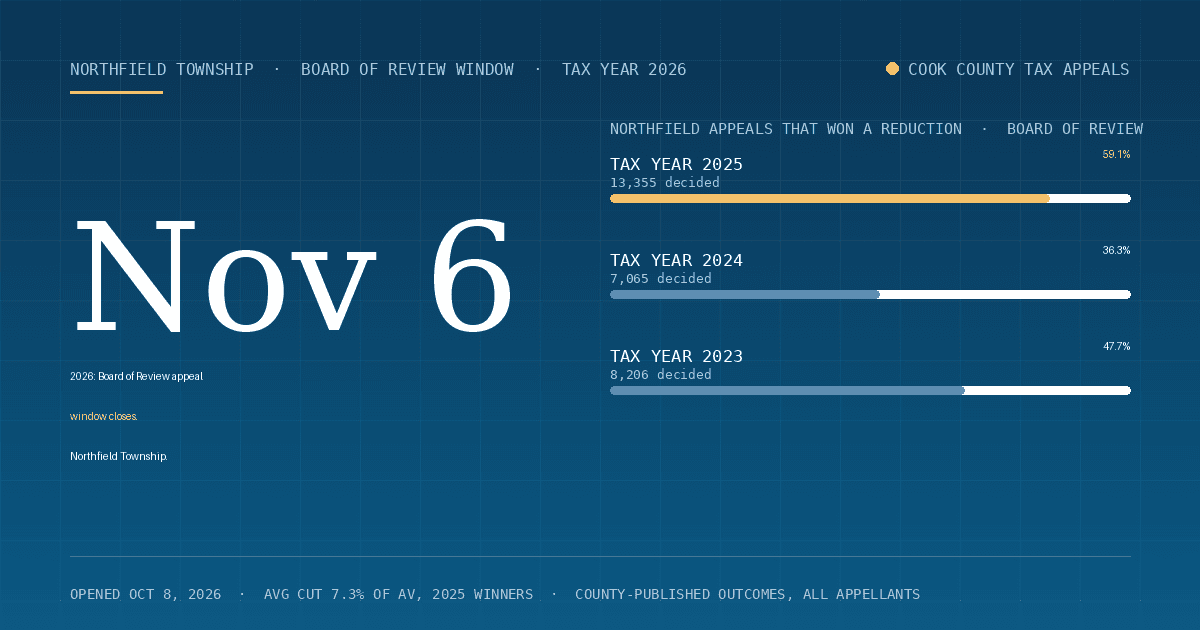
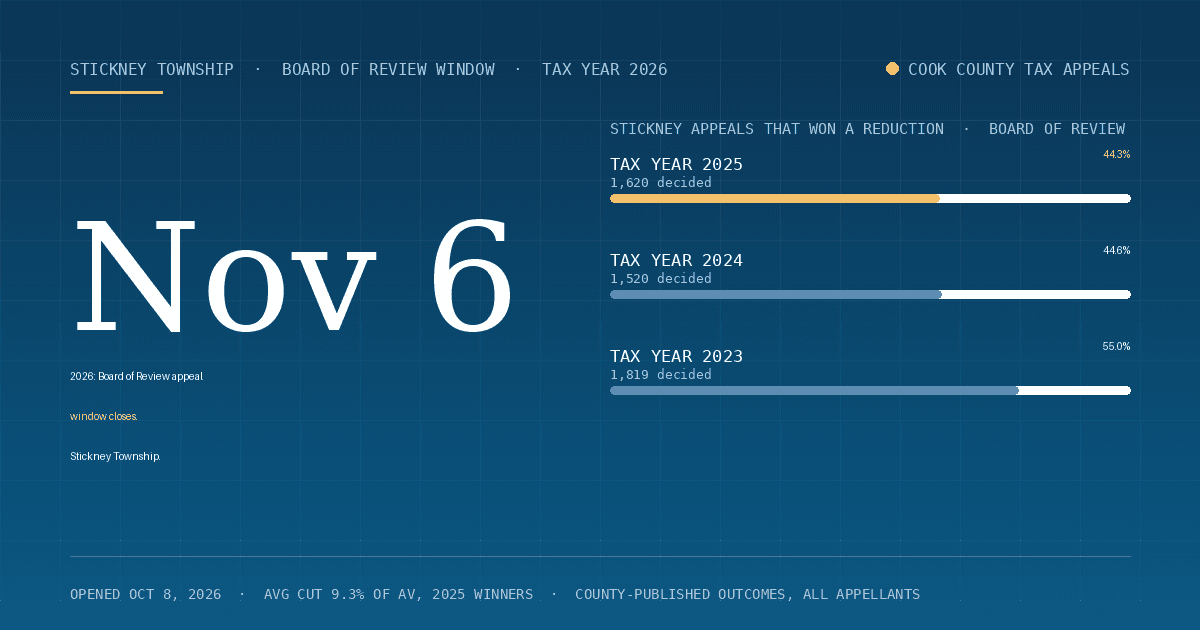
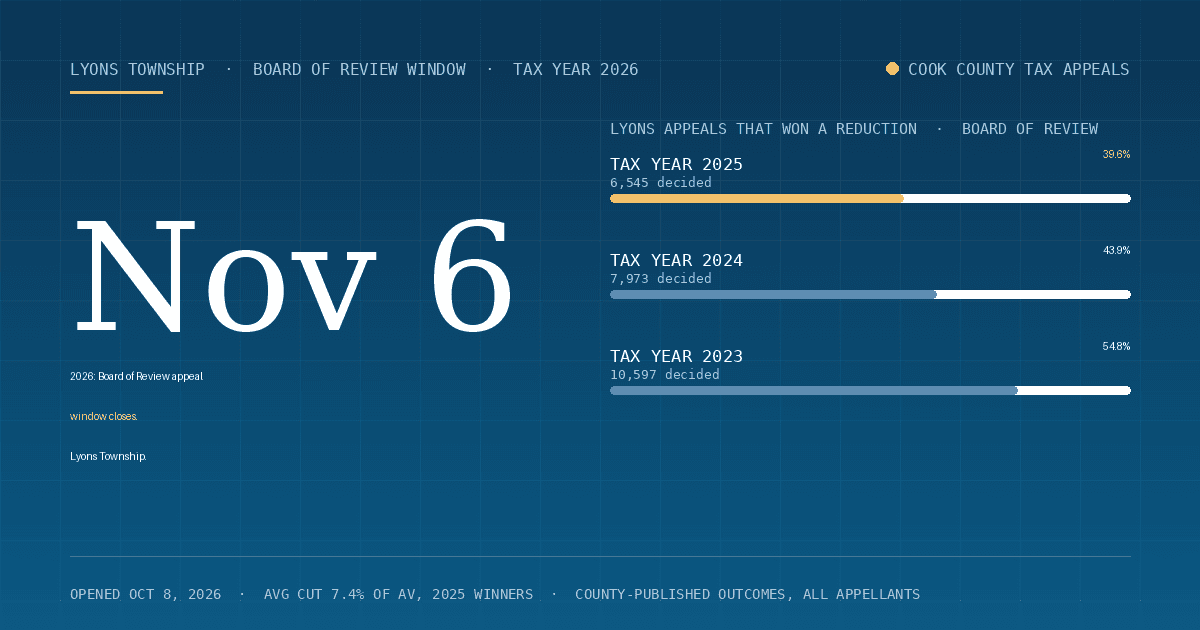
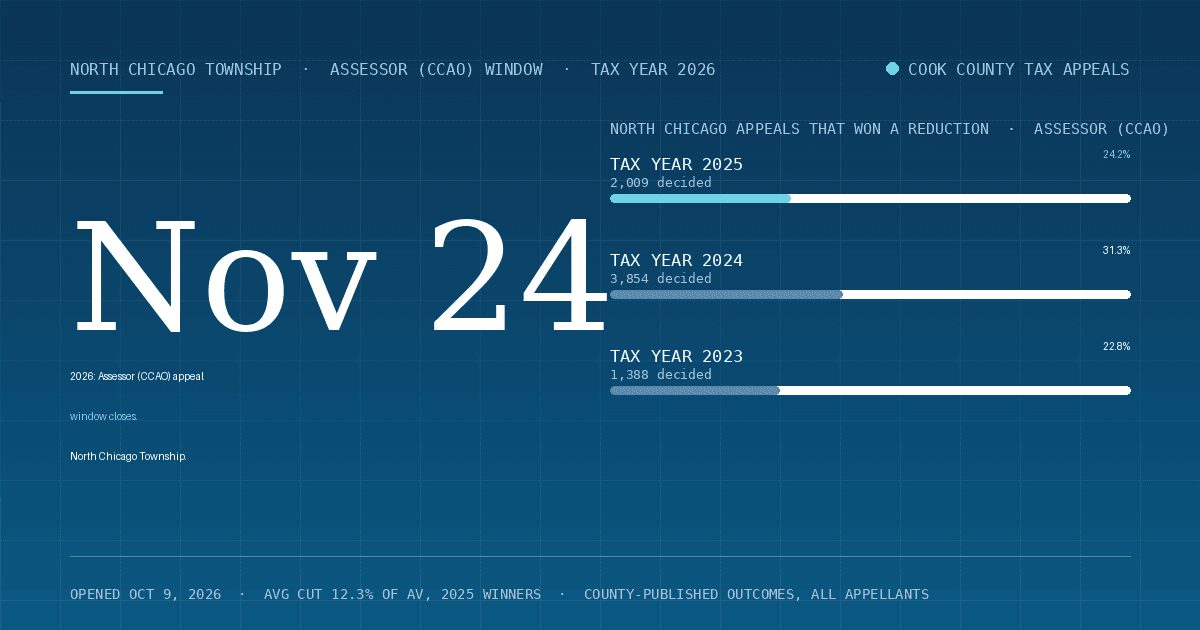
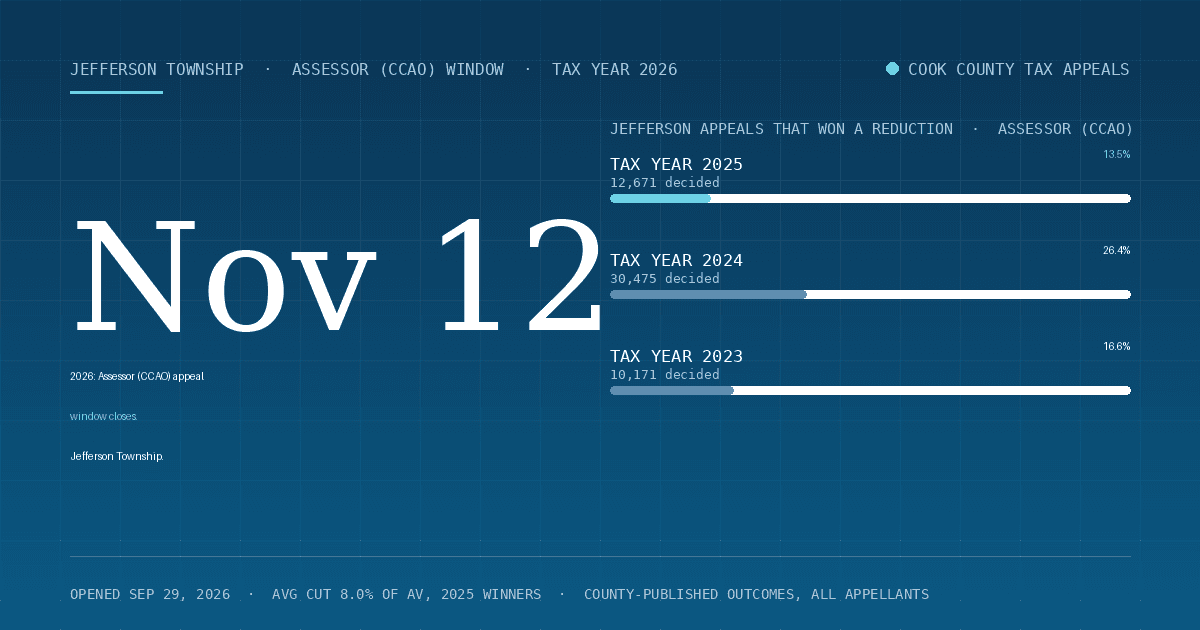
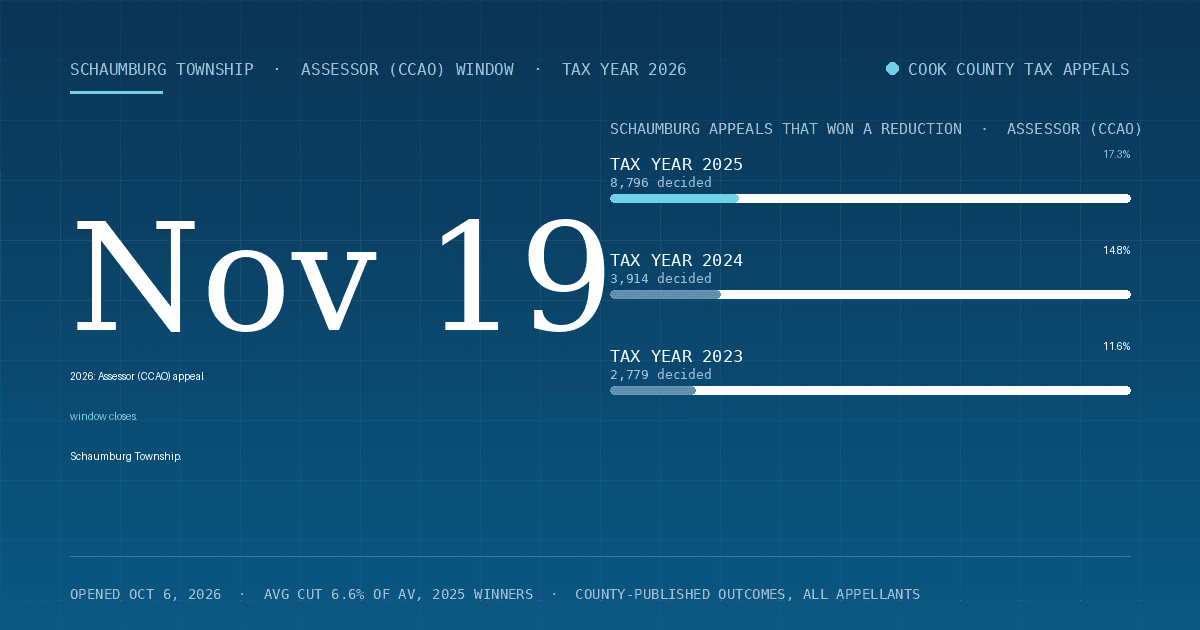
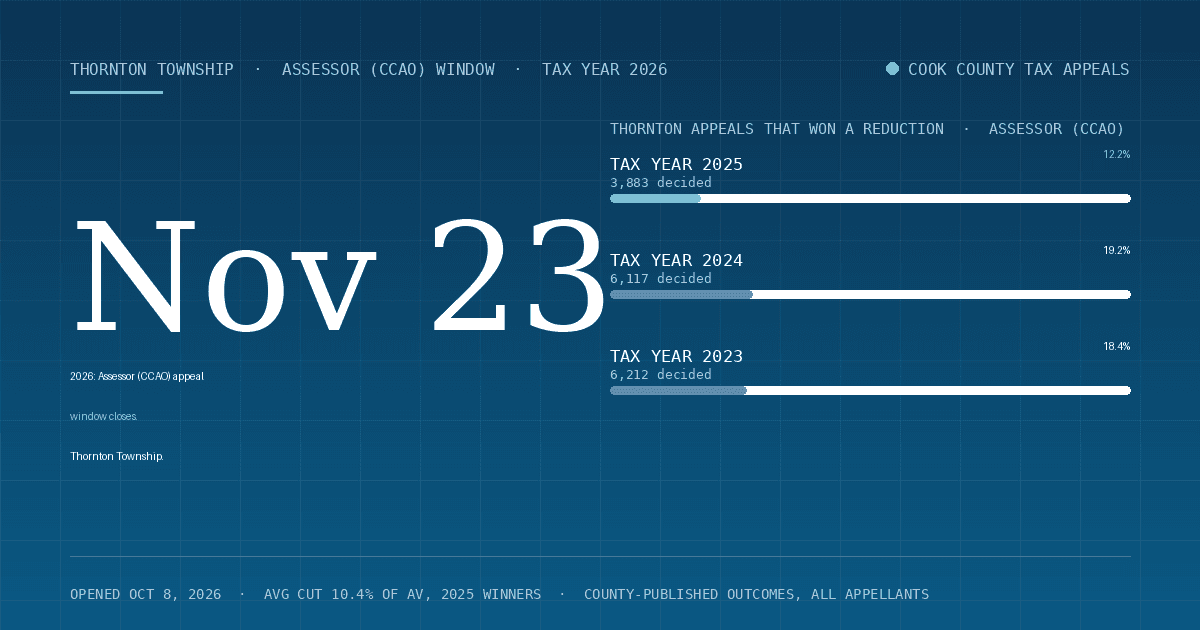
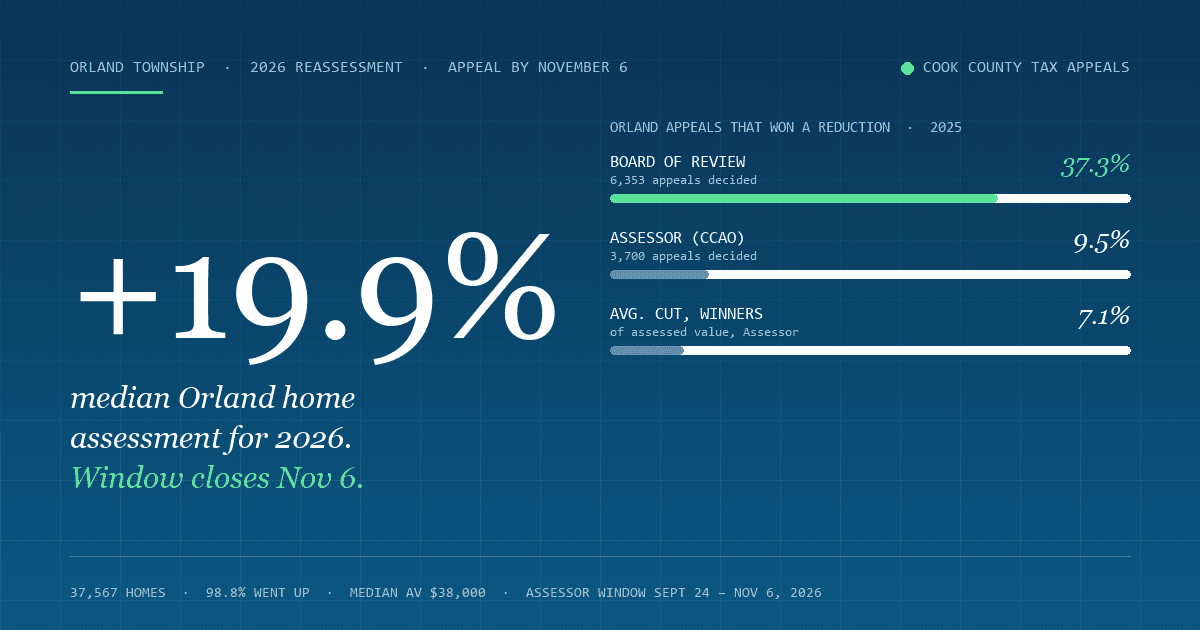
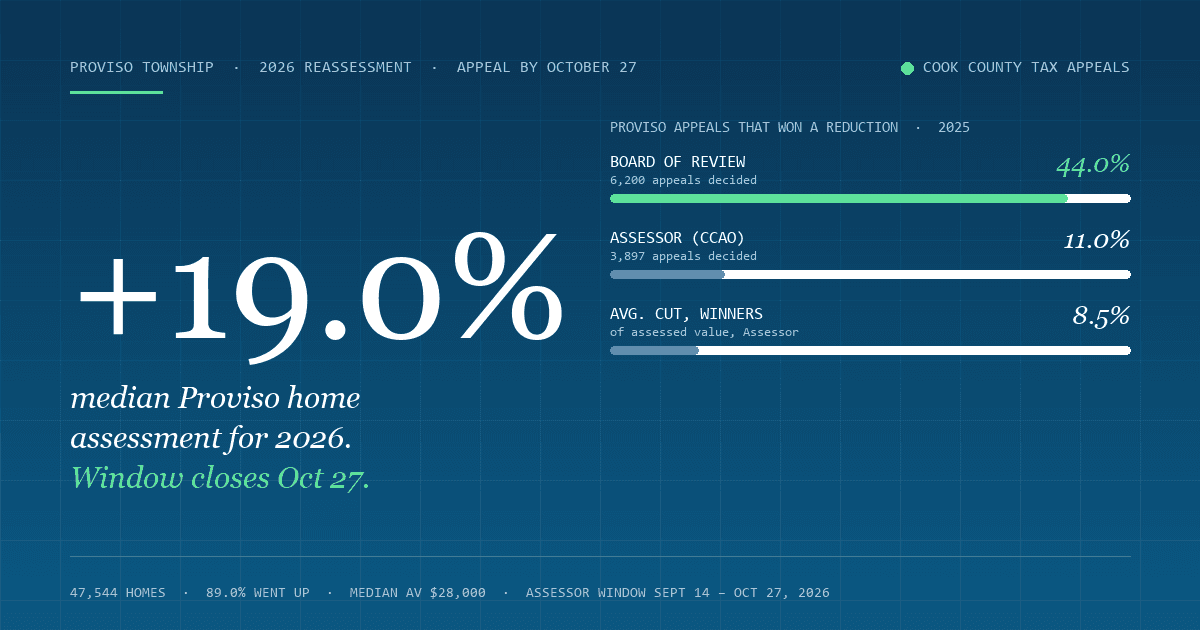
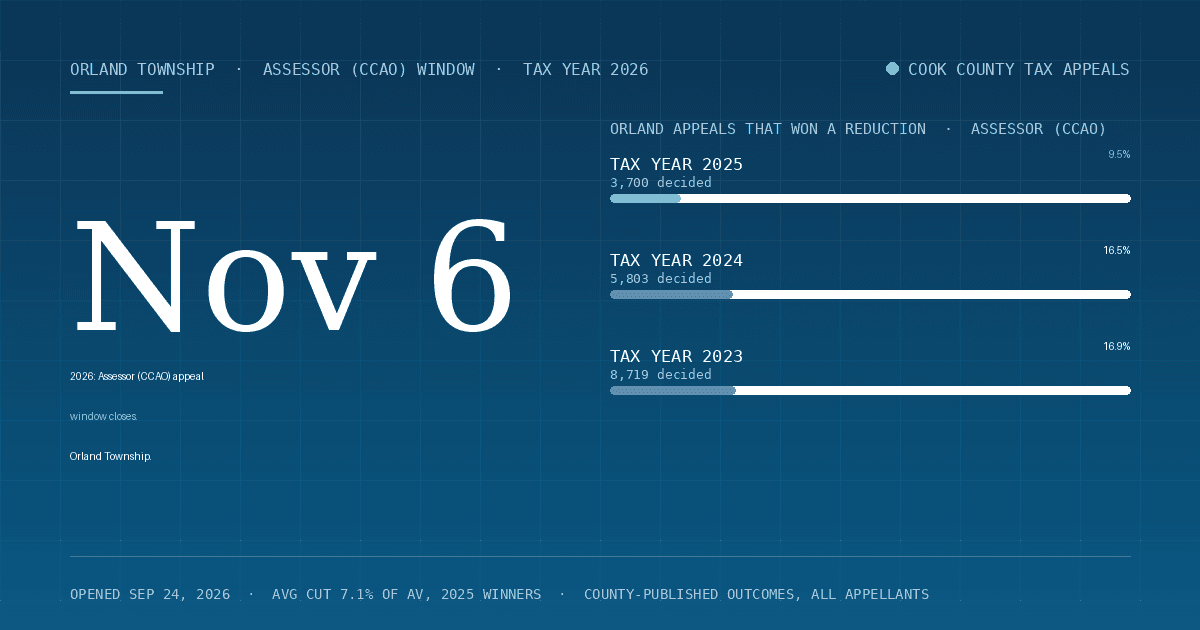
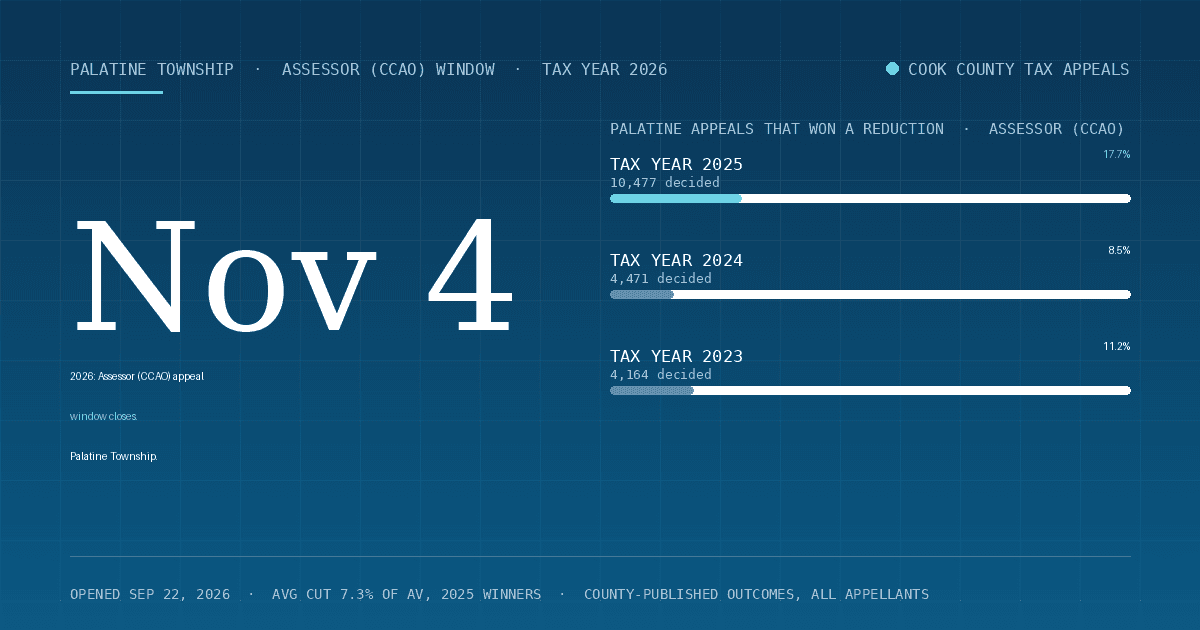
Filing windows open and close on a township schedule, so the first step is knowing when yours is open. Check your township's deadline here.
- How do I appeal my Cook County property taxes?
- Cook County Property Tax Attorney: When Representation Matters
08 · RecapKey takeaways
- Property tax funds local services — schools, safety, parks, and more.
- Your bill = (assessed value × equalizer − exemptions) × local rate. Homes are assessed at 10% of market value.
- Exemptions can save hundreds of dollars a year; make sure yours are on file.
- You pay in two installments — 55% first, the balance second.
- Every property is reassessed every three years, but you can appeal any year your assessment looks too high.
Think Your Assessment Is Too High?
Now that you know how the bill works, see whether yours is fair. Enter your address or PIN to check your appeal potential — no upfront cost. 25% of first-year savings, only if your assessment is reduced.
Check My AssessmentCook County Property Tax FAQ
How is my Cook County property tax calculated?
Your assessed value (10% of market value for homes) is multiplied by the state equalization factor (about 3.0) to get your equalized assessed value (EAV). Exemptions are subtracted, and your local tax rate is applied to what's left. In short: (assessed value × equalizer − exemptions) × local rate.
When are Cook County property taxes due?
In two installments. The first is 55% of the prior year's total tax, due in the early part of the year (the exact date is set annually — recently around early March). The second is the balance, due later in the year once the current year's numbers are finalized. Confirm dates on your bill or with the Cook County Treasurer.
What exemptions can lower my bill?
The Homeowner Exemption ($10,000 off EAV) is the most common. Seniors add $8,000, and there are exemptions for the Senior Freeze, persons with disabilities ($2,000), and veterans. The Homeowner and Senior exemptions generally renew automatically once enrolled.
How often is my property reassessed?
Every three years. Cook County is split into three triads — the City of Chicago (reassessed 2024), the north/northwest suburbs (2025), and the south/west suburbs (2023) — each reassessed on a rotating three-year schedule.
Can I appeal my assessment, and will it raise my taxes?
Yes, you can appeal — every year, not just in reassessment years — first with the Assessor and then the Board of Review. An appeal is a request to review your value; if it isn't reduced, your assessment simply stays the same.
Terms to know
Market value: what the Cook County Assessor estimates your property would sell for. It is the number your assessment starts from.
Assessment level: the share of market value that is assessed: 10% for homes, 25% for commercial and industrial property.
Assessed value: market value times the assessment level. A home with a $350,000 market value has a $35,000 assessed value.
Equalization factor: the multiplier the Illinois Department of Revenue sets each year so Cook County's assessments line up with the rest of the state. It was 3.0300 for the 2025 tax year.
Equalized assessed value (EAV): your assessed value times the state equalization factor. Exemptions are subtracted from it, and your local tax rate is applied to what remains.
PIN (Property Index Number): the 14-digit number that identifies your property on the assessment notice, the tax bill and every appeal.
Certificate of Error: the Assessor's correction of a past assessment, for a factual error or a missing exemption. The Treasurer then refunds or corrects the bill.
PTAB: the Illinois Property Tax Appeal Board, the state board that hears appeals from Board of Review decisions.
Notes & Sources
- Assessment levels and formula: Illinois Property Tax Code — residential property assessed at 10% of market value, commercial/industrial at 25%; bill = (assessed value × state equalization factor − exemptions) × local tax rate. The 2025 state equalization factor (multiplier) is 3.0300 (2024's was 3.0355; 2023's was 3.0163).
- Exemptions (standard Cook County EAV reductions): Homeowner $10,000; Senior Citizen $8,000 (on top of Homeowner); Persons with Disabilities $2,000; Disabled Veterans $2,500 / $5,000 / full by VA rating; Senior Freeze (income-based) freezes EAV. Administered by the Cook County Assessor's Office.
- Payment: two installments — the first is 55% of the prior year's total tax (due early in the year; date set annually), the second is the balance (due later in the year). Administered by the Cook County Treasurer; dates vary year to year. Under 35 ILCS 200/20-15, the owner is responsible for payment and any late interest even if a bill is not received.
- Reassessment: every property is reassessed once every three years by triad — City of Chicago (2024), north/northwest suburbs (2025), south/west suburbs (2023). Appeals are filed with the Cook County Assessor and Board of Review on township-specific schedules; annual appeals are available every year.
- This is general educational information, not legal or tax advice. Figures are illustrative and vary by property and tax code; confirm current details with the Cook County Assessor and Treasurer.
Keep Reading
This guide is general educational information about Cook County property tax and is not legal or tax advice. Assessment levels, the state equalization factor, tax rates, exemption amounts, and payment dates are set by the Cook County Assessor, the Illinois Department of Revenue, local taxing bodies, and the Cook County Treasurer, and can change year to year. Worked figures are illustrative and vary by property and tax code. Appeals are filed on township-specific schedules — always confirm current deadlines before filing. Representation is subject to a written engagement agreement.