Assessed Value vs Market Value: What Cook County Homeowners Need to Know
In Cook County, a home's assessed value is 10% of the Assessor's estimate of its market value (25% for most commercial property). Market value is what it would sell for. Your tax is worked out from the assessed value, after the state equalizer and exemptions, so a market value set too high raises your bill, and you can appeal it.
as a share of market value
as a share of market value
before the next cycle
Assessor + Board
The Short Version
- Market value is what your home would sell for. Assessed value is the figure the county uses to tax it.
- In Cook County, residential property is assessed at 10% of market value (commercial at 25%), per county ordinance.
- Assessments come from mass-data models, not individual inspections — so they often miss the real value of your specific home.
- When the assessment runs high, you're overassessed and overtaxed — sometimes for years, since a value can stand for a full three-year cycle.
- If your assessed value implies a market value higher than your home would really sell for, you may have a strong case to appeal.
Many homeowners assume their assessed value and market value are the same number. They're not — and in Cook County they're not even close by design. Understanding the gap is the first step to spotting an unfair assessment and deciding whether to appeal.
To see the Assessor's appraisal of your own home and the assessment it produced, side by side, use our free Cook County tax assessment calculator.
What Is Assessed Value?
The assessed value is the figure the Cook County Assessor's Office assigns to your property to calculate your taxes. In plain terms, it's the number the county uses to decide how much you owe.
The Assessor estimates your home's value using factors like:
- Location of the property
- Size and type of the home
- Recent sales data in the neighborhood
- Property characteristics such as age and improvements
That estimate is not always equal to real market value. When it comes in too high, your property is overassessed — and you pay more than your fair share.
Tax appraisal vs market value: are they the same?
No. The two terms get used interchangeably, but they answer different questions.
Market Value
What a willing buyer would pay for your home today. It moves with buyer demand, location, condition, and comparable sales in your area.
Assessed Value
The county's value for tax purposes — in Cook County, 10% of the Assessor's estimated market value for a home. Because it relies on mass models rather than a walk-through, it often diverges from what your home would actually fetch.
Tax assessment vs market value in Cook County: the 10% and 25% levels
In Cook County, residential property is generally assessed at 10% of estimated market value, and most commercial property at 25%. So a home the Assessor pegs at a $400,000 market value carries a $40,000 assessed value. The two figures are linked by that ratio — but the estimate of market value behind it can still be wrong.
There's also a step many homeowners miss. Your assessed value is not the last step. It is multiplied by the state equalization factor to give your equalized assessed value (EAV). Your exemptions come off that, and your local tax rate is applied to what is left. Here's the full chain on that $400,000 home:
| Market value | The Assessor's estimate of what the home would sell for | $400,000 |
|---|---|---|
| Assessed value | 10% of market value | $40,000 |
| Equalized assessed value | The assessed value times the state equalizer (3.0300 for the 2025 tax year) | $121,200 |
| Taxable value | After the $10,000 Homeowner Exemption | $111,200 |
The leverage point — lower the market-value estimate and every step below it shrinks. Appeal here.
The key takeaway: the entire bill flows from that first number. If the Assessor's market-value estimate is too high, everything downstream is inflated too — which is exactly what an appeal targets.
Why Homes Get Overassessed
Overassessment is more common than most owners expect. The usual culprits:
1. Incorrect property data
Assessor records sometimes list features your home doesn't have — extra square footage, an additional bathroom, a finished basement that isn't finished. Even small errors push the assessed value up.
2. Outdated or mismatched comparable sales
The model leans on comparable sales. If those comps are larger, newer, or renovated relative to your home, your value gets inflated. This is one of the biggest gaps between a tax appraisal and true market value.
3. Declining neighborhood values
If local prices soften but the assessment isn't updated quickly, you can be taxed on a value the market no longer supports.
4. Property condition issues
Structural problems, roof or water damage, and dated interiors all lower real market value. Unless you raise them in an appeal, the mass model won't know about them.
How Overassessment Hits Your Tax Bill
When the assessed value is too high, the bill follows. Even a small gap between the Assessor's market value and what your home would sell for can cost hundreds of dollars a year, sometimes thousands. It adds up each year the value stands. That's why so many Cook County homeowners file appeals when the numbers look off. You can see how the process works on our deadlines and appeal guide.
How to Tell If Your Home Is Overassessed
Run a quick gut check. You may want to review your assessment if:
- Your assessed value is higher than comparable homes nearby.
- Your home would realistically sell for less than the market value implied by your assessment (assessed value × 10).
- The Assessor's property record contains errors about your home.
- Your tax bill jumped without an obvious reason.
How to Appeal a Cook County Assessment
If you think you're overassessed, you have the right to file a property tax appeal. The process generally runs:
- Review your reassessment notice and confirm your filing window.
- Gather comparable sales that support a lower value.
- Identify any errors in the Assessor's record of your home.
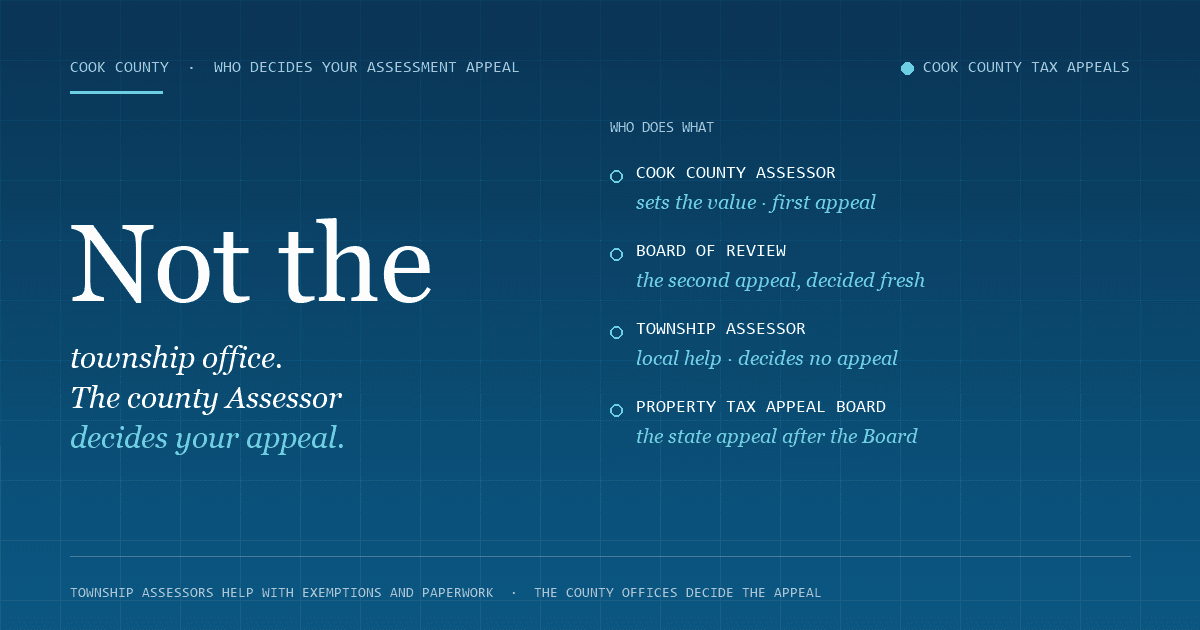
- Submit your evidence to the Assessor — and, if needed, the Board of Review.
Because a strong appeal rests on solid comparables and valuation arguments, many homeowners get help. Learn more about filing a residential property tax appeal in Cook County.
See If You're Overpaying
Enter your address and we'll check your assessment against comparable properties — so you can see whether your assessed value lines up with reality.
Check My AssessmentFrequently Asked Questions
Are property taxes the same as real estate taxes?
Yes. In Cook County, property tax and real estate tax are the same bill. Illinois does not tax personal property such as cars or furniture, so the tax is on your land and building. The Treasurer sends the bill, based on the Assessor's assessed value.
Is assessed value the same as market value in Cook County?
No. Market value is what your home would sell for; assessed value is the figure used to tax it. In Cook County, residential property is assessed at 10% of the Assessor's estimated market value, and most commercial property at 25%.
How do I estimate the market value the county is taxing me on?
For a home, multiply your assessed value by 10 (since residential is assessed at 10% of market value). If your home wouldn't realistically sell for that amount, you may be overassessed.
Why is my assessed value different from what my home is worth?
Assessments are produced by mass-data models, not individual inspections. Incorrect property records, mismatched comparable sales, shifting neighborhood values, or unreported condition issues can all push the Assessor's estimate away from true market value.
What is Equalized Assessed Value (EAV)?
After your assessed value is set, the state applies an equalization factor (a multiplier near 2.9 in Cook County) to produce the EAV. Your exemptions are subtracted from the EAV, and the local tax rate is applied to the remainder to calculate your bill.
Can I lower my property taxes if I'm overassessed?
Yes. If you can show the Assessor's market-value estimate is too high — usually with comparable sales or corrected property data — an appeal can reduce your assessed value and, with it, your tax bill. Appeals can be filed with the Assessor and the Board of Review.
Keep Reading
This article is general information about how Cook County values property for tax purposes and is not legal or tax advice. Assessment ratios and the state equalization factor are set by Cook County ordinance and the Illinois Department of Revenue and can change. Always confirm your figures against your reassessment notice and the Cook County Assessor's Office. Representation is subject to a written engagement agreement.