South Chicago Township Property Tax Appeal Results
When South Chicago Township was reassessed in 2024, about 27% of Cook County Assessor appeals won a reduction — and the typical winning appeal cut assessed value by roughly $6,790. Here’s what the county-wide data shows, broken down by property class, and why the reassessment year is the number that actually matters.
(2024 reassessment)
(1,342 appeals)
value cut
removed
South Chicago Township covers Chicago’s far Southeast Side — the South Chicago, East Side, Hegewisch, South Deering, and Calumet Heights neighborhoods, along with the heavy-industrial Calumet River corridor. Because it sits in the City of Chicago reassessment triad, its property values were freshly reset in 2024 and hold until the next reassessment in 2027, which makes 2024 the year that really counts for an appeal.
The 60-Second Version
- In the 2024 reassessment, South Chicago Township had 4,915 Assessor appeals, counting each appeal once, and 1,342 won a reduction — a 27.3% success rate.
- The typical (median) successful appeal cut assessed value by $6,790 — roughly $1,360 a year, or about $4,100 across the three-year cycle that value is locked in.
- Income and industrial property won most often: multifamily (49.7%) and commercial/industrial (43.0%) cleared close to half. Condo appeals were the toughest class (16.3%).
- 2025 was an off-year annual window, not a reassessment — fewer than half as many appeals, at a lower 20.0% rate. Judge your odds by the reassessment year.
01 · Why 2024 countsWhy the reassessment year is the one to read
Cook County reassesses property in three-year cycles. The City of Chicago triad — which includes South Chicago Township — was reassessed in 2024, and those values carry through 2026 until the next reassessment in 2027. A reassessment is when the Assessor resets your value, so it’s both the moment most likely to push your assessment too high and the appeal that locks in savings for the rest of the cycle.
That’s why this report leads on 2024. As you’ll see below, a commonly quoted 2025 figure counts each condo unit as its own appeal, which makes the off-year look far worse than it was.
02 · Overall resultsThe headline numbers for 2024
Across all property types in the 2024 reassessment, South Chicago Township recorded:
| Metric | Result |
|---|---|
| Total appeals filed | 4,915 |
| Appeals that won a reduction | 1,342 |
| Overall success rate | 27.3% |
| Median reduction (winning appeals) | $6,790 |
| Total assessed value removed | $465.8M |
A “reduction” here means the Assessor lowered the assessed value after review; appeals that ended in no change are counted as unsuccessful. A 27.3% success rate means roughly 1 in 4 appeals won — the ones that do tend to bring accurate property data, the right classification, and strong comparable sales or income evidence.
A note on averages: the average winning reduction was about $347,000, far above the $6,790 median. South Chicago’s industrial corridor includes some very large parcels whose big cuts pull the mean up; for a typical home or condo, the median is the honest yardstick.
03 · By property classWhere appeals actually won
Outcomes split sharply by property class — classification drives both how a property is valued and how an appeal is judged.
| Property class | Appeals | Won | Success | Median cut (AV) |
|---|---|---|---|---|
| Multifamily (3xx) | 147 | 73 | 49.7% | $156,201 |
| Commercial (5xx) | 781 | 336 | 43.0% | $95,000 |
| Residential (2xx) | 3,444 | 839 | 24.4% | $4,001 |
| Condominium (299) | 509 | 83 | 16.3% | $5,626* |
Income and industrial property led the township. Multifamily and commercial/industrial parcels won close to half their appeals, because income-producing property is valued on numbers — rents, vacancy, expenses — that an appeal can directly challenge with evidence. Their median reductions ($156,201 and $95,000) dwarf the residential figures, reflecting South Chicago’s heavy industrial base.
The condo paradox holds. Condo appeals had the lowest success rate (16.3%). *Counted by appeal, a condo appeal often covers a whole building's units, decided together, so its median cut ($5,626) is usually a building's, not one unit's. Mass-assessed and tightly comped against their own buildings, condos are simply harder to move — and as the next section shows, counting their units one by one is what made 2025 look so bad.
04 · What it’s worthTurning an assessment cut into tax dollars
An assessed-value reduction becomes real money once you run it through the state equalizer (3.0355 for the 2024 tax year) and South Chicago’s composite tax rate (about 6.62%). For the township-wide median cut of $6,790, that’s roughly $1,360 a year — and because a reassessment-year reduction holds through the cycle, about $4,100 over three years. By class:
| Property class | Median cut (AV) | Est. annual tax saving* |
|---|---|---|
| Multifamily (3xx) | $156,201 | ~$31,400 |
| Commercial (5xx) | $95,000 | ~$19,100 |
| Residential (2xx) | $4,001 | ~$805 |
| Condominium (299) | $5,626 | ~$1,130 |
*Illustrative: median assessed-value reduction × state equalizer (3.0355 for the 2024 tax year) × township composite rate (6.618606%), before exemptions. Your actual saving depends on your final assessment, exemptions, and the year’s rate.
05 · 2025 in contextWhy the off-year looks so different
You may see a 2025 figure for South Chicago Township quoted around a 4–5% success rate. That figure counts each condo unit as its own appeal — and in 2025 South Chicago’s condo owners appealed 14,905 units in just 166 appeals. Counted by appeal, the off-year annual window came in at 20.0%: lower than the reassessment year, but not dramatically:
| 2024 (reassessment) | 2025 (off-year) | |
|---|---|---|
| Appeals filed | 4,915 | 2,279 |
| Won a reduction | 1,342 | 456 |
| Success rate | 27.3% | 20.0% |
| Median reduction | $6,790 | $5,286 |
Counted by appeal, 2025 drew fewer than half as many appeals as 2024, and condo appeals were only 166 of them. The success rate dipped (20.0% vs. 27.3%), and when an off-year appeal did win, the typical cut ($5,286) was close to 2024’s ($6,790). The off-year rate reflects timing, not whether your assessment is defensible. Read your odds from the reassessment year.
06 · What it meansWhat this means for property owners
- Don’t trust the township average alone. In South Chicago, condo appeals win far less often than income and industrial property. Benchmark against your own class.
- Income and industrial owners have the best odds. If you own a commercial, industrial, or multifamily parcel here, roughly half of 2024 appeals in your class won — and the dollar cuts are large.
- Evidence wins. Accurate property characteristics, correct classification, and strong comparables (or income data) separate the appeals that move from the ones that don’t.
- Time it to the cycle. A reduction won in the reassessment year carries through 2026, so the savings compound across the cycle.
See Your South Chicago Appeal Potential
Check your property by address or PIN to see your assessment, your class, and an estimate of what an appeal could save — no upfront cost. 25% of first-year savings, only if your assessment is reduced.
Check My PropertySouth Chicago Township Appeal Results — FAQ
What was the appeal success rate in South Chicago Township?
In the 2024 reassessment, 1,342 of 4,915 Cook County Assessor appeals won a reduction in South Chicago Township, counting each appeal once — a 27.3% success rate. The 2025 off-year window had a lower rate (20.0%) on fewer than half as many appeals.
Where is South Chicago Township?
South Chicago Township covers Chicago’s far Southeast Side, including the South Chicago, East Side, Hegewisch, South Deering, and Calumet Heights neighborhoods and the Calumet industrial corridor. It is part of the City of Chicago and its reassessment triad.
Why do some 2025 figures look so low?
Because they count each condo unit as its own appeal: in 2025, 166 condo appeals covered 14,905 units. Counted by appeal, 2025 came in at 20.0%, below the 2024 reassessment year’s 27.3% but not dramatically; the reassessment year is the better benchmark.
Which property types had the best results?
Income and industrial property. Multifamily (49.7%) and commercial/industrial (43.0%) won close to half their 2024 appeals, versus 24.4% for residential and 16.3% for condo appeals.
How much can a successful appeal save?
The median winning 2024 appeal cut assessed value by $6,790, which works out to roughly $1,360 a year at the township composite rate — about $4,100 across the three-year cycle. Industrial and commercial reductions save far more. Figures are illustrative and vary by property.
Does a low township success rate mean I shouldn’t appeal?
No. Township averages include many weak or unsupported filings. A well-prepared appeal in your own class — correct data, right classification, strong comparables — can still win.
Notes & Sources
- Figures are derived from Cook County Assessor appeal records (public appeal-decision data) for parcels in South Chicago Township (Assessor town 76), tax years 2024 and 2025, counting each appeal once (a condo building's units, or a multi-parcel filing, decided together, are one appeal). A “reduction” means the Assessor lowered the assessed value on review.
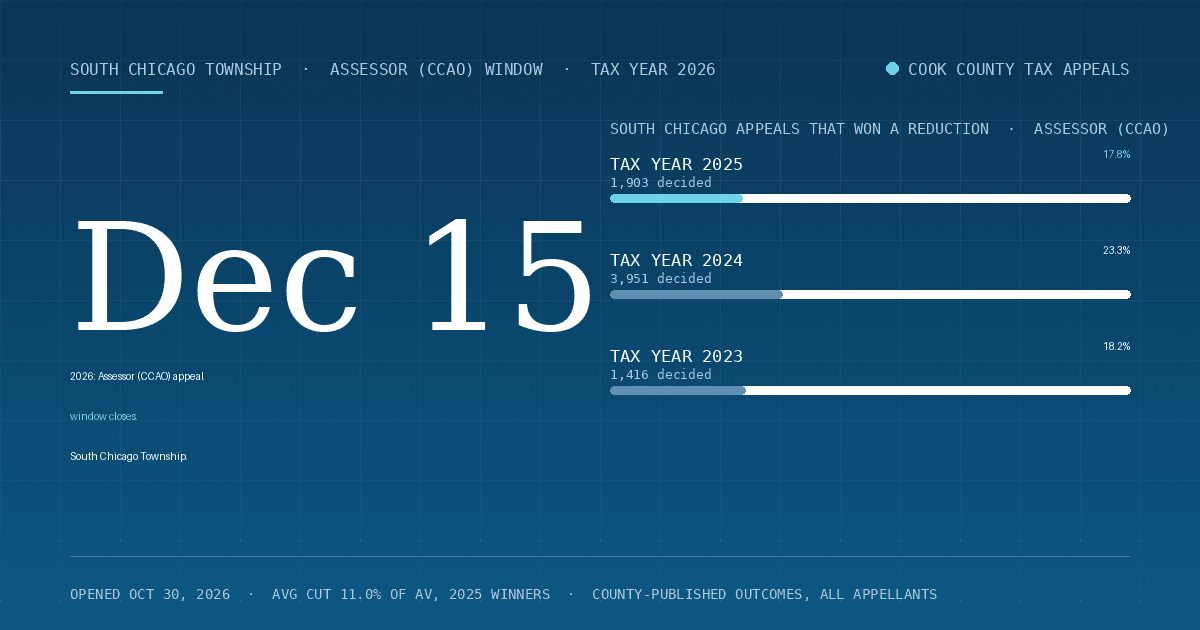
- Reassessment cycle reflects the City of Chicago triad (reassessed 2024, next 2027); South Chicago’s 2025 Assessor appeal window closed November 28, 2025.
- Estimated tax savings use the Illinois state equalization factor (3.0355 for the 2024 tax year) and South Chicago’s modal composite tax rate (6.618606%), before exemptions; they are illustrative, not a guarantee.
- Median is used as the typical reduction because a small number of large industrial and commercial properties skew the average upward.
- This analysis is general information, not legal or tax advice.
Keep Reading
This analysis summarizes Cook County Assessor appeal outcomes for South Chicago Township using public appeal-decision data and is general information, not legal or tax advice. Assessed values, exemptions, and tax rates are set by the Cook County Assessor, Clerk, and Treasurer. Estimated savings use the state equalization factor and the township’s composite rate before exemptions and are illustrative. “No upfront cost. 25% of first-year savings, only if your assessment is reduced.” describes our contingency fee model.