Cook County senior relief, in brief
- Senior Exemption: reduces your EAV by $8,000 if you're 65 or older — no income limit.
- Homeowner Exemption: reduces your EAV by $10,000 on your primary home — and once granted it renews automatically.
- Senior Freeze: for seniors with household income $65,000 or less for the 2025 tax year, rising to $75,000 for 2026, it locks your EAV at a base-year level so rising values don't raise it (it doesn't freeze the tax rate).
- They stack. A senior who holds both the Senior and Homeowner exemptions takes $18,000 off EAV before the Freeze even applies.
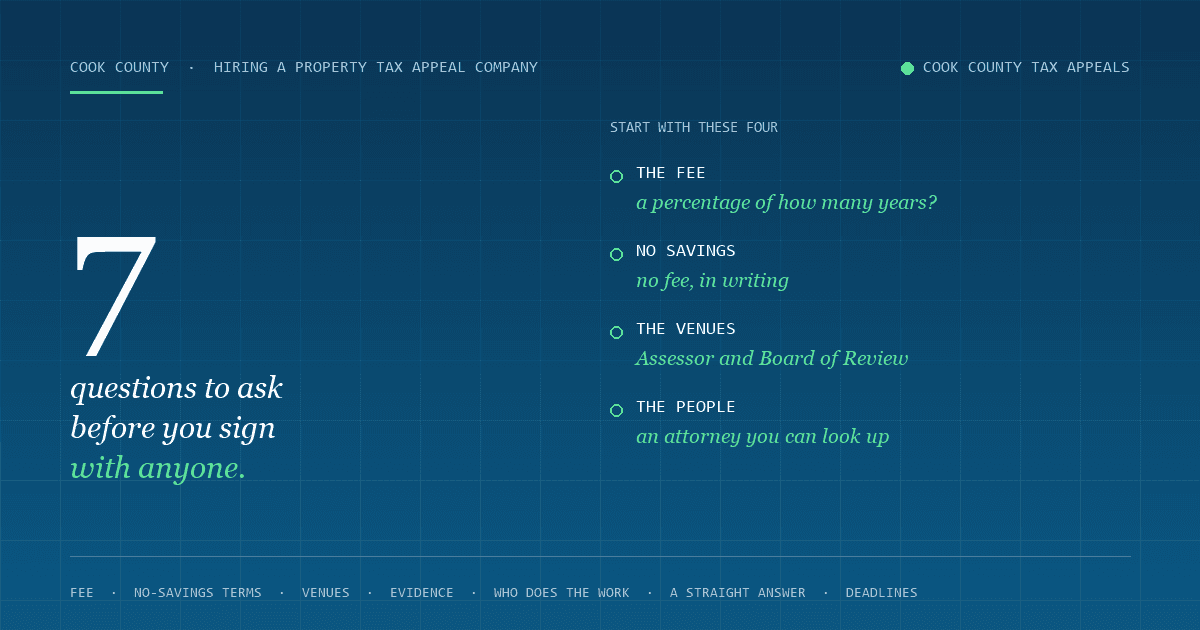
- An appeal goes deeper: exemptions cut the taxable portion, but an appeal lowers the assessed value itself — and the two work together. If you have the Senior Freeze, an appeal may lower your bill by less than it lowers your assessment. We check this before we file, and our fee is 25% of the first-year savings that reach your bill.
There's no age at which Cook County property taxes simply stop. But for senior homeowners, the county offers some of the strongest relief in Illinois — and most of it can be combined. The trick is knowing which programs you qualify for, making sure they're all applied, and checking whether the assessment underneath them is even fair.
01 · The exemptionsThe three exemptions that cut a senior's bill
Each of these works by reducing your Equalized Assessed Value (EAV) — the figure your tax rate is applied to. A larger EAV reduction means a smaller bill. One important caveat the Assessor stresses: the exemption amount is not the dollar amount taken off your bill — it's taken off your EAV, and your local tax rate determines the actual savings.[1]
Senior Exemption (Senior Citizen Homestead Exemption)
Reduces your EAV by $8,000. You qualify if you're 65 or older, own the home, and live in it as your primary residence — there is no income limit. Once granted it renews automatically unless your ownership or occupancy changes.
Homeowner Exemption
Reduces your EAV by $10,000 for any owner-occupant of a primary residence, regardless of age. It is its own application, and once granted it renews automatically each year.
Senior Freeze (Senior Citizens Assessment Freeze)
The full Freeze rules, including the yearly reapplication, are in the Cook County Senior Freeze guide.
For income-qualified seniors, this locks your EAV at the level of your base year, so future reassessments don't push the taxable value up. It does not freeze your tax rate or your bill — only the EAV stays fixed.
Cook County senior exemptions — at a glance
| Exemption | What it does & who qualifies |
|---|---|
| Senior Exemption | $8,000 off EAV · age 65+ · no income limit |
| Homeowner Exemption | $10,000 off EAV · any age · primary residence |
| Senior Freeze | Locks EAV at base year · age 65+ · household income ≤ $65,000 (2025 tax year; $75,000 for 2026) |
| Persons with Disabilities | Additional EAV reduction · qualifying disability |
| Veterans with Disabilities | Additional EAV reduction · service-connected disability |
They stack — and two of them renew on their own
A senior can hold the Senior Freeze together with the Senior and Homeowner exemptions. Combined, the Senior and Homeowner exemptions take $18,000 off your EAV — and the Freeze then protects that value from future increases. You don't have to choose between them.
02 · How to applyHow to apply for senior exemptions
Exemptions are filed with the Cook County Assessor, and many can be completed online. The Senior Exemption renews automatically once granted; the Senior Freeze must be re-filed every year because it's income-based.
Applying step by step
File with the Cook County Assessor
Apply online at the Assessor's site or download the paper form. The Senior, Homeowner, and Senior Freeze exemptions each have their own application.
Submit proof of age and occupancy
A photo ID establishes age and identity; an occupancy affidavit (and a second document if your ID address differs) confirms you lived in the home in the qualifying year.
For the Senior Freeze, document your income
The Freeze requires total household income at or below $65,000 for the 2025 tax year, rising to $75,000 for 2026 — including Social Security, pensions, wages, dividends, and interest. Attach the income proof requested on the form.
Apply before the filing deadline
Exemption filing periods are set each year. Miss it and you can often still recover a missed exemption through the Assessor's Certificate of Error process — sometimes for prior years.
Missed an exemption in a past year?
If you were eligible for an exemption that wasn't applied, the Assessor's Certificate of Error process can often recover it — including for recent prior tax years — and issue an adjusted bill or refund. It's worth checking your past bills.
03 · Where exemptions show upExemptions, the tax bill, and refunds
Exemptions are applied to your second-installment tax bill, not the first (the first installment is a flat 55% of last year's total). So the savings from a newly granted exemption appear later in the year.
- Check your overview. The Treasurer and Assessor both let you see which exemptions are currently applied to your property — a quick way to catch a missing one.
- Search for refunds. If you overpaid, or an exemption posted after you paid, you may be owed a refund — searchable on the Cook County Treasurer's site.
- Ask about deferral and assistance. Separate from exemptions, Illinois offers a senior tax-deferral program (a repayable loan against the home) and payment-plan options for those who need them.
Apply for exemptions and check which are on your property at the Cook County Assessor's site, cookcountyassessoril.gov. Search refunds and pay bills at the Cook County Treasurer's site, cookcountytreasurer.com. Filing periods change year to year — confirm current dates before you file.
04 · Beyond exemptionsHow an appeal saves seniors even more
Exemptions reduce the taxable portion of your value. An appeal does something different and deeper: it lowers the assessed value itself. Because exemptions are subtracted after the assessment is set, a lower assessment means every exemption is applied on top of an already-smaller number — so the two compound.
Exemptions vs. appeals — two different savings
| Exemptions | Appeals |
|---|---|
| Reduce the taxable portion of your value | Reduce the assessed value itself |
| Based on age, occupancy, income, status | Based on comparable properties & market value |
| Applied automatically once granted | Filed each year you want to contest the value |
| Same amount regardless of home value | Bigger when your home is over-assessed |
The Senior Freeze locks your EAV, but it doesn't guarantee that EAV was fair to begin with. If your assessment was too high in your base year, the Freeze just locks in an inflated number. That's why it's worth checking whether your assessment is in line with comparable homes — and appealing if it isn't, ideally before a Freeze locks it.
Make sure you're getting every dollar of relief.
We check that all your exemptions are applied, review your assessment against comparable homes, and file an appeal if your value is too high — so your relief sits on top of a fair number. $0 upfront. 25% of first-year savings, only if your assessment is reduced.
05 · Working with usWorking with us on senior relief
Property tax rules in Illinois are easy to get wrong, and a missed exemption or an unfair assessment can cost a senior homeowner hundreds of dollars a year. We review your assessment, identify exemptions you're missing, prepare and file your exemption applications, track the deadlines, and file an appeal where the value is too high.
We work on contingency for appeals: no upfront cost, and we're paid a share of the savings only if the appeal reduces your bill. If your assessment is already fair and your exemptions are all in place, the honest answer is to tell you so — and we will.
Frequently asked questions
How much is the senior exemption in Cook County?+
Who qualifies for the Senior Freeze in Illinois?+
What does the Senior Freeze actually do?+
Can I get the senior exemption and the homeowner exemption together?+
Do seniors ever stop paying property taxes?+
Where do I apply for a senior property tax exemption?+
How is an appeal different from an exemption?+
Should I appeal before the Senior Freeze locks my value?+
Seniors do pay property taxes — but the relief is real
Between the Senior Exemption, the Homeowner Exemption, the Senior Freeze, and a property tax appeal, a Cook County senior homeowner has several ways to bring the bill down — and most of them combine. Cook County Tax Appeals reviews your assessment, makes sure your exemptions are applied, and files an appeal where the value is too high. Nothing upfront on appeals; our fee is 25% of first-year savings, only if your assessment is reduced.
Sources & verification
Exemption amounts ($8,000 Senior, $10,000 Homeowner), the $65,000 Senior Freeze income limit, EAV mechanics, and the Certificate of Error process are drawn from the Cook County Assessor and Treasurer. Filing deadlines change year to year — confirm current dates before filing.
- Cook County Assessor's Office — Senior Exemption ($8,000 EAV) and Homeowner Exemption ($10,000 EAV). cookcountyassessoril.gov/exemptions
- Cook County Assessor's Office — Low-Income Senior Freeze Exemption, household income limit of $65,000 and annual filing. cookcountyassessoril.gov/senior-freeze-exemption
- Cook County Treasurer's Office — exemptions applied to the second installment, refund search, and senior assistance options. cookcountytreasurer.com
Claim every exemption — and make sure the assessment is fair.
Senior relief only works if your exemptions are applied and the value underneath them is right. We review your assessment, file your exemptions, and handle all three appeal tiers (Assessor, Board of Review, PTAB) under one engagement. $0 upfront. 25% of first-year savings, only if your assessment is reduced.