Schaumburg Township Residential Property Tax Appeal — What Wins for Homes & Condos
Schaumburg Township was reassessed in 2025 as part of Cook County's northwest suburban triad, and isn't due again until 2028 — but the value set in 2025 carries through the cycle, and you can appeal every year. In that reassessment, 15.9% of single-family home appeals and just 7.2% of condo appeals won a reduction. Here's what the data shows, what wins, and how to file.
(2025 reassessment)
(2025 reassessment)
AV reduction
cycle
The 60-Second Version
- Schaumburg was reassessed in 2025 (northwest suburban triad) and isn't due again until 2028 — but the value set in 2025 carries through the whole cycle.
- You can appeal every year, not just in reassessment years. If your 2025 value is too high, you can file in 2026 and 2027 too.
- In the 2025 reassessment, single-family homes won 15.9% and condos just 7.2% — with homes averaging about a $3,037 cut.
- Home type mattered. One-story houses and split-levels won most (18–21%), while condos and townhomes lagged near 7%.
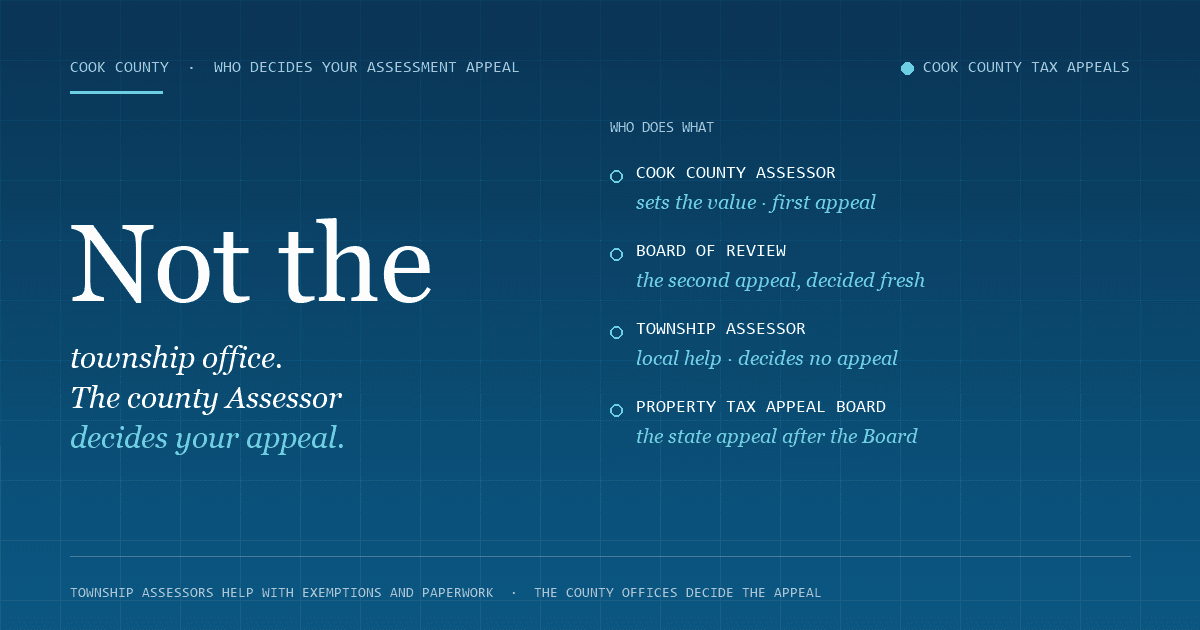
- Two levels of appeal each year: the Cook County Assessor first, then the independent Board of Review.
If you own a home in Schaumburg Township — in Schaumburg, Hoffman Estates, Streamwood, Hanover Park, Roselle, or part of Elk Grove Village — the 2025 reassessment set a value that follows you until 2028. The good news: you don't have to live with it until then. Cook County lets you appeal every year, and the 2025 results show clearly which kinds of homes had the strongest case.
01 · How your bill worksHow your tax bill is calculated
Every Cook County tax bill follows the same formula:
Residential property is assessed at 10% of the Assessor's estimated market value. An appeal targets that assessed value — if it's too high relative to comparable homes, a reduction lowers the taxable base that flows through the rest of the calculation. In a reassessment year like 2025, that value is freshly set and generally carries forward until the next reassessment, so getting it right matters for the whole cycle.
02 · What the data showsWhat the 2025 reassessment showed for homes
Schaumburg homeowners filed in large numbers in 2025. Across all residential filings, single-family homes won 15.9% of appeals and condominiums just 7.2% — and the success rate varied widely by home type:
| Class | What it generally represents | Appeals | Success |
|---|---|---|---|
| 2-99 | Condominium | 11,902 | 7.2% |
| 2-78 | Two-or-more story home (larger) | 2,504 | 15.3% |
| 2-03 | One-story home, 1,000–1,800 sq ft | 2,406 | 21.1% |
| 2-95 | Townhome / row house | 1,846 | 6.6% |
| 2-34 | Split-level home | 1,156 | 18.5% |
| 2-07 | Two-or-more story home, up to 2,000 sq ft | 1,081 | 16.8% |
The pattern: one-story houses (Class 2-03, at 21.1%) and split-levels (2-34, 18.5%) won at the high end, with the two-story classes in the mid-teens — while condominiums (2-99), the township's single largest group at nearly 12,000 appeals, came in at just 7.2%, and townhomes (2-95) lagged at 6.6%.
03 · Condos & townhomesWhy condos and townhomes win less often
Condominiums and townhomes won the least often — 7.2% and 6.6% — yet condos filed the most appeals of any type. Their values are typically set consistently building-by-building or development-by-development, which leaves less room to argue a single unit is mispriced relative to its neighbors. The appeals that succeed almost always lean on sales within the same association or development, plus documented unit-specific differences (floor, view, condition), rather than broad neighborhood comparisons. A generic condo or townhome filing rarely moved the number here.
04 · What winsWhat actually wins a Schaumburg home appeal
Homes are valued mostly on comparable sales, so residential appeals are won on comparison — not on frustration with the bill. Three grounds carry the most weight:
- Lack of uniformity (the strongest residential argument). If comparable homes near you — similar size, age, style, and lot — are assessed for less per square foot than yours, your assessment is "non-uniform" and should be brought in line.
- Overvaluation. If recent sales of similar nearby homes — or a recent purchase or appraisal of your own home — come in below the Assessor's implied market value, you can argue the assessment overstates what your property is worth.
- Factual error in your record. Too much square footage, a finished basement that isn't finished, an incorrect bathroom count — correcting the record can lower the assessment on its own.
05 · What it's worthWhat a reduction is worth
Schaumburg's composite tax rate runs around 10%. A reduction in assessed value translates into annual savings that repeat for as long as the lower value holds:
Illustrative estimate using Schaumburg's state equalization factor and composite rate; excludes exemptions and varies by tax code. Our fee: 25% of first-year savings, only if your assessment is reduced.
06 · How to fileHow to file your Schaumburg appeal
- Find your PIN and pull your assessment. Confirm the current value and the characteristics the Assessor has on record for your home, using your 14-digit Property Index Number.
- Check the calendar for Schaumburg's window. Confirm the current-year "open" and "last file" dates on the Assessment & Appeal Calendar. Don't file before the township opens — early filings can be deleted.
- Assemble your evidence. Comparable homes assessed for less, any recent sale or appraisal of your home, and photos or records correcting anything wrong in your property description.
- File online with the Assessor during Schaumburg's open window, then again with the Board of Review — an independent body that opens after the Assessor's window, even if the Assessor reduced you only partially or not at all.
Confirm Schaumburg's current-year dates on our deadlines page before you file.
07 · Where Schaumburg standsYou can appeal every year — the 2026 window is open
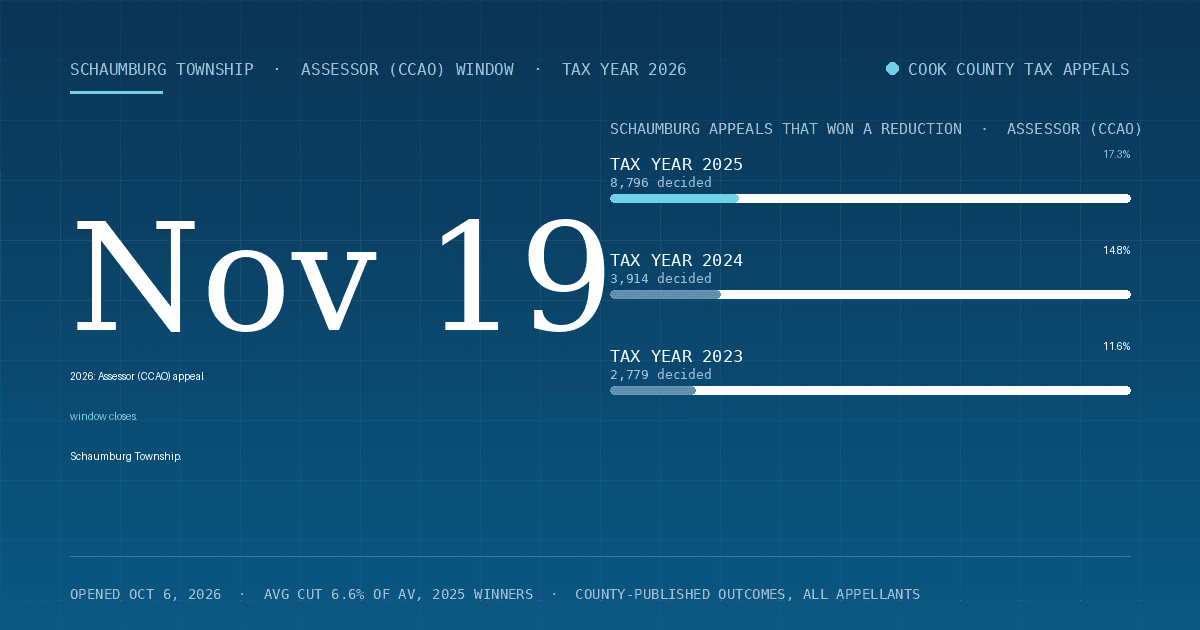
Schaumburg was reassessed in 2025, so its values are generally set until the next reassessment in 2028. But the right to appeal isn't limited to reassessment years — Cook County lets you challenge your assessed value every year. Schaumburg's 2026 Assessor window is open October 6 to November 19, 2026, and filing again is especially worth doing if you didn't appeal in 2025 or your result didn't go far enough. For the full township picture including commercial, see our Schaumburg 2025 appeal results.
See What Your Schaumburg Home Could Save
Enter your address or PIN to compare your assessment against similar Schaumburg homes and check your current appeal window — no upfront cost. 25% of first-year savings, only if your assessment is reduced.
Check My AssessmentSchaumburg Residential Appeal FAQ
Can I appeal in Schaumburg if it isn't a reassessment year?
Yes. Schaumburg was last reassessed in 2025 and is next due in 2028, but Cook County allows an appeal every year. If your 2025 value is too high, you can file in the off-years — 2026 and 2027 — to correct the bills you haven't paid yet. Confirm Schaumburg's current-year window before filing.
How did homes do in Schaumburg's 2025 reassessment?
Single-family homes won 15.9% of appeals and condos just 7.2%. By type, one-story houses did best (21.1%) and split-levels 18.5%, while townhomes won only 6.6%. Homes averaged about a $3,037 reduction in assessed value among winners.
Why do condos and townhomes win less often?
Their values are typically set consistently building-by-building or development-by-development, leaving less room to argue a single unit is mispriced. The strongest appeals use sales within the same association or development and documented unit-specific differences.
How much could a reduction save me?
Schaumburg's composite tax rate runs around 10%. As a rough guide, a $5,000 cut in assessed value translates to roughly $1,515 a year, and it repeats for as long as the lower value holds. Estimates exclude exemptions and vary by tax code.
Does filing an appeal risk raising my taxes?
An appeal is a request to review your assessed value. If it isn't reduced, your assessment stays as it was. You can also pursue a separate, second-level appeal at the Board of Review after the Assessor.
Data & Sources
- Reassessment cycle: Schaumburg Township (code 35) is in the northwest suburban triad, reassessed in 2025 (next 2028). Its 2026 Assessor window runs October 6 to November 19, 2026; annual appeals are available every year.
- 2025 residential results: Cook County Assessor Appeals dataset (Cook County Data Catalog), Schaumburg Township, tax year 2025 — single-family (Class 2) 9,821 appeals, 15.9%, avg winning cut ~$3,037; condominium (2-99) 11,902 appeals, 7.2%, ~$1,646.
- Residential class detail (2025): condominium (2-99) 7.2% on 11,902; larger two-story (2-78) 15.3% on 2,504; one-story 1,000–1,800 (2-03) 21.1% on 2,406; townhome/row house (2-95) 6.6% on 1,846; split-level (2-34) 18.5% on 1,156; two-story up to 2,000 sq ft (2-07) 16.8% on 1,081.
- Assessment level and formula: Illinois Property Tax Code — residential property assessed at 10% of market value; bill = assessed value × state equalization factor × local tax rate − exemptions.
- Tax-saving estimates use Schaumburg's state equalization factor (3.0300 for the 2025 tax year) and a representative composite rate (~10%); estimates exclude exemptions and vary by tax code. Filing windows are set by the Cook County Assessor and Board of Review. All data is public and county-wide; no firm-specific results are stated.
Keep Reading
This article covers residential property tax appeals in Schaumburg Township, Cook County, and is general information, not legal or tax advice. Results figures are drawn from public Cook County Assessor appeal data for tax year 2025; individual results depend on the property and the evidence presented. Tax-saving figures are estimates that exclude exemptions and vary by tax code. Filing windows are set by the Cook County Assessor and Board of Review and change through the year — always confirm your current deadline before filing. Representation is subject to a written engagement agreement.