Riverside property tax appeal data — what the numbers say
- The 2026 deadline has passed. The Cook County Assessor's office stopped accepting 2026 Riverside appeals at 11:59 PM on June 8, 2026. There are no extensions[4]
- 2023 (the last Riverside reassessment year) was a strong year for appellants. 56% of homes that filed any appeal that year won at least one reduction — at the Assessor, the Board of Review, or both[3]
- The Board of Review is where most reductions came from. 855 Riverside homes in 2023 won only at BOR after losing or not filing at CCAO. Filing at both tiers is the strategic move[3]
- 2026 should look like 2023, not 2025. Reassessment years consistently produce higher rates than non-reassessment years: 56.2% of homes that appealed won somewhere in 2023, vs. 48.0% in 2024 and 40.6% in 2025[3]
If you live in Riverside Township and you're holding a 2026 reassessment notice — or wondering whether the appeal that landed in your mailbox in late April is worth filing in the next window — this is the data analysis you need. We pulled every Riverside appeal record from 2023 through 2025 using verified Cook County public records and ran the math. The short version: filing works more often than most homeowners assume, particularly in reassessment years like 2026, and particularly when you file at both the Cook County Assessor and the Board of Review. The longer version, with breakdowns by year, tier, and property class, follows.
Should you file next time? Three questions.
- What did the Assessor estimate your home is worth? The number is on the 2026 reassessment notice mailed April 24, or you can look it up by address at cookcountyassessoril.gov.
- What could you sell it for today? Check Zillow, Redfin, and recent sales of similar homes within 0.5 miles.
- Is the Assessor's number at least 10% above your honest estimate? If yes, you have a credible appeal — and the data above says you have a meaningful chance of winning if you file at both CCAO and the Board of Review. If no, the work may not justify the upside.
01 · The headline dataHow often do Riverside property tax appeals actually win?
Cook County's property tax appeal system has three tiers — the Cook County Assessor (CCAO), the Cook County Board of Review (BOR), and the Illinois Property Tax Appeal Board (PTAB). Each is an independent review with its own standards and its own success rate. The data shows substantial variation across all three.
The 2023 Riverside numbers (the most recent reassessment year)
The 2023 reassessment is the most relevant year for the 2026 cycle, because reassessments follow the same three-year rotation. Here's how Riverside performed that year:[1][2]
2023 Riverside homeowner appeals, counted by appeal · by tier
Two things stand out immediately. First, the Board of Review approves a substantially higher share of appeals than the Assessor — 54.9% vs. 34.1% of homeowner appeals in 2023. That gap is consistent across years and across townships, and it reflects how the two agencies are structured: the Assessor reviews valuations its own office set, while the Board of Review is a separate three-member elected body that reviews evidence from scratch. Second, counting each appeal once (a condo building's units, decided together, are one appeal), the rate at either tier alone tells only part of the story — the share of homes that won somewhere is the more interesting statistic.
Homes that won anywhere — by year
The per-tier rates above (34.1% at the Assessor, 54.9% at the Board) measure outcomes for individual appeals. But most Cook County property owners care about a different question: "If I appeal, what's the probability I'll get a reduction somewhere?" For that question, the right measurement is what we call the won-anywhere rate — the share of Riverside homes that filed any appeal in a given tax year and received at least one reduction at any tier that year. It counts homes, not appeals: each home once, whether it appealed at one tier or both.
Riverside homes that won anywhere · by year
The pattern is the most important takeaway from this analysis. Reassessment years produce materially higher success rates than non-reassessment years — 56.2% in 2023 versus 48.0% in 2024 and 40.6% in 2025. Two factors drive the gap. First, reassessment years bring in higher appeal volume from owners reacting to new valuation notices, which includes more strong cases. Second, the Cook County Assessor has more discretion to correct values in the year they're being set; in later years, the Assessor's office is more constrained by precedent.[3]
The implication for 2026: the next Riverside reassessment year is the strategic year to file. Properties planning to appeal should anchor their expectations on the 2023 number (56.2%), not the non-reassessment-year rates that follow it.
About the methodology
All three won-anywhere rates are calculated identically, for homes (Class 2) only — every Riverside home that appealed at the Assessor and/or the Board that year, each counted once. A home that won at both in the same year counts once in its year's rate. The numbers are not comparable to "per-appeal" success rates (which count each filing separately); they measure the share of homes that ended each year with at least one reduction.
02 · The three-tier strategyWhy filing at both CCAO and BOR is the winning move
Most homeowners file a Cook County property tax appeal once, at the Cook County Assessor, and stop if they get a "no change" decision. The data shows that's the wrong move. The Board of Review is an entirely separate appeal with its own filing window — and the data shows it approves substantially more reductions than the Assessor.
How the three tiers differ
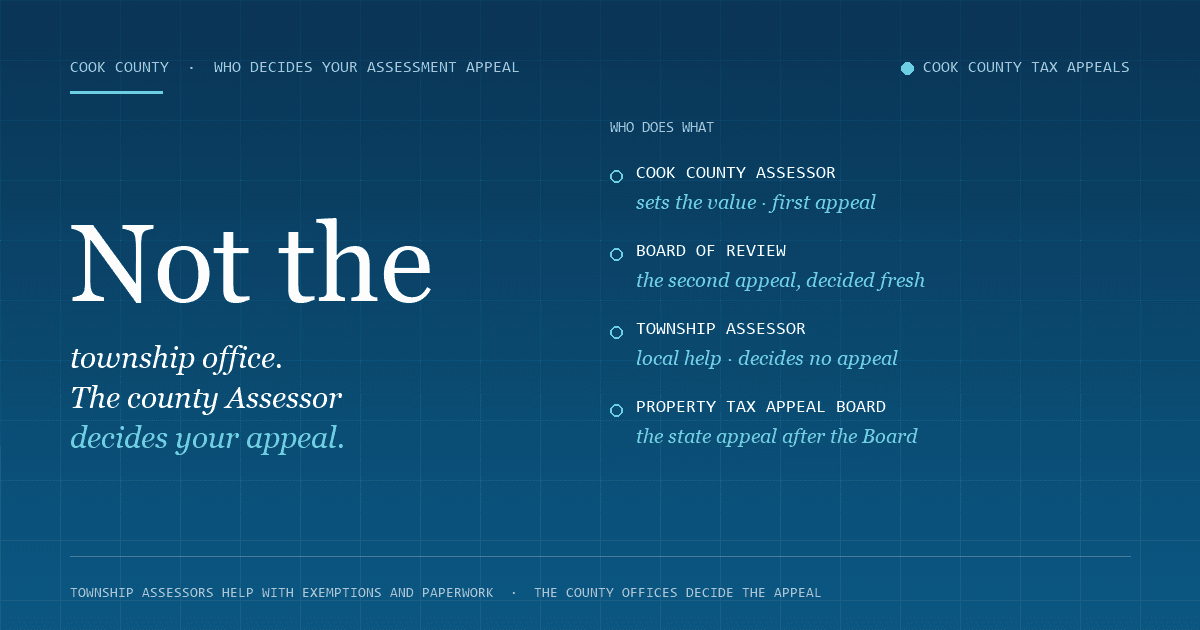
- Cook County Assessor (CCAO). Reviewed by the office that set your value. In Riverside Township, the 2026 appeal window opened April 24 (when reassessment notices mailed) and closed June 8, 2026. Approves about a third of residential appeals during reassessment years.
- Cook County Board of Review (BOR). An independent three-member elected body. The BOR window for Riverside opens after the Assessor certifies its results — typically late summer or fall. Approved more than half of Riverside homeowner appeals in the 2023 reassessment year (54.9%).[2]
- Illinois Property Tax Appeal Board (PTAB). A state-level review of last resort. Decisions take 12–30 months; mostly used for high-stakes commercial cases or properties where CCAO and BOR both declined despite strong evidence.
The decomposition by year shows exactly how the two-tier strategy pays off — and it shows the pattern is consistent every year, not just in reassessment years. For each Riverside tax year, here is how the appellant pool divides:
Where the wins came from · by year
The full year-by-year decomposition:
- 2023 (reassessment year): 460 won only at CCAO · 855 won only at BOR · 197 won at both · 1,179 lost at every tier. 1,512 homes (56.2%) ended with at least one reduction.
- 2024: 116 won only at CCAO · 665 won only at BOR · 28 won at both · 877 lost at every tier. 809 homes (48.0%) ended with at least one reduction.
- 2025: 156 won only at CCAO · 392 won only at BOR · 20 won at both · 830 lost at every tier. 568 homes (40.6%) ended with at least one reduction.
The headline finding is consistent across all three years: "won only at BOR" is the largest winning segment, every year. In 2023, the only-BOR group was nearly 2x larger than the only-CCAO group. In 2024, it was nearly 6x larger. In 2025, it was 2.5x larger. Across the three years combined, 1,912 Riverside homes won reductions only at the Board of Review — they would have ended with no reduction if they'd stopped at CCAO. That is the single most important data point for any property owner deciding whether to file at one tier or both.
Why so many properties never benefit from these rates
The won-anywhere rates apply only to homes that appeal. Riverside has 6,466 parcels in total, 5,902 of them homes. In each of the three years analyzed, only a fraction filed at any tier — 2,691 homes in 2023, 1,686 in 2024, 1,398 in 2025. The majority of the township's homes pay tax based on the Assessor's initial value with no challenge. The strategic question every year is whether to be in the appellant pool or outside it.
All appeal counts and outcomes are pulled from two public Cook County government datasets: the Cook County Assessor Appeals records and the Cook County Board of Review Appeals records, both published at datacatalog.cookcountyil.gov. The data was filtered to Riverside Township (township code 34) for tax years 2023 through 2025. Full dataset identifiers are included in the Sources section at the bottom of this page for anyone who wants to verify the numbers independently.
03 · By property classWho wins more often: residential, commercial, or condo?
The 34.1% Assessor figure for 2023 Riverside is the homeowner number. Commercial and condo appeals had materially different outcomes that same year:
Single-family — 34.3%
1,873 appeals · 643 won. The largest category by far. Average assessed-value reduction on winning appeals: $4,961. For a typical Riverside single-family home (Class 2-03), that translates to roughly $1,300–$1,500 a year in tax savings at the township's current effective rate. Residential is also the easiest filer profile because comparable-sales evidence is widely available and pro se filings are routine.
Commercial — 46.2%
52 appeals · 24 won. Materially higher rate than residential, and dramatically higher dollar savings: the average reduction on winning commercial appeals was $107,237 in assessed value. Commercial appeals typically rely on income-approach valuations and require professional representation; the higher win rate reflects more rigorous evidence.
Condo / Co-op — 11.8%
17 appeals · 2 won. The lowest rate among the three classes — but with a sample this small, the percentage is noisy. Counted by appeal, a condo appeal can cover a whole building's units, decided together. Condos are harder to appeal because comparable-sales evidence within a building is limited, and condo declarations often constrain the per-unit valuation methodology.
Why commercial wins more often
Two reasons. First, commercial valuations rely on income-approach methodology (capitalization rate, net operating income), which produces clearer "wrong value" arguments than the sales-comparison approach used for residential properties. Second, commercial appeals are almost always filed by attorneys or licensed agents with deep property-tax experience, who self-select into the cases most likely to win. Residential appeals include far more pro se filings with marginal evidence, which pulls the average rate down.
04 · Dollar valueWhat a typical Riverside reduction actually saves
A reduction in assessed value is not the same as a reduction in your tax bill — the bill depends on the equalization factor and local tax rate. Here's how the math actually translates:
From assessed-value reduction to tax savings
The full conversion: $4,961 in AV reduction × the 2023 Illinois equalization factor of 3.0163 = $14,964 in equalized assessed value, multiplied by Riverside's effective tax rate of approximately 9.3% = $1,392 per year in real tax savings. Across the three-year reassessment cycle (2026, 2027, 2028 bills), that adds up to roughly $4,175 in total tax savings on the average case, at today's tax rate.
For commercial properties the dollar figures are larger by an order of magnitude. The average winning commercial appeal in 2023 Riverside reduced assessed value by $107,237 — translating to roughly $30,100 a year in tax savings, or $90,200 over the reassessment cycle. The higher the underlying property value, the larger the absolute dollar reduction tends to be.
Why average AV reductions look small compared to home prices
Cook County residential properties are assessed at 10% of estimated fair market value, then multiplied by the state equalizer (about 3x). So a Riverside home with a market value of $592,000 carries an assessed value of roughly $59,200. A $4,961 AV reduction is about 8.4% off that AV — meaningful but not radical. The dollar savings is what matters at the end: $1,392 a year over three years.
05 · Using this dataWhat the success rates mean for 2026
Three concrete actions, ranked by impact, if you're a Riverside property owner planning the next appeal:
- File at both the Cook County Assessor AND the Board of Review. The Riverside data is unambiguous on this. In 2023, 855 homes — the largest single winning segment — won reductions only at the Board of Review after losing or not filing at CCAO. Stopping at the Assessor's stage is the single most common preventable mistake. The 2026 CCAO window closed June 8 and the BOR window ran August 3 to September 1. File at both next time.
- If your 2023 appeal didn't win, refile in 2026. The 2026 reassessment establishes a fresh estimated market value with fresh evidence and fresh comparable sales. A prior "no change" decision has zero binding effect. Reassessment years also produce materially higher success rates than non-reassessment years — 56.2% of homes that appealed won somewhere in 2023, versus 48.0% in 2024 and 40.6% in 2025. 2026 is the strategic year to refile.
- Build evidence-quality before you file. For residential properties, the strongest single piece of evidence is 3 to 5 comparable sales of similar homes within 0.5 miles, sold 2023 to 2025, where the per-square-foot price is materially below your assessment implies. Documented factual errors (wrong square footage, wrong bath count) come second — and they're the easiest appeals to win.
The 2026 Riverside windows
The Cook County Assessor mailed 2026 reassessment notices to Riverside Township homeowners on April 24, 2026. The appeal deadline at the Assessor's Office was 11:59 PM on June 8, 2026, and the Board of Review's Riverside window ran August 3 to September 1, 2026. For a detailed walkthrough of the 2026 Riverside reassessment process, see our companion guide: Riverside Property Tax Appeal 2026: Deadline June 8.
See your property's expected reduction range based on the verified Riverside data above.
Enter your Riverside address. We'll pull your 2026 reassessment notice, identify comparable sales within 0.5 miles, model the appeal outcome against the verified Riverside Township success-rate data — and show you the projected tax savings and odds. 60 seconds. No signup to see the estimate. $0 upfront. 25% of first-year savings, only if your assessment is reduced.
Frequently asked questions about Riverside appeal success rates
What percentage of Riverside property tax appeals win a reduction?+
At the Cook County Assessor (CCAO): 34.1% of homeowner appeals won (645 of 1,890), counting each appeal once.
At the Board of Review (BOR): 54.9% of homeowner appeals won (996 of 1,813).
Homes that won anywhere (Assessor and Board together): 56.2% — of the 2,691 Riverside homes that appealed at any tier in 2023, 1,512 received at least one reduction (each home counted once).
For comparison, in non-reassessment years the won-anywhere rate declines: 48.0% in 2024 and 40.6% in 2025. Reassessment years like 2026 should be expected to perform closer to 2023.
Are Cook County Board of Review appeals more likely to succeed than CCAO appeals?+
How much does a typical winning Riverside appeal save in property taxes?+
What's the difference between the 34.1% and 56% success rates?+
34.1% is the rate at one tier (Cook County Assessor) in one year (2023) for homeowner appeals, counting each appeal once. It tells you the odds for a single filing.
56% is the won-anywhere rate: of all Riverside homes that filed at any tier — the Assessor and/or the Board — in 2023, more than half received at least one reduction. It tells you the odds for a home that pursues both tiers in the same year.
The difference is what they count: 34.1% counts appeals at one tier, 56% counts homes across both.
Which property class has the highest appeal success rate in Riverside?+
If my Riverside appeal lost in 2023, should I appeal again in 2026?+
Does filing pro se hurt my chances vs. hiring an attorney?+
What evidence is most likely to win a Riverside appeal?+
1. Documented factual errors in the property characteristics (wrong square footage, wrong year built, wrong bath count). These are the easiest appeals to win — well over 50% success rate when the error is documented with closing papers or blueprints.
2. Comparable sales — 3 to 5 sales of similar homes within 0.5 miles of yours, sold between 2023 and 2025, at per-square-foot prices materially below your assessment.
3. Recent purchase price — if you bought the home within the past 18 months at arm's length and the price was materially below the Assessor's estimate, the HUD-1 settlement statement is strong evidence.
How long after filing will I know whether my Riverside appeal won?+
What does it cost to appeal in Riverside if I hire Cook County Tax Appeals?+
The Riverside data is clear: appeals work — especially when you file strategically.
The single most important takeaway from this analysis: filing once at the Cook County Assessor and stopping at "no change" leaves substantial probability on the table. In every year analyzed (2023, 2024, 2025), the largest winning segment was homes that won only at the Board of Review — 855 in 2023, 665 in 2024, 392 in 2025. They would have walked away with nothing if they'd stopped at CCAO. For the next Riverside window, the strategic move is to file at the Assessor and to plan for a Board of Review filing in the late-summer window that follows.
Cook County Tax Appeals handles every stage of the process. Our licensed Illinois tax attorneys and CPAs build the evidence, file the petitions, and escalate strategically across tiers wherever it produces the largest reduction. We charge 25% of first-year savings, only if your assessment is reduced. There is no upfront cost.
Sources & methodology
All appeal counts and success rates in this analysis are pulled from Cook County government sources and verified against multiple independent records.
- Cook County Open Data Portal. "Assessor — Appeals" dataset (y282-6ig3). Filtered to township_code = 34 (Riverside), year = 2023. datacatalog.cookcountyil.gov
- Cook County Open Data Portal. "Board of Review — Appeals" dataset (7pny-nedm). Filtered to Riverside Township records, 2023. datacatalog.cookcountyil.gov
- Cook County Tax Appeals internal database. Won-anywhere outcomes for Riverside Township homes (Class 2; town code 34) for tax years 2023, 2024, and 2025: every home that appealed at the Assessor and/or the Board within each year, each home counted once, no cross-year aggregation. A home counts as "reduced" if any decided appeal at any tier in the year won a reduction. Results: 2023 (reassessment year): 1,512 of 2,691 homes (56.2%). 2024: 809 of 1,686 (48.0%). 2025: 568 of 1,398 (40.6%). Per-tier rates count each appeal once (a condo building's units, decided together, are one appeal).
- Cook County Assessor's Office. "Property Values for Riverside Township Released." Press release, 2026. cookcountyassessoril.gov
- Cook County Assessor's Office. "2023 Reassessments in Riverside Township." Published May 2023.
- Riverside Township Assessor's Office. Assessor Services. riversidetownship.org
- Illinois Department of Revenue. "2023 Equalization Factor for Cook County: 3.0163." tax.illinois.gov
- Cook County Board of Review. "Filing an Appeal." cookcountyboardofreview.com
56% of Riverside homes that appealed won in 2023. The next window opens in 2027.
The Cook County Assessor's 2026 Riverside appeal window closed at 11:59 PM on June 8, 2026, and the Board of Review's ran August 3 to September 1. The verified data above shows that 56% of Riverside homes that appealed in 2023 received at least one reduction. The pattern repeats every year: filing at both tiers is the strategic move. Cook County Tax Appeals handles every tier and escalates strategically wherever the evidence supports it. Our fee is 25% of first-year savings, only if your assessment is reduced. $0 upfront.