Chicago & Cook County Property Tax Rates by Township
Property tax is one of the biggest costs of owning real estate in Cook County — and you can estimate yours from four numbers: your assessed value, the state equalizer, your local tax rate, and your exemptions. This guide walks through the math, gives you a verified composite-rate reference by township, and shows how the same home can carry a very different bill depending on where you own it.
10% of market
25% of market
(3.0300 in 2025)
by township
The 60-Second Version
- Estimate your bill from four numbers: assessed value × state equalizer, minus exemptions, times your local tax rate.
- Homes are assessed at 10% of market value (commercial at 25%); the 2025 state equalizer was 3.0300.
- Your local composite rate is the biggest variable — for 2025 it runs from about 6.9% across the City of Chicago to about 21.9% for the median home in Thornton, and 1,432 homes in Bloom and Thornton sit in tax codes above 30%.
- That spread is huge: the same $300,000 home can owe roughly $5,600 in the city or $17,700 in Thornton.
- Exemptions lower the taxable value, and if your estimate looks too high, an appeal can lower it further.
Want the fast version? Use our Cook County property tax calculator to get an instant estimate from your property's details. Want to understand what's driving the number — and whether it's too high? Keep reading.
01 · The formulaHow the calculation works
Every Cook County estimate comes from the same formula:
- Assessed value — set by the Cook County Assessor. Homes are assessed at 10% of market value, commercial and industrial property at 25%. A $300,000 home has an assessed value of about $30,000.
- State equalizer — a countywide multiplier from the Illinois Department of Revenue that keeps assessment levels uniform statewide. It's run around 3.0 (3.0300 in 2025). Assessed value × equalizer = your equalized assessed value (EAV).
- Local tax rate — the combined "composite" rate of your schools, municipality, and other taxing bodies. This varies the most by location (see the table below).
- Exemptions — reductions in EAV, applied before the rate. The Homeowner Exemption alone removes $10,000 of EAV.
02 · Rates by townshipComposite tax rates vary widely
Your local rate is the single biggest reason two similar homes can have very different tax bills. Across Cook County's townships, the composite rate ranges from about 6.9% in the City of Chicago to about 21.9% for the median home in Thornton on the 2025 rates, and a few south-suburban tax codes run above 30%. Here is the median 2025 composite rate for homes in every township:
| Township / area | Region | Approx. composite rate |
|---|---|---|
| City of Chicago (all 8 townships) | City | ~6.9% |
| New Trier | North suburb | ~6.4% |
| Northfield | North suburb | ~6.8% |
| Barrington | NW suburb | ~6.8% |
| Evanston | North suburb | ~7.3% |
| Norwood Park | NW suburb | ~7.4% |
| Lemont | SW suburb | ~7.5% |
| Elk Grove | NW suburb | ~7.8% |
| Maine | NW suburb | ~8.0% |
| Niles | North suburb | ~8.3% |
| Schaumburg | NW suburb | ~8.6% |
| Wheeling | NW suburb | ~8.7% |
| Hanover | NW suburb | ~8.7% |
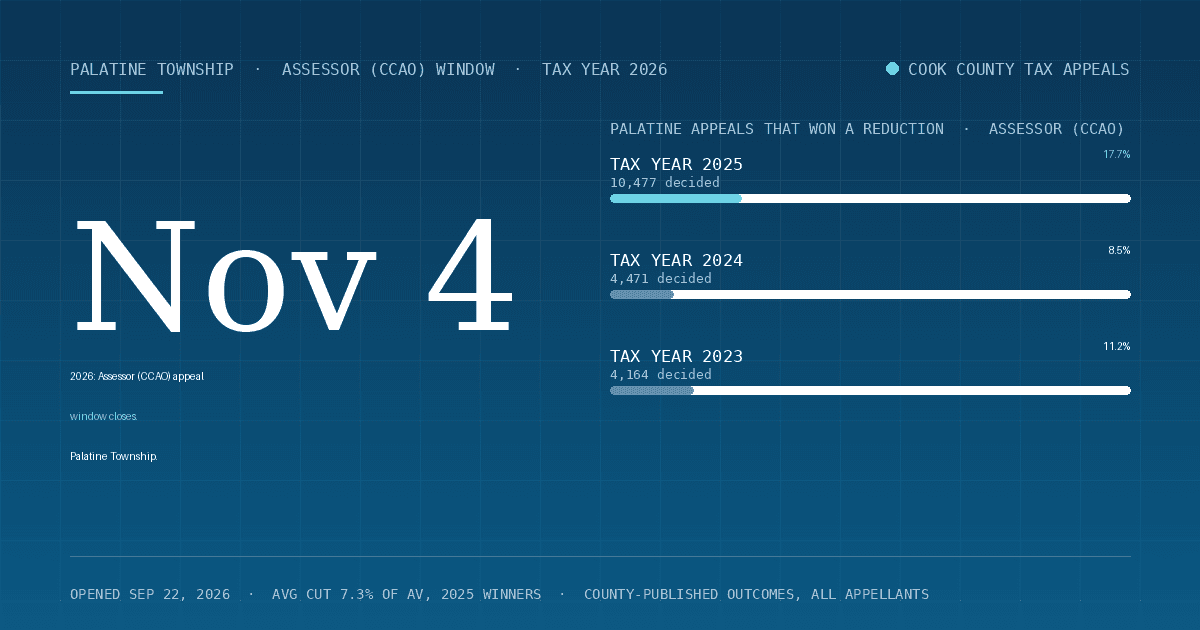
| Palatine | NW suburb | ~8.7% |
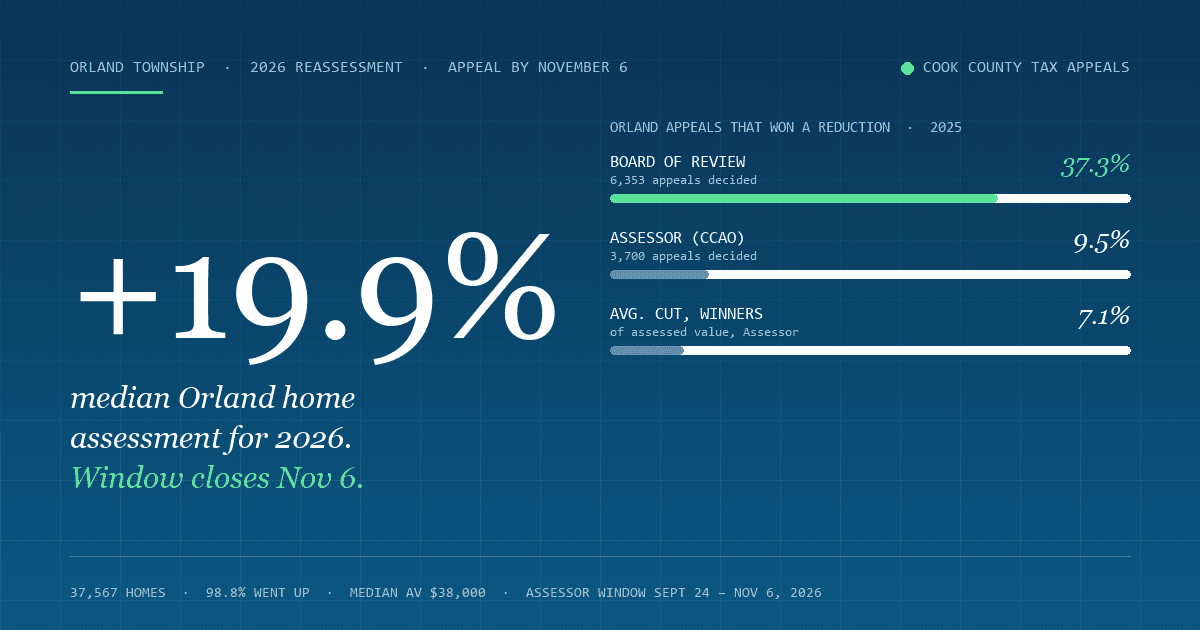
| Orland | SW suburb | ~8.7% |
| Lyons | West suburb | ~9.1% |
| Leyden | West suburb | ~9.6% |
| River Forest | West suburb | ~9.8% |
| Palos | SW suburb | ~9.9% |
| Stickney | West suburb | ~11.2% |
| Worth | SW suburb | ~11.2% |
| Riverside | West suburb | ~11.4% |
| Cicero | West suburb | ~11.5% |
| Oak Park | West suburb | ~11.7% |
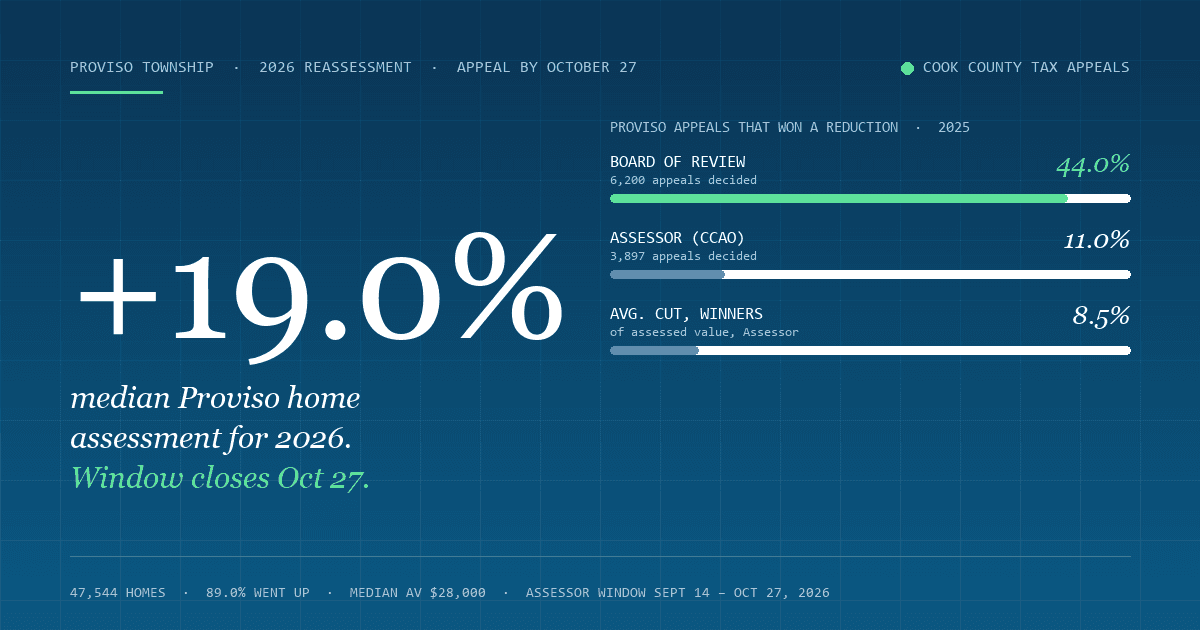
| Proviso | West suburb | ~11.7% |
| Berwyn | West suburb | ~12.4% |
| Bremen | South suburb | ~13.6% |
| Bloom | South suburb | ~15.5% |
| Rich | South suburb | ~16.1% |
| Calumet | South suburb | ~18.4% |
| Thornton | South suburb | ~21.9% |
Median 2025 composite rate for homes (Class 2) in each township, from the Cook County Clerk's 2025 tax-rate file joined to the county's parcel records. Your exact rate depends on your tax code, and within a township it can sit well above or below the median: in Thornton the 2025 rates run from about 12.9% to 35.8%.
03 · Worked exampleSame home, different township
Take a $300,000 owner-occupied home with the Homeowner Exemption. The first steps are identical everywhere — only the local rate changes:
Now apply three different local rates to that same taxable EAV:
| Location (example rate) | Estimated annual tax |
|---|---|
| City of Chicago (~6.9%) | ~$5,580 |
| NW suburb, e.g. Schaumburg (~8.6%) | ~$6,960 |
| South suburb, e.g. Thornton (~21.9%) | ~$17,720 |
Same house, the same assessment, the same exemption — but roughly 2.5 times the tax depending on the township. That's why location matters so much, and why your local rate is worth understanding.
04 · CommercialEstimating commercial property
Commercial and industrial property is assessed at 25% of market value rather than 10%, so the assessed base is much larger. A $1,000,000 commercial building has an assessed value of $250,000 and an EAV around $757,500 (× 3.0300). At a city rate of ~6.9%, that's roughly $52,000 a year; at a ~10% suburban rate, closer to $76,000. Commercial owners generally don't get homestead exemptions, which makes an accurate assessment — and an appeal when it's too high — especially valuable.
05 · ExemptionsExemptions that lower the estimate
Exemptions reduce your taxable EAV before the rate is applied. The most common:
- Homeowner Exemption — $10,000 off EAV for an owner-occupied primary residence.
- Senior Citizen Exemption — an additional $8,000 off for owners 65+.
- Senior Freeze — for income-qualified seniors, freezes the EAV at a base-year level.
- Persons with Disabilities ($2,000) and veterans' exemptions — additional relief, with disabled-veteran exemptions ranging up to a full exemption.
For the full list, amounts, and how to apply, see our Cook County homestead exemption guide.
06 · Too high?What if your estimate looks too high?
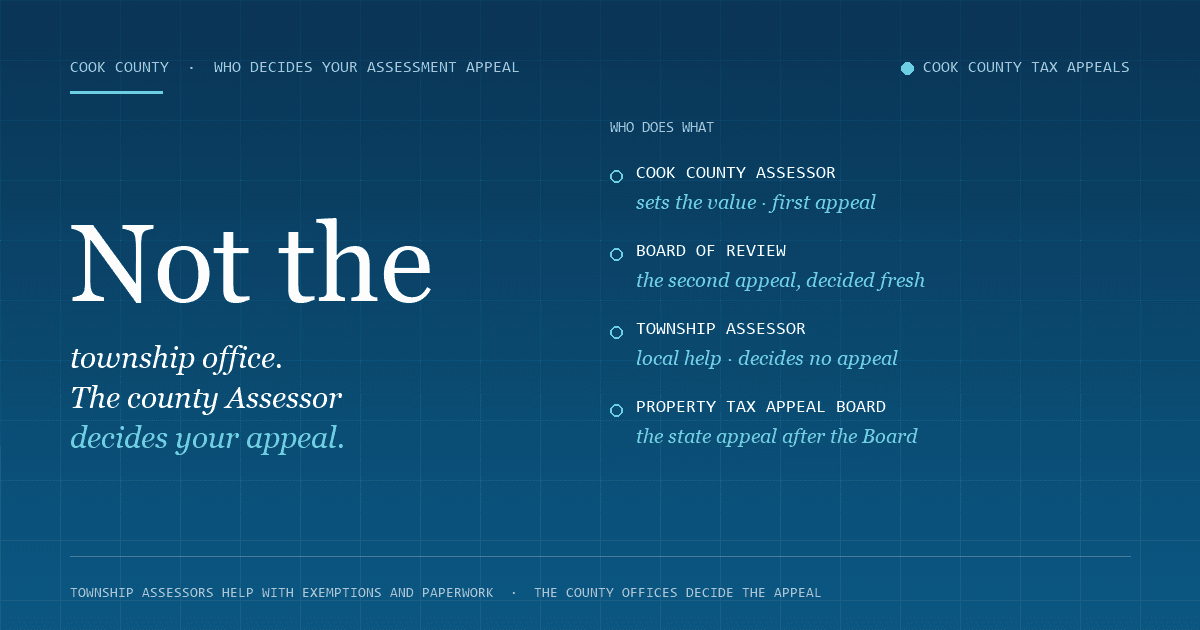
A calculator tells you what you'd owe at your current assessed value — but it can't tell you whether that assessment is fair. If your estimate looks higher than expected, the assessed value is usually the lever: if it's too high relative to comparable properties, you can appeal to bring it down, which lowers every part of the calculation that follows. You can appeal every year, first with the Cook County Assessor and then the Board of Review, each on a township schedule.
Estimate, Then See If You Can Lower It
Run your numbers in our property tax calculator, then check whether your assessment is too high. Enter your address or PIN — no upfront cost. 25% of first-year savings, only if your assessment is reduced.
Check My AssessmentCook County Property Tax Calculator FAQ
How do I estimate my Cook County property tax?
Multiply your assessed value (10% of market value for homes) by the state equalizer (about 3.0) to get your EAV, subtract your exemptions, and multiply by your local composite tax rate. In short: (assessed value × equalizer − exemptions) × local rate.
Why are two similar homes taxed so differently?
Usually the local composite tax rate. On the 2025 rates it runs from about 6.9% across the City of Chicago to about 21.9% for the median home in Thornton, so the same home can owe roughly 3.2 times as much depending on the township.
What tax rate should I use for my area?
Use the approximate composite rate for your township as a starting point (see the table above), but your exact rate depends on your specific tax code within the township. Your actual bill from the Treasurer shows your precise rate.
Does the calculator include exemptions?
Exemptions reduce your taxable EAV before the rate is applied. The Homeowner Exemption removes $10,000 of EAV, seniors add $8,000, and other exemptions apply for disabilities and veterans. Make sure the ones you qualify for are reflected when you estimate.
My estimate seems high — what can I do?
If your assessed value is too high relative to comparable properties, you can appeal to lower it — every year, first with the Assessor and then the Board of Review. A lower assessment lowers everything downstream in the calculation.
Notes & Sources
- Calculation: Illinois Property Tax Code — residential property assessed at 10% of market value, commercial/industrial at 25%; estimate = (assessed value × state equalizer − exemptions) × local composite tax rate. The 2025 state equalization factor was 3.0300 (the 2024 factor was 3.0355; 2023's was 3.0163).
- Composite rates: the median 2025 composite rate for homes in each township, computed from the Cook County Clerk's 2025 tax-rate file (2025-tax-code-agency-rates.xlsx) joined to the county's parcel records — from about 6.9% across the City of Chicago to about 21.9% in Thornton, the highest township. Exact rates vary by tax code within a township. Cook County has 38 townships.
- Exemptions (standard Cook County EAV reductions): Homeowner $10,000; Senior Citizen $8,000; Persons with Disabilities $2,000; veterans' exemptions up to a full exemption; Senior Freeze (income-based) freezes EAV. Administered by the Cook County Assessor's Office.
- Worked figures are illustrative and exclude adjustments beyond the exemptions shown; your actual bill depends on your specific assessed value, tax code, and exemptions.
- This is general educational information, not legal or tax advice. Appeals are filed with the Cook County Assessor and Board of Review on township-specific schedules; confirm current details before filing.
Keep Reading
This guide explains how to estimate Cook County property tax and is general educational information, not legal or tax advice. Assessment levels, the state equalization factor, composite tax rates, and exemption amounts are set by the Cook County Assessor, the Illinois Department of Revenue, local taxing bodies, and the Cook County Treasurer, and can change year to year. Composite rates shown are approximate and vary by tax code; worked figures are illustrative. Appeals are filed on township-specific schedules — always confirm current deadlines before filing. Representation is subject to a written engagement agreement.