How Much Can You Save With a Cook County Property Tax Appeal?
It depends on your property type, your local tax rate, and how over-assessed you are — but the county-wide data gives real benchmarks. About 47% of Cook County homes that appealed in 2024 won a reduction at the Assessor, the Board of Review, or both, and the typical winning home appeal trimmed assessed value enough to save several hundred to over a thousand dollars a year. Here’s how the numbers actually break down.
won in 2024 (either stage)
cut when a home appeal wins
AV reduction
AV reduction
One of the first questions owners ask is simply: how much can I actually save? There’s no single number, because savings depend on your property type, where you are (tax rates vary widely across Cook County), and how far your assessment sits above what comparable properties carry. But the public appeal data shows clear, honest patterns — and they’re more encouraging than most owners expect once you understand the two-stage process.
The 60-Second Version
- Cook County has two appeal stages — the Assessor first, then the Board of Review. Counting each home once, about 47% of homes that appealed in 2024 won a reduction at one stage or both.
- Each stage, counting each appeal once (2024): homes won 20% at the Assessor and 48% at the Board of Review; multifamily 48% at each; commercial 40% and 32%; condo appeals 27% and 24%.
- When an appeal wins, the median assessed-value cut is roughly 7% for homes (and for a condo building's appeal) and 15–19% for apartment and commercial property.
- In dollars: a typical home saves about $560–$1,280 a year; commercial owners often save several thousand. For a home, a lower value generally holds until the next reassessment.
01 · The dollarsHow much owners actually save
Savings come from lowering your assessed value, which is the figure used to calculate your share of the local tax burden. Run a reduction through the state equalizer (3.0355 for the 2024 tax year) and your local composite rate, and the assessed-value cut becomes an annual tax saving. Because rates vary across the county — roughly 6.6% in the City of Chicago up to 15%+ in some south suburbs — the same reduction is worth more in a high-rate area.
| Property type | Median cut (AV) | Est. annual saving* |
|---|---|---|
| Home (residential) | $2,810 | ~$560–$1,280 |
| Condominium (one appeal per building) | $8,750 | shared across the units |
| Commercial / industrial | $50,690 | ~$10,160–$23,080 |
| Multifamily (apartments) | $31,500 | ~$6,310–$14,340 |
For homeowners, a successful appeal often saves several hundred dollars a year, and sometimes more than a thousand — usually by correcting a value set higher than similar nearby homes. For commercial and apartment owners, the higher assessed values mean even a modest percentage cut translates into thousands of dollars annually.
*Illustrative: median assessed-value reduction × state equalizer (3.0355 for the 2024 tax year) × a local composite rate between ~6.6% (City of Chicago) and ~15% (higher-rate suburbs), before exemptions. Your actual saving depends on your final assessment, your exemptions, and your local rate.
02 · Your real oddsThe two-stage process behind the success rate
You’ll see Cook County appeal “success rates” quoted very differently depending on what’s being counted. The reason is that there are two separate places to appeal:
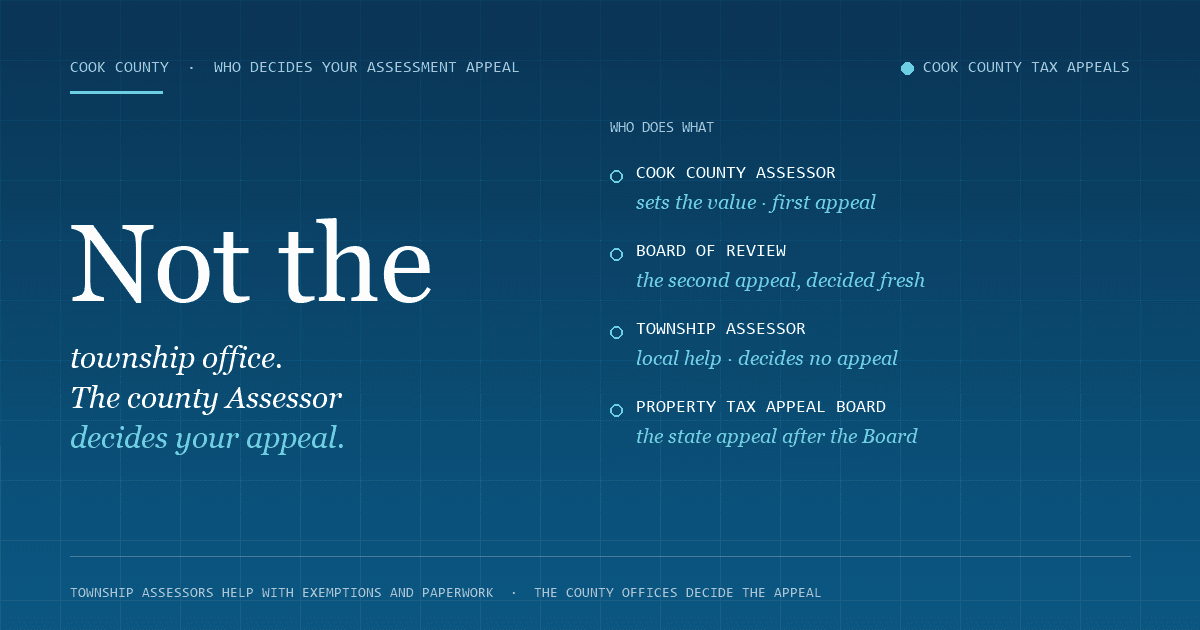
- The Cook County Assessor — the first pass. On its own, the Assessor changed about 22% of 2024 appeals county-wide, counting each appeal once.
- The Cook County Board of Review — a separate, second appeal for owners who don’t get the result they want from the Assessor.
Counting each home once, about 47% of Cook County homes that appealed in 2024 won a reduction at either stage. Each stage’s own rate, counting each appeal once, varies a lot by property type:
| Property class | Assessor (appeals) | Board of Review (appeals) |
|---|---|---|
| Multifamily (3xx) | 48.4% (5,627) | 48.4% (8,741) |
| Residential (2xx, not condos) | 20.0% (173,609) | 48.0% (223,676) |
| Commercial / industrial (5xx) | 39.7% (11,289) | 32.0% (26,305) |
| Condominium (299) | 26.5% (10,768) | 24.3% (11,179) |
| All classes | 22.4% (202,366) | 45.2% (272,195) |
The takeaway: a single Assessor pass wins less often than many headlines suggest, and the Board of Review is where most of the wins come: homes won 20% at the Assessor and 48% at the Board, and 47% of homes that appealed won at one stage or both. Income property (apartments, commercial) did well at both stages; condominium appeals — each usually covering a whole building — won about a quarter of the time at either stage.
03 · The reductionHow big is a typical cut?
When an appeal succeeds, how much does the assessment actually drop? County-wide, the median reduction among winning 2024 appeals (at either stage, each appeal counted once) was:
| Property class | Median reduction |
|---|---|
| Residential (homes) | ~7% |
| Condominium | ~7% (per building) |
| Commercial / industrial | ~19% |
| Multifamily | ~15% |
So the “typical” winning reduction is about 7% for homes and condo buildings, and in the mid-to-high teens for apartment and commercial property — not the eye-popping figures you sometimes see. The properties that see the largest percentage cuts are the ones that were clearly over-assessed and came in with the strongest evidence. That’s the lever you control: accurate property data and solid comparables.
04 · Year to yearSuccess rates in 2024 and 2025
Results shift year to year, mostly with the reassessment cycle and the mix of who files. At the Assessor stage, the county-wide rate was about 22% in 2024 and 19% in 2025, counting each appeal once. Year-to-year moves mostly reflect the reassessment cycle and who files. They don’t mean a well-supported 2025 appeal is less likely to succeed.
Because the Board of Review stage for a given year completes after the Assessor stage, the most complete combined picture is from 2024 — which is why this report’s headline odds use that year. Each new reassessment and shift in the market opens fresh appeal opportunities, which is why reviewing your assessment every year pays off.
05 · Bottom lineIs an appeal worth it?
- Check every year. Many owners overpay simply because they never review their value. A few minutes can flag whether you’re over-assessed.
- Know your class odds. Nearly half of homes that appealed won at one stage or both in 2024, and multifamily appeals won about half the time at each stage — benchmark against your own property type, not a single headline number.
- Use both stages. If the Assessor says no, the Board of Review is a separate shot — and that’s where a lot of the combined success comes from.
- The savings add up. A reduction generally holds until the next reassessment, so a single successful appeal can pay off for the whole cycle.
See How Much You Could Save
Check your property by address or PIN to see your assessment, your class, and an estimate of what an appeal could save — no upfront cost. 25% of first-year savings, only if your assessment is reduced.
Check My PropertyCook County Appeal Savings — FAQ
What is the Cook County property tax appeal success rate?
It depends on what’s counted. Counting each appeal once, about 22% of 2024 appeals won a reduction at the Assessor and about 45% at the Board of Review, county-wide. Counting each home once, about 47% of homes that appealed in 2024 won at one stage or both. By appeal, multifamily won about 48% at each stage, commercial 40% and 32%, and condo appeals 27% and 24%.
How much can I save with a property tax appeal?
For a typical home, a successful appeal saves roughly $560–$1,280 a year, depending on your local tax rate. Commercial and apartment owners often save several thousand dollars a year because their assessed values are higher. Figures are illustrative and vary by property.
How big is a typical reduction?
Among winning 2024 appeals, the median assessed-value cut was about 7% for homes and for a condo building’s appeal, about 15% for multifamily, and about 19% for commercial property, counting each appeal once. Clearly over-assessed properties with strong evidence often see larger reductions.
Where do I file a Cook County appeal?
Most owners start with the Cook County Assessor during their township’s appeal window. If the result isn’t satisfactory, there is a separate appeal to the Cook County Board of Review for eligible properties — a second chance that lifts the combined success rate.
Does a lower assessed value always mean a lower tax bill?
Not dollar-for-dollar. Your bill also depends on local tax rates and levies, which the Assessor doesn’t set. But lowering your assessed value reduces your share of the total burden, which generally lowers your bill.
Is there a cost to appeal?
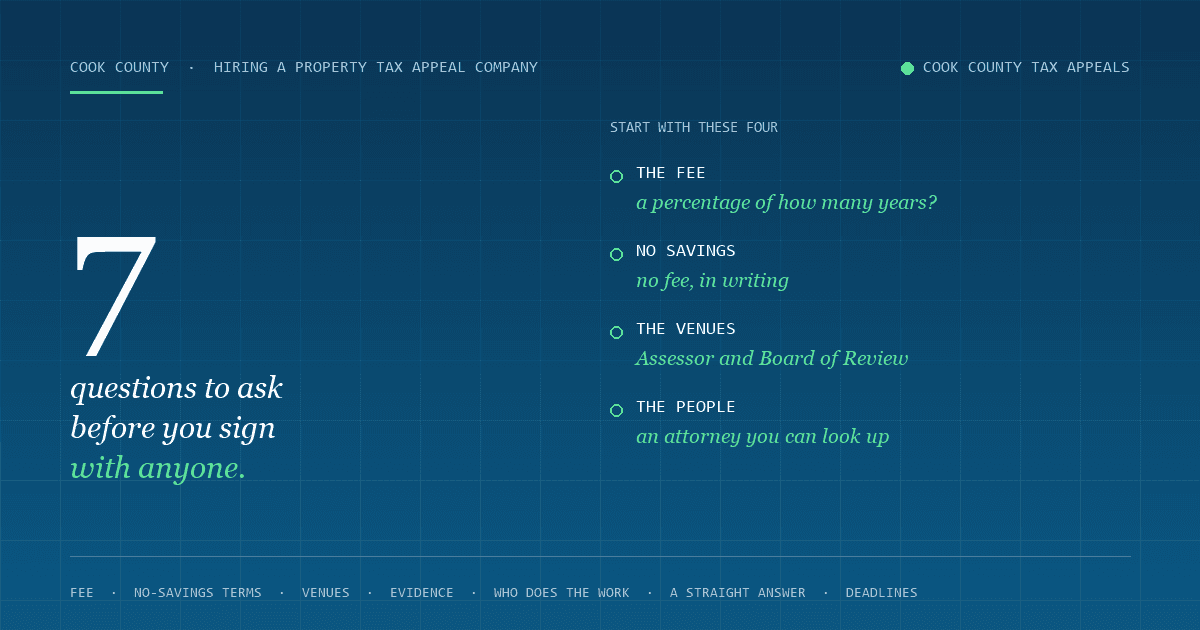
Filing with the Assessor or Board of Review is free to do yourself. Many owners work with a service on a contingency basis — no upfront cost. Our fee: 25% of first-year savings, only if your assessment is reduced.
Notes & Sources
- Success rates and reductions are derived from Cook County Assessor appeal records and Cook County Board of Review decision data (public datasets), tax years 2024 and 2025, county-wide. Rates count each appeal once (a condo building's units or a multi-parcel filing, decided together, are one appeal), except the homes figure, which counts each home once across both stages.
- Combined success rate counts a parcel as successful if it won a reduction at the Assessor or the Board of Review, measured at the parcel (PIN) level to avoid double-counting.
- Estimated dollar savings use the Illinois state equalization factor (3.0355 for the 2024 tax year) and a local composite tax-rate range of roughly 6.6%–15%, before exemptions; they are illustrative, not a guarantee.
- Median is used as the typical reduction because a small number of very large properties skew the average upward.
- This analysis is general information, not legal or tax advice.
Keep Reading
This analysis summarizes Cook County Assessor and Board of Review appeal outcomes using public data and is general information, not legal or tax advice. Assessed values, exemptions, and tax rates are set by the Cook County Assessor, Clerk, and Treasurer. Estimated savings use the state equalization factor and a range of local composite rates before exemptions and are illustrative. “No upfront cost. 25% of first-year savings, only if your assessment is reduced.” describes our contingency fee model.