Cook County Property Tax Appeal Success Rates & Savings
In 2024, Cook County’s Board of Review decided about 272,000 property assessment appeals, counting each appeal once (a condo building’s units, decided together, are one appeal) and covering more than half a million parcels — and 45.2% of them won a reduction. That’s up from 42.1% two years earlier. Here’s what the verified county data shows about your odds, your savings, and how to file.
The short version
- 45.2% of 2024 Board of Review appeals won a reduction — 123,045 out of 272,195 decided, counting each appeal once.
- The win rate has climbed every year: 42.1% (2022) → 44.2% (2023) → 45.2% (2024).
- Multi-family had the highest reduction rate at 48.4%; residential 46.9%; commercial & industrial 32.0%.
- A reduction lowers your assessed value, which lowers your tax bill — commercial savings tend to be far larger in dollar terms.
- Roughly one in three Cook County properties appeals each year; filing is free at the Board of Review.
What are your odds of winning an appeal?
Better than most people assume — and improving. According to the Cook County Board of Review Appeal Decision History, the county’s open dataset of every appeal decision, 45.2% of the 272,195 appeals decided in 2024 resulted in a reduction, counting each appeal once. Only a tiny fraction (32 appeals) ended in an increase; the rest were left unchanged.
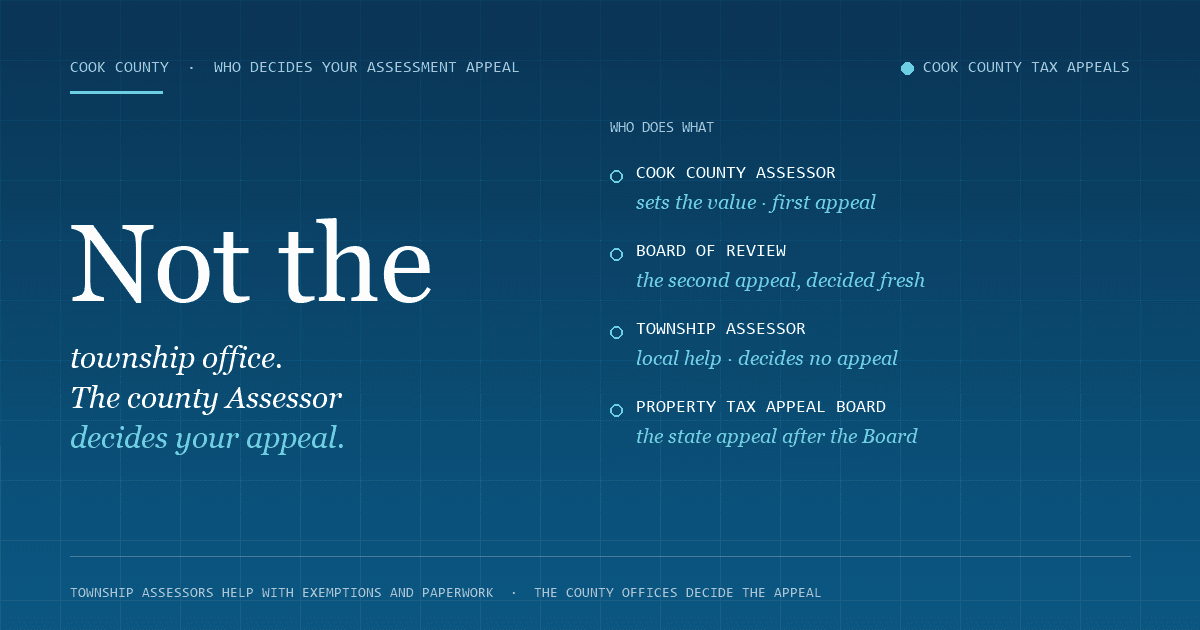
That headline number is for the Board of Review, the second of Cook County’s two appeal levels. Many owners also file first at the Assessor’s office, and the two stages are independent — you can be denied at the Assessor and still win at the Board. Public reporting from the Board has put the share of taxpayer appeals that ultimately see a decrease at a little over 56% when both stages are considered together.
Success rates are rising year over year
The most striking pattern in the data isn’t the headline rate — it’s the trajectory. The share of appeals winning a reduction at the Board of Review has gone up every year for three years running:
| Tax year | Appeals decided | Reductions | Reduction rate |
|---|---|---|---|
| 2022 | 238,952 | 100,609 | 42.1% |
| 2023 | 245,969 | 108,789 | 44.2% |
| 2024 | 272,195 | 123,045 | 45.2% |
An 11-point jump in two years is substantial. It reflects both rising assessments — which give owners more room to argue they’ve been over-valued — and a Board that has been granting relief on a larger share of well-supported appeals.
Success rates by property class
Your odds depend partly on what you own. Here is how the 2024 reduction rate broke down across the three largest property categories:
| Property class | Appeals decided | Reduction rate |
|---|---|---|
| Multi-family | 8,741 | 48.4% |
| Residential | 234,843 | 46.9% |
| Commercial & industrial | 26,305 | 32.0% |
Residential appeals dominate by sheer volume — nearly half a million of them — and win at roughly the county-wide average. Multi-family properties posted the highest reduction rate. The rates cluster fairly tightly, which means the deciding factor in any individual appeal is far more about the quality of the evidence than the property type.
How much can you actually save?
A successful appeal lowers your property’s assessed value, and a lower assessed value flows directly into a lower tax bill. How much you save depends on how over-assessed you were and your local tax rate, so the range is wide.
For homes, a successful appeal commonly trims a few hundred to a couple thousand dollars off the annual bill. For commercial and multi-family owners, where assessed values are far higher, the same percentage cut can mean five figures in yearly savings.
Two things make the savings compound. First, a reduction usually holds until the next reassessment, so a single win can lower your bill for multiple years. Second, Cook County reassesses on a three-year cycle by triad, so a correction made early in a cycle carries forward.
Why appealing is worth it
With nearly two in five appeals winning at the Board of Review — and the rate climbing — sitting out the process means a meaningful chance of overpaying that you simply forfeit by default. Assessments are mass-produced estimates; they are frequently wrong, and the only way the system corrects an over-assessment on your specific property is if someone files.
The downside is limited: of the 272,195 appeals decided in 2024, only 32 ended with an increase. Filing at the Board of Review is free, and the practical question for most owners isn’t whether an appeal can succeed — the data shows it routinely does — but whether their particular assessment is high enough to be worth challenging.
How to start your appeal
Begin by checking your assessment against comparable properties in your neighborhood. If similar homes are assessed lower than yours, or if recent sales suggest your assessed market value is too high, you likely have grounds. Watch your township’s appeal windows — each township opens and closes on its own schedule at both the Assessor and the Board of Review — and gather your evidence (comparable assessments, recent sales, photos of any condition issues, or an appraisal) before the window opens.
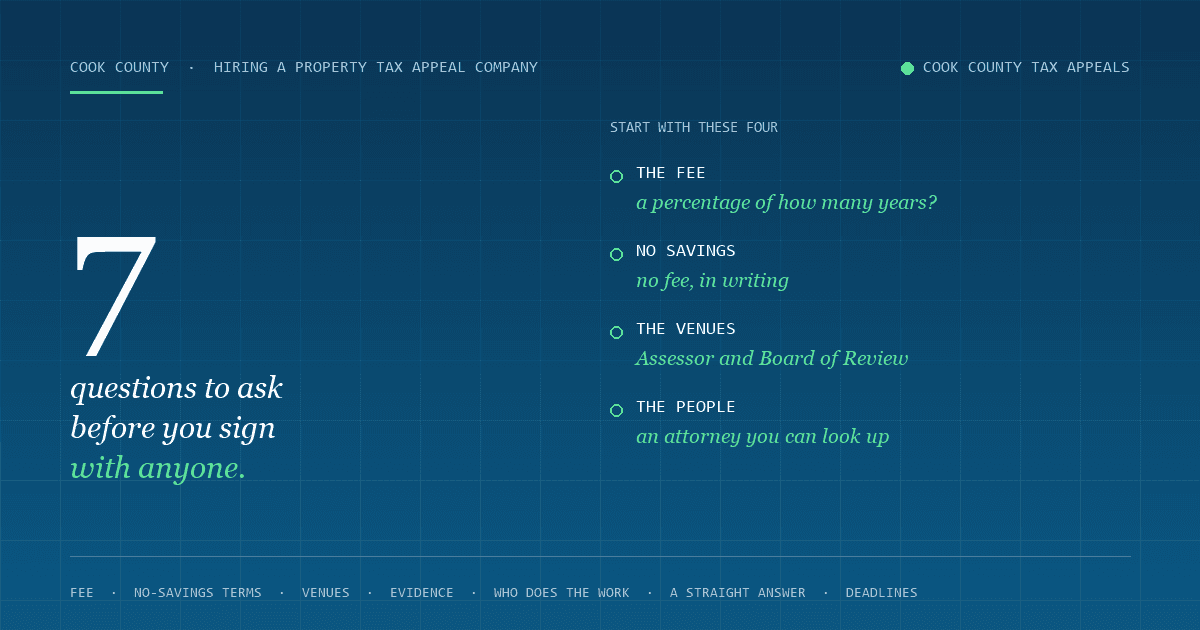
If you’d rather not navigate the deadlines, comparables, and filing portals yourself, Cook County Tax Appeals handles the full process — reviewing your assessment, building the comparable-sales case, and filing at both the Assessor and the Board of Review on your behalf.
Frequently asked questions
What percentage of Cook County appeals are successful?
How much can I save by appealing my property taxes?
Which property types win appeals most often?
Can my assessment go up if I appeal?
Is there a cost to appeal?
See if your assessment is too high
With about 45% of appeals winning a reduction and the rate climbing, it’s worth a look. Review your assessment and start your appeal today.
Start your appealSource: Cook County Board of Review Appeal Decision History, Cook County Open Data (dataset 7pny-nedm), tax years 2022–2024. Aggregate, county-wide public data. Figures reflect Board of Review decisions; combined Assessor-plus-Board outcomes per Cook County Board of Review public reporting.