Orland Township Property Tax Appeal: Your 2026 Reassessment Guide
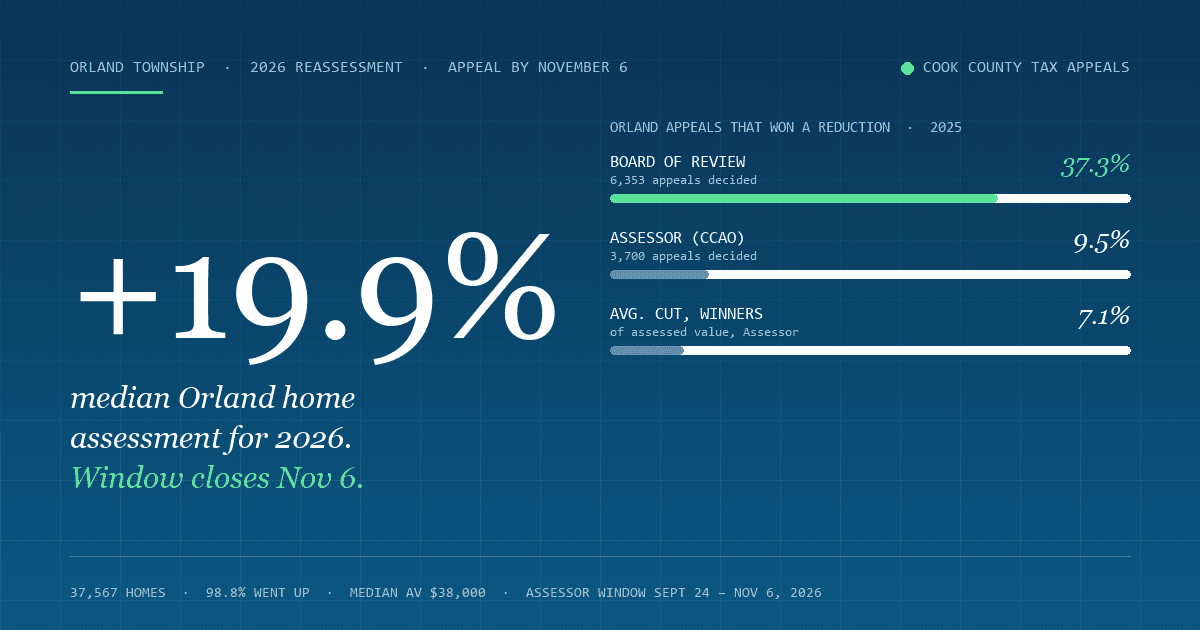
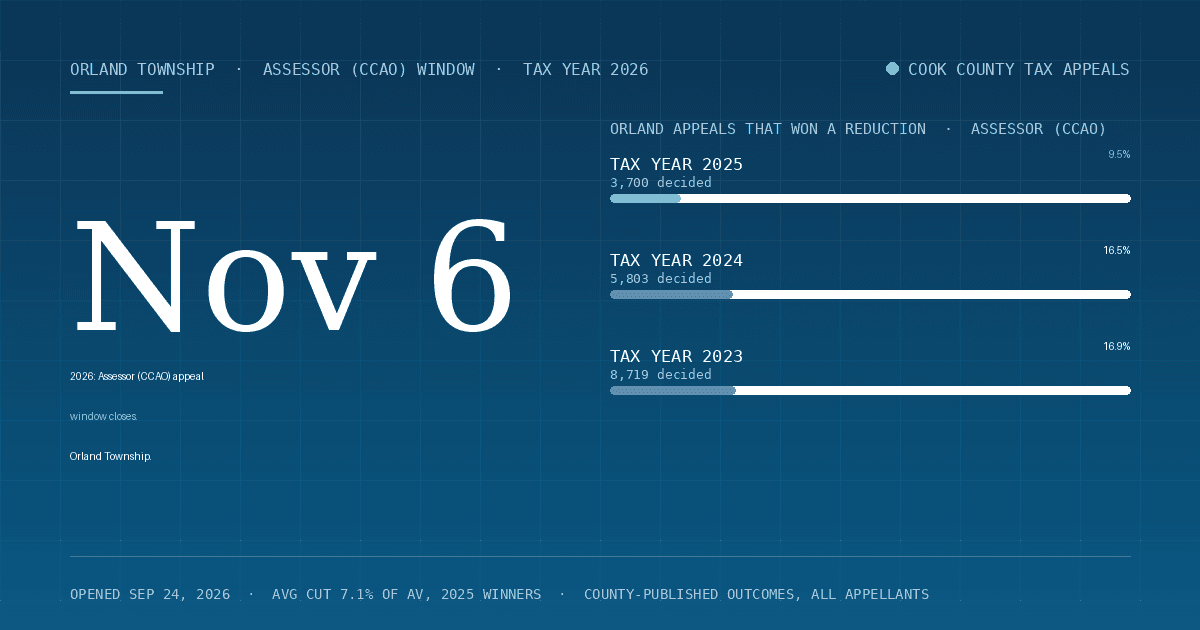
Orland Township's 2026 reassessment notices are out, and the Assessor's appeal window runs September 24 to November 6, 2026 — with a second chance at the Board of Review, whose window opens after the Assessor certifies the township. Here's exactly how the process works, and what it takes to win an Orland appeal.
- Orland Township is reassessed in 2026. New value notices are out; the Assessor's window opened September 24.
- You can appeal to the Cook County Assessor's Office (CCAO) until November 6, 2026, then to the Board of Review when its Orland window opens. These are two separate filings — you can use both.
- Appealing is free, and a higher assessment is not automatic justification — you need evidence that you're over-assessed relative to comparable homes.
- We're a Cook County firm that handles Orland appeals end to end — reviewing your assessment, building the comparables, and filing at both the Assessor and the Board of Review. There's no upfront cost; we work on contingency.
Why 2026 matters for Orland homeowners
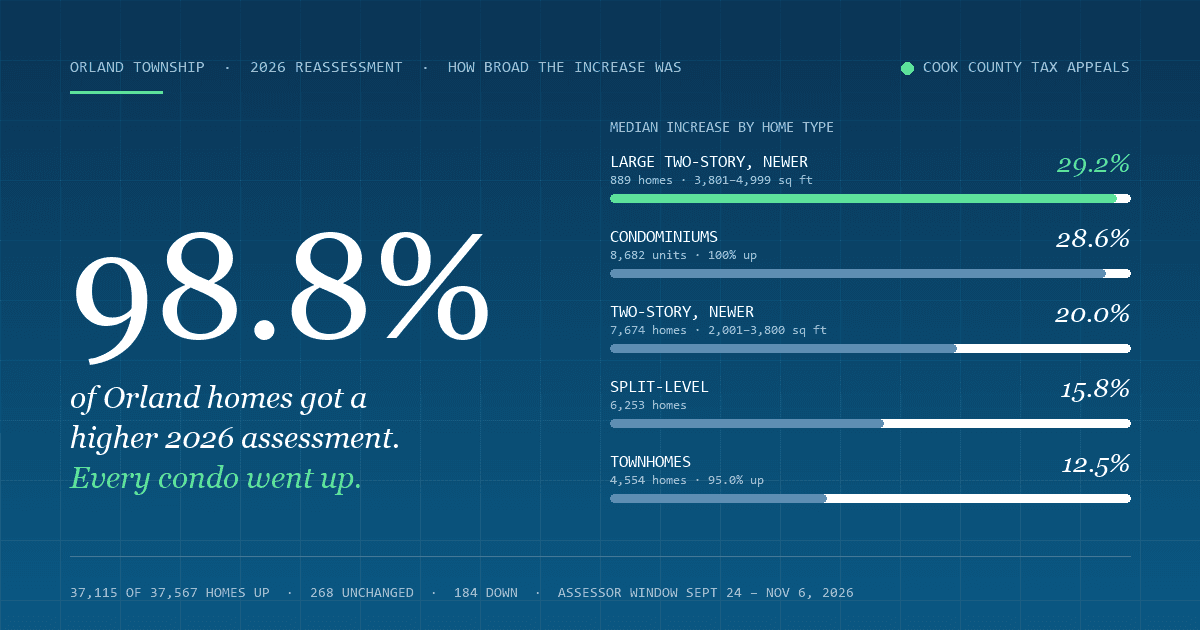
Cook County reassesses property on a three-year cycle, split into three geographic groups. Orland Township sits in the south/southwest suburban group, which means your home is getting a fresh assessment in 2026 for the first time since 2023. That notice — the Assessor's window for Orland opened September 24 — sets the assessed value that drives your property tax bill for the next three years.
That makes the weeks before November 6 the single most valuable window you'll have until 2029. An assessment that's even modestly too high compounds across three tax years before the next reassessment resets it. Catching an error now is worth far more than catching it later.
The notice you receive is not a tax bill. It's the Assessor's opinion of your home's market value as of January 1, 2026, expressed as an assessed value (10% of market value for residential property in Cook County). If that opinion is too high — because the data on your home is wrong, or because comparable homes are assessed for less — you have grounds to appeal.
The 2026 Orland appeal timeline
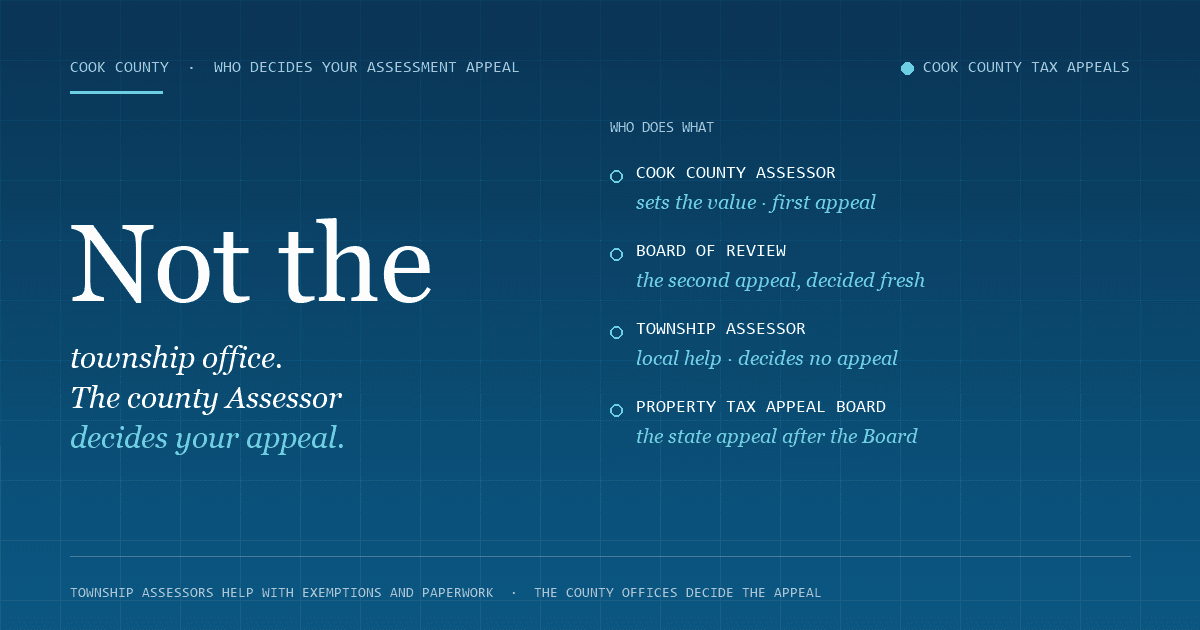
There are two distinct bodies you can appeal to, in sequence. Missing the first does not bar you from the second, but using both gives you two independent shots at a reduction.
- September 2026 Reassessment notices out Your new proposed assessed value arrives. The clock starts here.
- September 24 – November 6, 2026 Cook County Assessor (CCAO) appeal window File directly with the Assessor's office. This is the first and fastest path to a correction.
- After the Assessor certifies Orland Board of Review (BoR) appeal window An independent body. You can appeal here even if the Assessor denied or reduced you — and even if you skipped the CCAO entirely.
- Later in 2026 Decisions issued · 2026 tax bill reflects the result Reductions flow through to the Second Installment bill, typically issued the following year.
The Assessor's window for Orland runs about six weeks this year and closes November 6, 2026. Treat your notice as your signal to act rather than counting on the last day. Filing early also means a calmer, less rushed evidence package.
What actually wins an Orland appeal
A higher number on your notice is frustrating, but frustration isn't grounds for an appeal. The Assessor and Board of Review reduce assessments for specific, evidence-backed reasons. The three that carry the most weight:
1. Lack of uniformity (the strongest residential argument)
This is the workhorse of residential appeals. If comparable homes in your neighborhood — similar size, age, style, and lot — are assessed for less per square foot than yours, your assessment is "non-uniform" and should be brought in line. In a township like Orland, with large subdivisions of similar homes, strong comparables are often available.
2. Overvaluation
If recent sales of similar nearby homes — or a recent purchase or appraisal of your own home — come in below the Assessor's implied market value, you can argue the assessment overstates what your property is actually worth.
3. Factual error in your property record
The Assessor's description of your home may simply be wrong: too much square footage, a finished basement that isn't finished, a wrong bathroom count, or a garage that doesn't exist. Correcting the record can lower the assessment on its own.
| Evidence that wins | Evidence that rarely helps |
|---|---|
| Assessed values of comparable neighbors | "My taxes went up too much" |
| Recent comparable sales below your value | Your personal budget or hardship |
| A recent appraisal or purchase price | The condition of the local roads |
| Photos/records correcting a factual error | Comparison to a different township |
How to file your Orland appeal, step by step
- Find your PIN and read the notice. Your Property Index Number is on the reassessment notice and any tax bill. Note the proposed assessed value.
- Pull your comparables. Identify similar homes near you and compare their assessed values to yours. This is where most of the work — and most of the win — lives.
- Choose your grounds. Usually lack of uniformity, overvaluation, or a factual correction (often a combination).
- File with the Assessor by November 6. The CCAO accepts appeals online. Attach your comparables and any supporting documents.
- If needed, file with the Board of Review when its Orland window opens. A separate filing with an independent body — a genuine second chance.
- Wait for the decision. Any reduction carries through to your tax bill automatically; you don't re-file to claim it.
Most single-family Orland appeals that succeed produce a meaningful but not life-changing reduction — in the rough range of several hundred dollars a year for a typical home, sustained across the three-year cycle. The cost to file is your time, or a contingency fee if you use a firm. The downside of filing is essentially zero: an appeal cannot raise your assessment.
What it takes to win an Orland appeal
Orland is one of the communities we work in most, and that experience comes down to judgment: knowing which Orland homes are genuinely over-assessed and which aren't, which comparables the Assessor and Board of Review actually respond to, and how to package a filing so it isn't dismissed on a technicality. Appeals are won case by case, on the strength of the evidence — not on volume.
If your home isn't over-assessed, the right answer is to tell you so — and we will. There's no value in filing a weak appeal, and a careful read of your comparables up front is what separates a reduction from a wasted filing.
We charge nothing upfront. We work on contingency, which means we're only paid a share of the savings if your appeal actually reduces your bill. If there is no reduction, there is no fee. The entire process — from looking up your PIN to a filed appeal — can usually be completed online in a single sitting.
See if your Orland home is over-assessed
Enter your address and we'll check your 2026 assessment against comparable Orland Township homes — free, no obligation, and no upfront cost to file.
Check my assessment →Orland Township appeal FAQ
When exactly is the Orland appeal deadline in 2026?
Orland's 2026 reassessment notices are out. The Cook County Assessor's appeal window runs September 24 to November 6, 2026, and the Board of Review window opens after the Assessor certifies the township. Treat the notice as your cue to act rather than relying on the final day.
Will appealing make my assessment go up?
Rarely. Across 2021-2025, about 1 in 1,000 decided Cook County appeals ended in a higher assessment; the rest resulted in a reduction or no change. The downside of filing a well-supported appeal remains small.
Can I appeal to both the Assessor and the Board of Review?
Yes, and many homeowners do. They are two separate bodies. You can file with the Assessor by November 6 and, regardless of that outcome, file again with the independent Board of Review when its window opens. You can also skip the Assessor and go straight to the Board.
What's the difference between my assessment and my tax bill?
Your reassessment notice states a proposed market value and assessed value — not a dollar amount owed. The tax bill comes later and depends on the assessed value, the local tax rate, exemptions, and the equalization factor. Appealing targets the assessed value, which is the one component you can directly challenge.
How much could I realistically save?
It depends entirely on how over-assessed your home is. A typical successful single-family Orland appeal produces a reduction in the range of a few hundred dollars per year, sustained across the three-year cycle. Some save more, some less, and some homes aren't over-assessed at all.
Do I have to pay anything to appeal?
Filing the appeal yourself with the county is free. If you work with our firm, there's no upfront cost — we work on contingency and are paid only a share of the savings if your appeal succeeds. If there is no reduction, there is no fee.