Orland Commercial Property Tax Appeal — Your Income Is the Argument
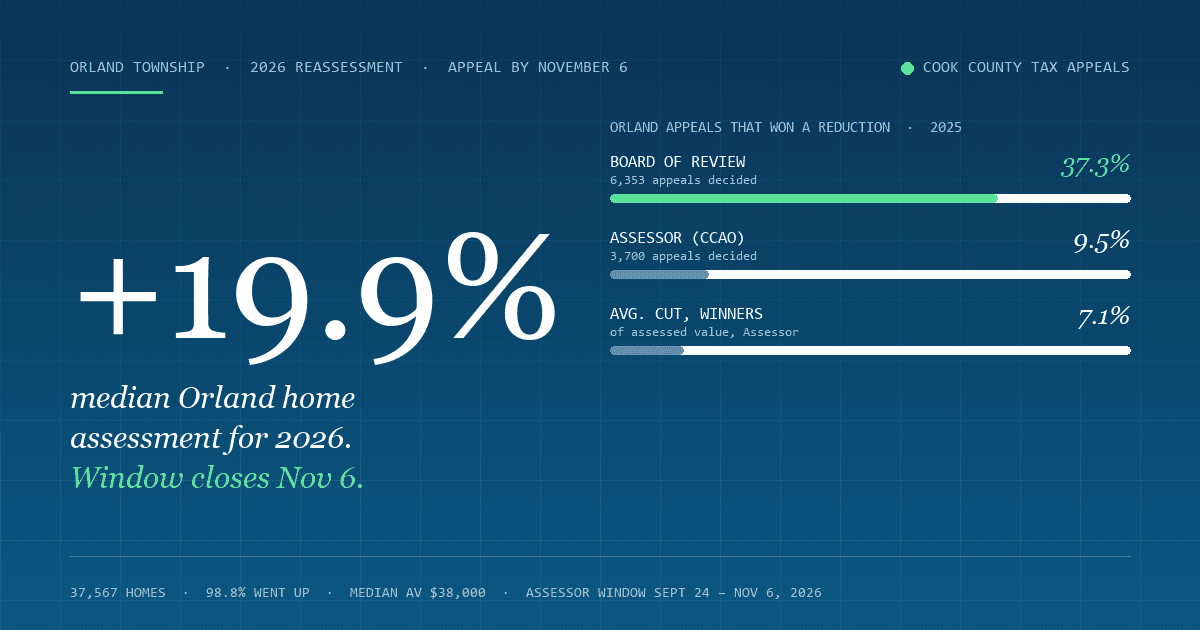
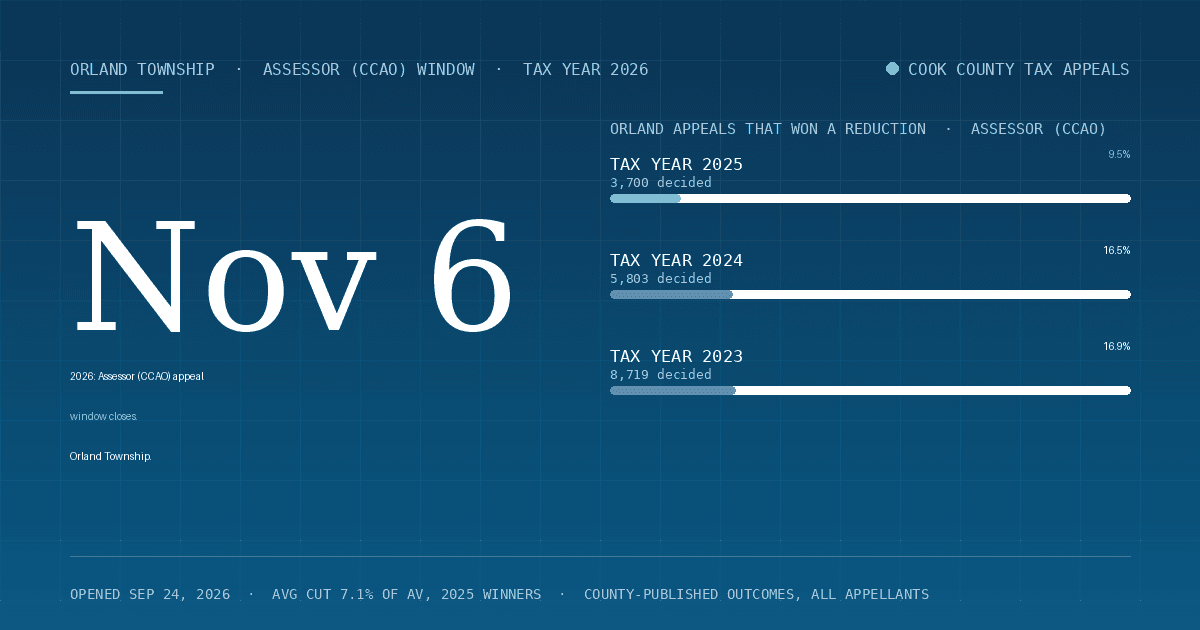
Orland Township is reassessed in 2026, and the value set this year drives your commercial tax bill through 2029. The 2026 reassessment notices are out, and the Assessor's appeal window runs September 24 to November 6, 2026. For income-producing property, the most powerful appeal isn't about square footage — it's about what the building actually earns. In the last reassessment, the average winning commercial appeal cut roughly $115,000 off the assessed value.
reassessment year
(last reassessment)
success rate
AV reduction
The Short Version
- Orland is a 2026 reassessment township. The value set this year drives your commercial bill through the next reassessment in 2029.
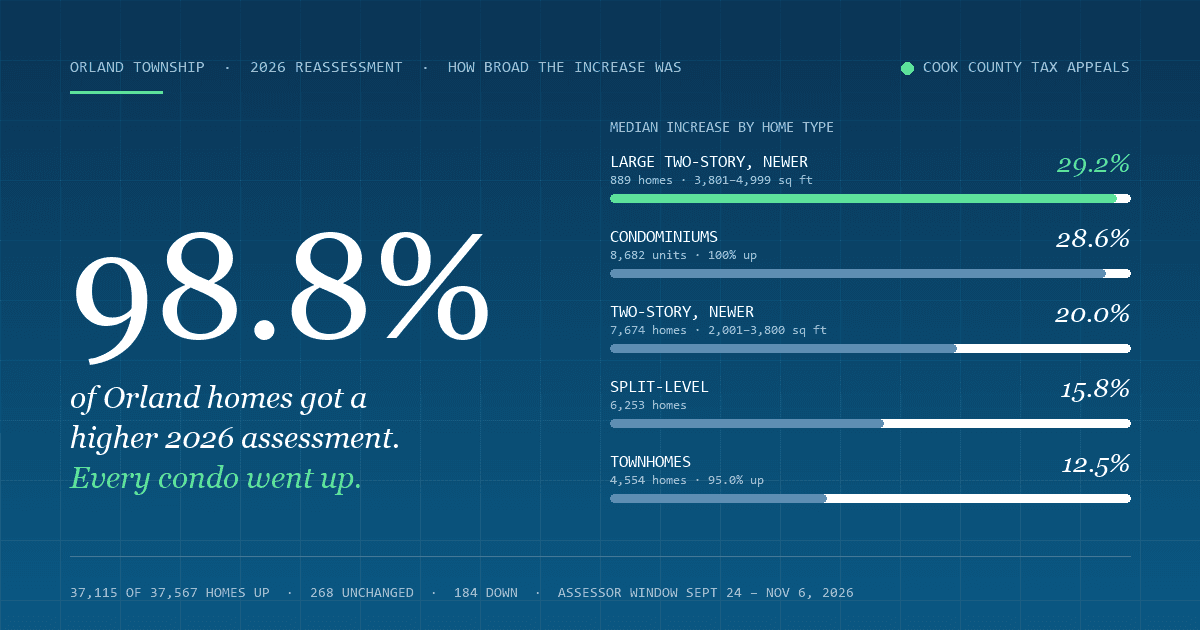
- Notices are out. Orland's Assessor window runs September 24 to November 6, 2026, and commercial and industrial (Class 5) assessments rose a median 15.6% (what the 2026 notices show). Get your income-and-expense records in order now; the Board of Review window follows after the Assessor certifies the township.
- Income-producing property is valued on what it earns. Your rent roll, expenses, vacancy, and the right capitalization rate are the core of a strong commercial appeal.
- The last reassessment was worth it: in 2023, 31.8% of Orland commercial appeals and 57.1% of multi-family (7+ unit) appeals won a reduction — and the average winning commercial cut was about $114,997 in assessed value.
- You don't have to wait for the notice, either — Cook County lets you appeal every year, and Orland owners filed thousands of appeals in 2024 and 2025.
Commercial and multi-family owners in Orland Township face a different reassessment math than homeowners. Income property is assessed at a higher level (25% of market value, versus 10% for homes), and its value is driven by economics — rent, expenses, and risk — not just physical characteristics. With Orland's retail corridors and large commercial base, the dollars at stake are significant, which is exactly why the most effective commercial appeals are built on the numbers your property actually produces.
Orland Is Reassessed in 2026
Cook County reassesses each township once every three years, on a three-section "triad" rotation — the City of Chicago, the north suburbs, and the south and west suburbs. Orland is in the south and west suburban group, last reassessed in 2023 and due again in 2026. Whatever value is set this year generally carries forward until the next reassessment in 2029 — so a correction now protects three years of bills.
Your Notice Is Here — Here's What to Do
Orland's 2026 reassessment notices have been mailed, and the Assessor's window for Orland runs September 24 to November 6, 2026. For commercial owners, assemble your evidence now:
- Pull together your income-and-expense records. Rent roll, current leases, and operating statements are the backbone of a commercial appeal.
- Document vacancy and collection loss. Genuine vacancy, concessions, or unpaid rent all lower effective income — and value.
- Check your notice — and the deadline page. The Assessor's window for Orland runs September 24 to November 6, 2026. Track your exact filing window on our Cook County deadlines page.
Your Income Is the Argument
For most commercial and multi-family property, the Assessor leans on the income approach — estimating value from the net income a building can generate. That's good news for owners, because it means your appeal can be grounded in hard financial evidence rather than subjective comparisons. The core inputs:
- Actual rents (the rent roll). If your building earns less than the Assessor assumed — below-market leases, concessions, or older rents — that gap supports a lower value.
- Operating expenses. Real expense levels reduce net income, and net income drives value.
- Vacancy and collection loss. Genuine vacancy or unpaid rent lowers effective income and, with it, value.
- Capitalization rate. The rate used to convert income into value matters enormously; the right cap rate for your property type and risk can move the number significantly.
Put together, an income-and-expense package that shows the building's real economics is the strongest case a commercial owner can bring.
What the Last Reassessment Showed
Orland's 2023 reassessment is the clearest preview of 2026 — and income-property owners did well. Class 5 (commercial and industrial) appeals succeeded 31.8% of the time, and Class 3 (multi-family, 7+ units) reached 57.1%. The dollar reductions were large: the average winning commercial appeal cut about $114,997 in assessed value, and the average multi-family cut about $52,948.
| Class | What it generally represents | Appeals | Success |
|---|---|---|---|
| 5-17 | One-story commercial building | 186 | 33.9% |
| 5-90 | Commercial / mixed-use building | 45 | 31.1% |
| 5-97 | Commercial building with apartments | 37 | 56.8% |
| 3-15 | Apartment building, 7+ units | 27 | 66.7% |
| 5-92 | Two-or-more story commercial building | 26 | 57.7% |
| 5-93 | Industrial / commercial building | 25 | 32.0% |
The income-producing classes that carry strong rent evidence — buildings with apartments, multi-family, and two-story commercial — led the pack, several landing between 55% and 67%. Single-story retail and industrial came in around the low 30s. The pattern is consistent with the income approach: when an owner documents real economics, the value often moves.
What a Reduction Is Worth in Orland
Orland's composite tax rate runs around 8.5% — lower than the inner-ring suburbs — but commercial assessed values (and the cuts won on appeal) are large, so the dollars are real:
Illustrative estimate using Orland's state equalization factor and a common composite rate (~8.5%, varies by area). At the 2023 average winning commercial cut of about $114,997, the annual saving would be roughly $29,600. Commercial reductions are not always carried into the next year, so many owners appeal each year. Our fee: 25% of first-year savings, only if your assessment is reduced.
What Wins a Commercial Appeal
- A complete income-and-expense package. Rent roll, leases, and operating statements that show the building's true net income.
- Vacancy and collection evidence. Documentation of real vacancy, concessions, or uncollected rent.
- The right capitalization rate. Support for a cap rate appropriate to your property type, location, and risk.
- Comparable evidence where useful. Sales or assessments of similar income properties to reinforce the income conclusion.
Because commercial cases are evidence-heavy, the Board of Review second window can matter even more than for homes — it's a separate, independent review if the Assessor doesn't move.
You Can Appeal Every Year
The right to appeal isn't limited to reassessment years. Cook County lets you challenge your assessed value every year — and Orland owners do: more than 6,400 appeals were filed in 2024 and over 3,800 in 2025, both ordinary (non-reassessment) years. If your value already looks too high, you don't have to wait — but a reassessment year like 2026 is the strongest moment to act, because the whole township is being revalued at once.
How to File Before November 6
- Pull your PIN and new proposed value from the 2026 reassessment notice or the Assessor's website.
- Assemble your income-and-expense documentation — rent roll, leases, operating statements, and vacancy records.
- File your Orland commercial appeal with the Assessor before your filing deadline.
- Plan for the Board of Review window later in the year if the Assessor doesn't lower your value.
Want a read on whether your assessment is out of line? Review the signs your property is overassessed, or confirm your window on our deadlines page.
File Before Orland's November 6 Deadline
Have your assessment reviewed against your building's real income and comparable properties, with no upfront cost. 25% of first-year savings, only if your assessment is reduced. Register now and we'll help you file before Orland's November 6 deadline.
Check My AssessmentOrland Commercial Appeal FAQ
Is 2026 a reassessment year for Orland?
Yes. Orland is part of the south and west suburban triad, last reassessed in 2023 and reassessed again in 2026. The value set in 2026 generally carries forward until the next reassessment in 2029.
When is the Orland 2026 commercial appeal deadline?
The Assessor's window for Orland runs September 24 to November 6, 2026. The Board of Review window opens later, after the Assessor certifies the township — confirm your current window on the deadlines page before filing.
How is commercial property valued for taxes?
Most income-producing property is valued using the income approach — estimating value from the net income the building generates, based on rents, expenses, vacancy, and a capitalization rate. Commercial property is also assessed at 25% of market value, versus 10% for homes.
How did commercial appeals do in the last reassessment?
In Orland's 2023 reassessment, 31.8% of commercial (Class 5) appeals and 57.1% of multi-family (Class 3) appeals won a reduction. The average winning commercial cut was about $114,997 in assessed value, and the average multi-family cut about $52,948.
What evidence makes the strongest commercial appeal?
A complete income-and-expense package: rent roll, leases, and operating statements showing true net income, plus documentation of vacancy or collection loss and support for the right capitalization rate. Comparable sales or assessments can reinforce the income conclusion.
Data & Sources
- Cook County triad schedule: Orland Township (code 28) is in the south and west suburban group, last reassessed in 2023, reassessed again in 2026 (next 2029). Orland's 2026 Assessor window (September 24 to November 6, 2026) is from the Assessor's published calendar.
- Last-reassessment results: Cook County Assessor Appeals dataset (Cook County Data Catalog), Orland Township, tax year 2023 — Class 5 commercial 547 appeals, 174 marked "Change" (31.8%), avg reduction ~$114,997; Class 3 multi-family 42 appeals, 24 (57.1%), avg reduction ~$52,948.
- Annual-year appeal activity: 6,461 Orland appeals in 2024 and 3,842 in 2025 (non-reassessment years), confirming appeals are available every year.
- Tax-saving estimates use Orland's state equalization factor (3.0300 for the 2025 tax year) and a common composite rate (~8.5%, varies by area); estimates exclude exemptions. All data is public and county-wide; no firm-specific results are stated.
Keep Reading
This article covers the 2026 Orland Township reassessment and commercial appeal timing and is general information, not legal or tax advice. Last-reassessment figures are drawn from public Cook County Assessor appeal data; individual results depend on the property and the evidence presented. Tax-saving figures are estimates that exclude exemptions and vary by tax code. Filing deadlines are set by the Cook County Assessor and Board of Review — Orland's 2026 Assessor window is September 24 to November 6, 2026; always confirm your window before filing. Representation is subject to a written engagement agreement.