Maine Township Commercial Tax Appeal: Deadlines & Assessment Trends
Maine Township's commercial assessments climbed sharply in the 2025 reassessment, and they don't reset again until 2028. But commercial owners in Des Plaines, Park Ridge, Niles, and Glenview don't have to wait three years to push back — you can appeal a Cook County commercial assessment every single year. Here's how the deadlines work, what the trends show, and how to file.
- Maine Township was reassessed in 2025; the next triennial reassessment is 2028. Those new values flow through to tax bills issued in 2026 and stay in place until the next cycle.
- You do not have to wait for a reassessment year. Cook County lets commercial owners file an appeal every year when the township opens — the deadline is posted on the Assessor's Assessment & Appeal Calendar.
- Commercial property is assessed on an income approach (rent, vacancy, expenses, cap rate) — which means the inputs the Assessor used, not just comparable sales, are where appeals are won.
- The 2025 reassessment pushed Maine commercial values up materially. If your income figures don't match the Assessor's assumptions, you likely have grounds.
Why Maine Township commercial owners should pay attention now
Cook County reassesses every property on a three-year triennial cycle. Maine Township — part of the north/northwest suburban triad, covering Des Plaines, Park Ridge, Niles, Glenview, Morton Grove, and Rosemont — was last reassessed in 2025. Reassessment notices went out in June 2025, and those values are reflected on the Second Installment tax bills issued in 2026. The next scheduled reassessment isn't until 2028.
That long gap is exactly why appealing matters. A commercial assessment that's set too high in 2025 doesn't quietly correct itself — it carries forward and drives your tax bill for the entire cycle. And because commercial assessments are typically much larger than residential ones, even a modest percentage reduction can translate into a meaningful dollar figure on a commercial bill.
You can appeal in a non-reassessment year. Many commercial owners assume the only chance to challenge an assessment is when a reassessment notice arrives. It isn't. Cook County opens an annual appeal window for every township, every year — so even though Maine isn't reassessed again until 2028, you can still file in 2026, 2027, and 2028.
The Maine Township commercial appeal deadline
There is no single fixed date that applies every year. Cook County sets appeal windows township by township, and the dates move from one year to the next. The reliable way to find your deadline is the Assessor's Assessment & Appeal Calendar, which lists when each township "opens" and the "last file date" to appeal.
For reference, in the 2025 reassessment cycle Maine Township opened in June and the Assessor's appeal deadline was July 18, 2025, with the Board of Review window following later. In a non-reassessment year the window still exists — it's just posted closer to when the township opens.
- Step one · every year Check the Assessor's Assessment & Appeal Calendar Find Maine Township's "open" date and "last file date." This is your deadline.
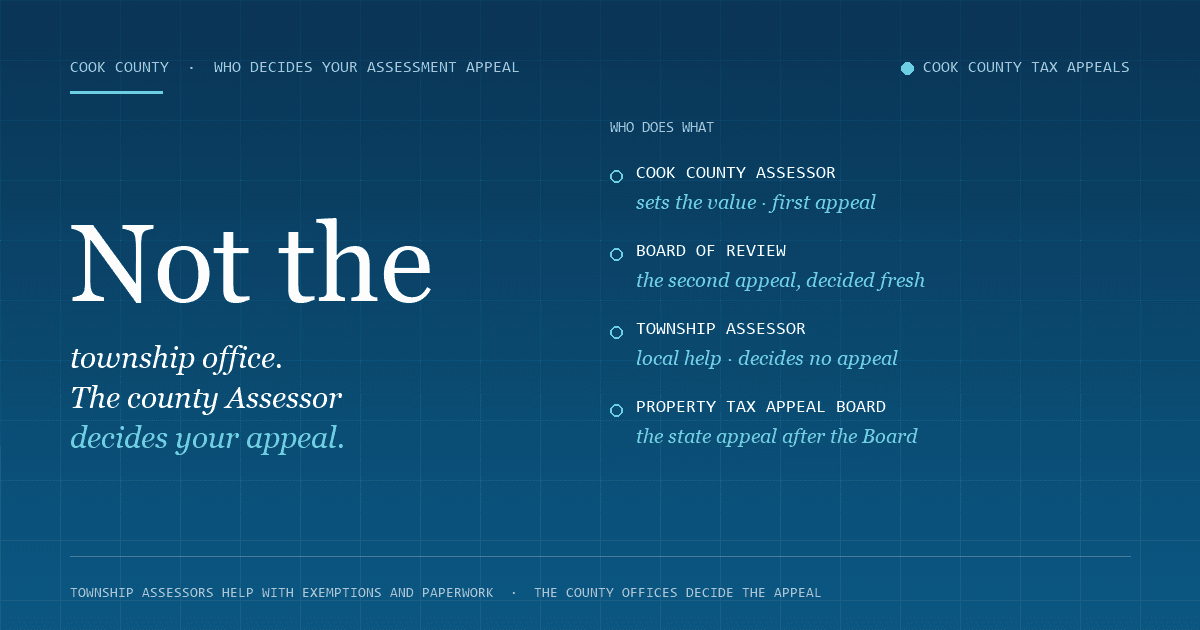
- First filing Cook County Assessor's Office (CCAO) File during the township's open window. For commercial property, this is where income-and-expense evidence does the most work.
- Second filing Cook County Board of Review (BoR) An independent body that opens after the Assessor's window. You can appeal here even if the Assessor reduced you partially — or not at all.
- If still over-assessed PTAB or Circuit Court For larger commercial disputes, the Illinois Property Tax Appeal Board or the courts are a further step after the Board of Review.
What the 2025 reassessment trends show
Commercial values in Maine Township have been rising, and the 2025 reassessment accelerated that. The total value of commercial property in the township jumped roughly 36% in the 2025 reassessment — an increase of more than $1 billion — while residential values rose about 25% over the same period. Commercial and multi-family property carried much of the increase because those classes are valued on income, and rents and occupancy recovered after the pandemic.
The increases weren't uniform. The pattern in 2025 ran heaviest at the larger end: properties valued over $1.5 million saw some of the steepest jumps, mid-sized commercial parcels (roughly $1 million to $1.5 million) rose around 32%, and even smaller commercial properties under $250,000 went up about 27%. A few specifics worth knowing as a commercial owner:
| Trend | What it means for your appeal |
|---|---|
| Income-based valuation | Your assessment is driven by assumed rent, vacancy, and expenses — if those assumptions are off, the value is too. |
| Rising rents post-2022 | The Assessor leaned on recovering market rents; if your actual rent roll is lower, that's direct evidence. |
| Larger properties saw bigger jumps | Higher-value commercial parcels often had the steepest increases — and the most room to challenge. |
| Cap-rate assumptions | A cap rate set too low inflates value. Market-supported cap rates are a core part of a strong commercial appeal. |
The takeaway: a commercial appeal in Maine Township isn't about arguing the market went down. It's about showing the Assessor's income assumptions for your specific property don't match reality.
What actually wins a commercial appeal
Commercial appeals turn on different evidence than residential ones. The strongest grounds:
1. Income approach evidence (the centerpiece)
Your actual rent roll, leases, operating statements, and vacancy history. If the Assessor assumed market rents and full occupancy but your building runs below that, the income that supports the assessed value is overstated.
2. Lack of uniformity
If comparable commercial properties nearby are assessed at a lower level relative to their income or square footage, your assessment is non-uniform and should be brought in line.
3. Overvaluation vs. market
A recent purchase, a current appraisal, or comparable commercial sales that come in below the Assessor's implied market value.
4. Factual and classification errors
Wrong square footage, an incorrect property class, or characteristics that don't match the actual building. These corrections can move the assessment on their own.
Residential appeals can win on comparables alone. Commercial appeals usually require your financials — rent rolls, income-and-expense statements, and leases. The owners who assemble that package early tend to fare best.
How to file your Maine Township commercial appeal
- Find your PIN and pull your assessment. Use the Assessor's site to confirm your proposed assessed value and the property characteristics on record.
- Check the calendar. Confirm Maine Township's current-year open and last-file dates on the Assessment & Appeal Calendar.
- Assemble income documentation. Rent roll, leases, and a recent income-and-expense statement. This is the heart of a commercial appeal.
- File with the Assessor. Submit your appeal and supporting financials before the last-file date.
- File with the Board of Review. A separate, independent filing — a genuine second opportunity.
- Escalate if warranted. For large disputes, PTAB or the courts remain available after the Board of Review.
Working with us on a commercial appeal
Commercial appeals reward experience with the income approach and with how the Cook County Assessor and Board of Review weigh financial evidence. We handle the analysis — reviewing your rent roll and operating statements against the Assessor's assumptions, building the comparable and cap-rate case, and filing at both the Assessor and the Board of Review.
We work on contingency: there's no upfront cost, and we're paid a share of the savings only if the appeal actually reduces your bill. If your commercial assessment is already fair, the honest answer is to tell you so — and we will. For commercial property, where the dollars at stake are larger, that candor matters.
See if your Maine Township commercial property is over-assessed
Send us your PIN and we'll review your 2025 assessment against the income approach the Assessor used — free, no obligation, and no upfront cost to file.
Review my commercial assessment →Maine Township commercial appeal FAQ
When is the Maine Township commercial appeal deadline?
It changes year to year. Cook County opens an appeal window for each township annually, and the exact "open" and "last file" dates are posted on the Assessor's Assessment & Appeal Calendar. In the 2025 reassessment cycle, Maine's Assessor deadline was July 18, 2025; the Board of Review window followed later. Check the calendar for the current year's dates.
Can I appeal if 2026 isn't a reassessment year for Maine?
Yes. Maine Township was reassessed in 2025 and isn't scheduled again until 2028, but Cook County allows an appeal every year. You can file in any year when the township's appeal window is open — you don't have to wait for a reassessment notice.
How is commercial property assessed in Cook County?
Commercial and multi-family property is generally valued using an income approach: the Assessor estimates the property's income based on use, market rent, vacancy, collection loss, and expenses, then applies a capitalization rate. Because the value is driven by those assumptions, your actual financials are the strongest evidence in an appeal.
What documents do I need for a commercial appeal?
Typically your rent roll, current leases, and a recent income-and-expense statement, plus anything that corrects the property record (square footage, class, condition). Comparable commercial assessments or sales and a market-supported cap rate strengthen the case further.
Will appealing raise my assessment?
Rarely. Across 2021-2025, about 1 in 1,000 decided Cook County appeals ended in a higher assessment; the rest resulted in a reduction or no change. The downside of a well-supported appeal remains small.
What does it cost to appeal a commercial assessment?
Filing yourself with the county is free. Working with our firm, there's no upfront cost — we work on contingency and are paid only a share of the savings if the appeal succeeds. If there is no reduction, there is no fee.