A single appeal-success-rate number for Leyden Township doesn't exist — at least, not one that tells anyone the truth. The Cook County data is unambiguous: your property class shapes everything. The success rate, the size of the AV reduction, and most importantly the dollar savings on your tax bill all depend on whether you own a condo, a single-family home, a small apartment building, a larger multi-family property, or a commercial parcel.
This post breaks down the complete 2025 Leyden Township appeal record by property class, joining each parcel's Assessor and Board of Review history by 14-digit PIN. Nothing below is a township average; everything is class-specific.
01 · How appeals workThe two-stage Cook County property tax appeal process
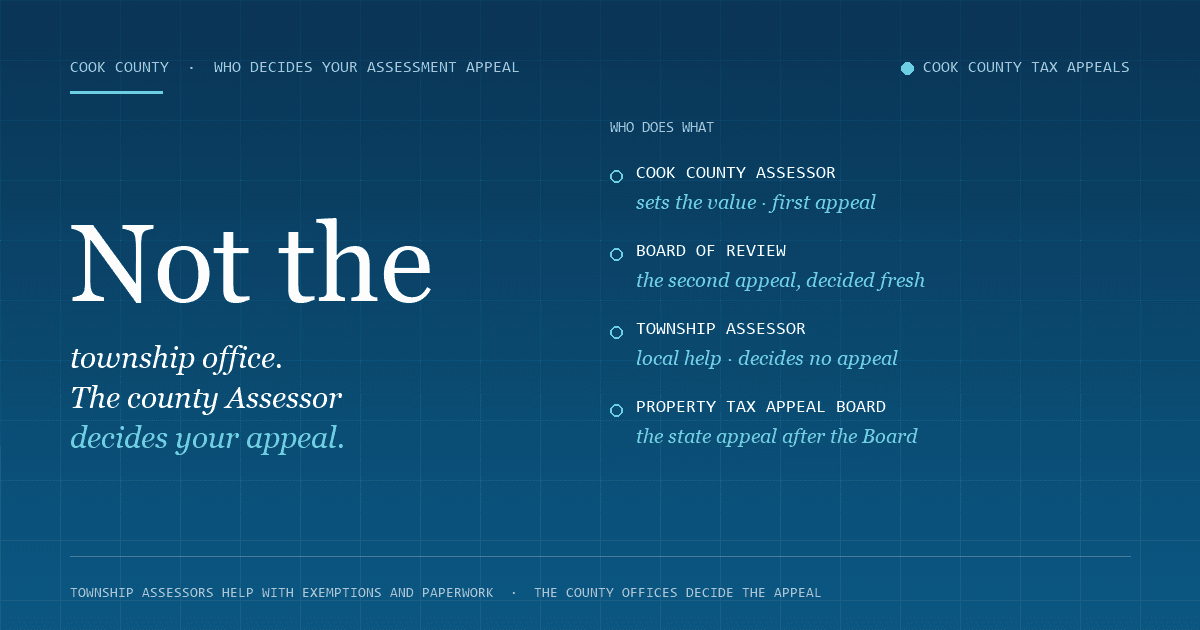
Cook County runs appeals through two independent bodies. Stage one is the Cook County Assessor's Office (CCAO), which mails an assessment and then opens an appeal window for each township. Stage two is the Board of Review (BOR), a separate quasi-judicial agency that reviews assessments after the Assessor closes. Owners can file at either stage; many file at both. The two stages aren't redundant — they apply different standards. The CCAO checks internal consistency with mass-appraisal models; the BOR conducts evidence-based hearings.
Looking at only one stage hides the full story, so for every class below we report all three perspectives: the CCAO alone and the BOR alone, each counting every appeal once (a filing that covers a whole condo building or several parcels is one appeal), and a "both stages" view that joins the two by PIN — so each property is counted once, with success defined as a change at either level.
02 · Find your property classLeyden Township 2025 appeal results, by property class
Use the tabs below to see the Leyden 2025 data for your property class. Numbers swap based on your selection — success rates at each stage, the average assessed-value journey, and the estimated annual tax-bill savings for that class. Commercial sits separately from residential because of its different level of assessment (25% vs 10%), and within the Class 2 residential bucket, condos and small apartments are split out because their outcomes differ from single-family homes.
Single-family homes
The AV journey for single-family homes
What this means for single-family owners
Single-family is the largest residential bucket by volume but won 18.5% of its CCAO appeals (counting each appeal once). The BOR more than triples that to 62.3% — and parcels that escalate end-to-end average $672 in annual tax-bill relief, with the typical assessed value moving from $35,090 to $33,075. Over a 3-year reassessment cycle, that's roughly $2,000 in cumulative savings before the next reassessment resets.
Condominiums
The AV journey for condos
What this means for condo owners
Condos have a surprisingly counter-intuitive pattern: counting each appeal once (one appeal usually covers a whole building), the CCAO's average cut per appeal ($3,328) is actually larger than the BOR's ($2,981). That's because by the time most condos arrive at the BOR, the Assessor has already done much of the work — the BOR is making smaller marginal adjustments on top. The combined effect is still real: 53.9% of condo parcels won a change at one of the two stages, and end-to-end savings average about $196 per year. The dollar figure is small because condo AVs are small, but the percentage reduction (3.8%) is the meaningful comparison.
Small apartment buildings
The AV journey for small apartments
What this means for small-apartment owners
2-to-6-unit buildings sit in a distinctive spot — assessed at the Class 2 residential rate but with materially higher AVs than single-family or condos. CCAO success rate is the lowest of any residential subclass at 16.9%, but the BOR jumps to 49.2%. Owners who escalate to both stages average $1,132 in annual tax-bill relief on a 5.2% AV reduction.
Multi-family (7+ units)
The AV journey for multi-family
What this means for multi-family owners
Multi-family (Class 3) is the strongest-performing class in Leyden. The CCAO already approves 60.9% of these appeals — far higher than residential — and the BOR pushes that to 69.8%. The combined success rate of 77.4% is the highest of any class. Owners who file at both stages see an average $9,612 in annual tax savings on a 20.2% AV reduction. This is also the class where filing only at the BOR leaves the most on the table, since the CCAO success rate is so unusually high.
Commercial & industrial
The AV journey for commercial
What this means for commercial owners
Commercial owners get the largest dollar reductions, but it's mostly because their starting AVs are 4× higher than residential at the same market value (25% LOA vs 10%). On a percentage basis, the 24.6% end-to-end AV cut for commercial is comparable to multi-family's 20.2%. CCAO success rate of 48.7% is significantly higher than residential — the Assessor's office treats commercial appeals with more scrutiny because of the larger sums involved. Owners who escalate to both stages average $34,832 in annual tax-bill relief.
A condo owner reading "Leyden's average tax savings is $9,464/year" would be wildly misled. The real figure for their class is closer to $196 — 48× smaller. That's why every number above is class-specific.
Hire Cook County Tax Appeals to file your Leyden Township appeal.
Enter your PIN and we'll calculate your specific savings opportunity based on your property class, tax code, and current AV. We escalate every case across all three appeal tiers — CCAO, BOR, and PTAB. 25% of first-year savings, only if your assessment is reduced. Nothing upfront.
03 · All classesAll Leyden Township property classes compared
Here is the same data above arranged for direct comparison across classes. The success-rate chart shows how the CCAO, BOR, and combined rates vary; the data table below shows every per-class number in one matrix.
Success rate by class — CCAO, BOR, and Combined
Leyden Township · 2025 · % of appeals (or parcels) that produced a change
Per-class summary · CCAO + BOR + Combined
| Class | CCAO rate (by appeal) | BOR rate (by appeal) | Both stages (by property) | Avg AV cut (end-to-end) | Est. savings/yr |
|---|---|---|---|---|---|
| Single-family homesClass 2 · LOA 10% | 18.5% | 62.3% | 55.1% | $2,015 | ~$672 |
| CondominiumsClass 2-99 · LOA 10% | 37.8% | 35.5% | 53.9% | $587 | ~$196 |
| Small apts (2–6 units)Class 2-11 · LOA 10% | 16.9% | 49.2% | 52.5% | $3,395 | ~$1,132 |
| Multi-family (7+ units)Class 3 · LOA 10% | 60.9% | 69.8% | 77.4% | $28,839 | ~$9,612 |
| Commercial & industrialClass 5 · LOA 25% | 48.7% | 64.2% | 74.0% | $104,505 | ~$34,832 |
04 · TakeawaysThree takeaways for Leyden Township property owners
Your class is the most important variable
Commercial parcels saved 178× more per year than condos on average. Township-wide "averages" hide this and mislead almost every reader.
The BOR is where most residential appeals win
Counting each appeal once, residential CCAO rates ran 17–38% and BOR rates 36–62%. The Board of Review was the higher-yield stage for single-family homes and small apartments; condo appeals did about as well at either stage.
Escalating still matters — for every class
The combined "filed at both" success rate is higher than either single stage for every class. The right strategy is the same regardless of property type: appeal at both stages.
Methodology · data sources & calculations
Source Official Cook County Assessor and Board of Review appeal records for tax year 2025, filtered to Leyden Township (township code 20). Class buckets Property classes are bucketed by Cook County's 3-digit class code:Class 2 excluding sub-codes 99 and 11 → single-family; Class 2-99 → condos; Class 2-11 → small apartments (2–6 units); Class 3 → multi-family (7+ units); Class 5 → commercial & industrial. Vacant land, incentive classes, and not-for-profit are omitted from the per-class analysis because of low volume.
Success definitions
Each stage counts every appeal once (a filing that covers a whole condo building or several parcels is one appeal); a CCAO appeal succeeds when it is marked "Change" and a BOR appeal when its result is "Decrease". The combined success rate counts each parcel once with success defined as a change at either stage; where a parcel has multiple CCAO records, the most favorable certified value is used.
Tax-savings conversion
Tax-bill savings are calculated from AV reductions using AV × state equalizer × composite tax rate. We use the 2025 final Cook County equalizer of 3.0300 (Illinois Department of Revenue) and an illustrative 11% composite tax rate based on Leyden's weighted municipal average — actual rates by tax code in Leyden range from ~7% (Rosemont) to ~13% (Northlake/Melrose Park). The resulting multiplier is ~0.333, meaning roughly 33¢ of annual tax savings per $1 of AV reduction. The multiplier is class-invariant because the equalizer and tax rate apply uniformly to AV — Cook County's class LOA differences are already baked into the AV before this calculation. Actual savings depend on a parcel's specific tax code, applicable exemptions (homeowner, senior, etc.), and the equalizer of the year in question.
Frequently asked questions
Why doesn't this post have a single headline success rate?+
Why are commercial reductions so much larger than residential?+
Should I file at both stages?+
How does an AV reduction become a tax-bill savings?+
(AV × state equalizer − exemptions) × composite rate. Your AV is already adjusted for your property class (10% LOA for Class 2/3, 25% for Class 5), so the savings calculation works the same regardless of class. Applying the 2025 final state equalizer of 3.0300 and an illustrative ~11% composite tax rate gives a multiplier of about 0.333 — roughly 33¢ of annual tax savings per $1 of AV reduction. Your actual multiplier depends on your specific tax code; rates vary across Leyden's municipalities.How were the combined-by-PIN figures calculated?+
Conclusion: file your Leyden Township appeal — for your class
The 2025 Leyden Township property tax appeal data tells five different stories — one for each property class. A condo owner saved an estimated $196/year on average; a multi-family owner saved $9,612; a commercial owner saved $34,832. Reporting an "average" across these five buckets isn't analysis, it's smearing. What every Leyden property owner — whether you're in Franklin Park, Elmwood Park, Schiller Park, River Grove, Northlake, Melrose Park, Rosemont, Norridge, or Park Ridge — should remember: appeals work, escalating to both the Cook County Assessor and the Board of Review is the right strategy, and the dollar figures that matter are the ones for your class, not the ones for the township.
Five property classes. Five different answers.
The data shows what you own determines what you can save. Hire us to file your Leyden Township property tax appeal — across the Cook County Assessor, Board of Review, and (if needed) the Illinois Property Tax Appeal Board. Get a property-specific estimate in under 60 seconds, with no upfront cost. We only get paid — 25% of your first-year savings — if we save you money.