Lemont commercial & industrial owners, short on time
- 2026 is a reassessment year for Lemont. The value the Assessor sets this year drives your commercial tax bill for the whole triennial cycle — through 2029.
- Commercial and industrial property is valued on the income approach — market rent, vacancy, operating expenses, and a capitalization rate. Each input is an assumption you can challenge.
- Your financials are the evidence. Rent roll, leases, and a recent income-and-expense statement are what move a commercial appeal.
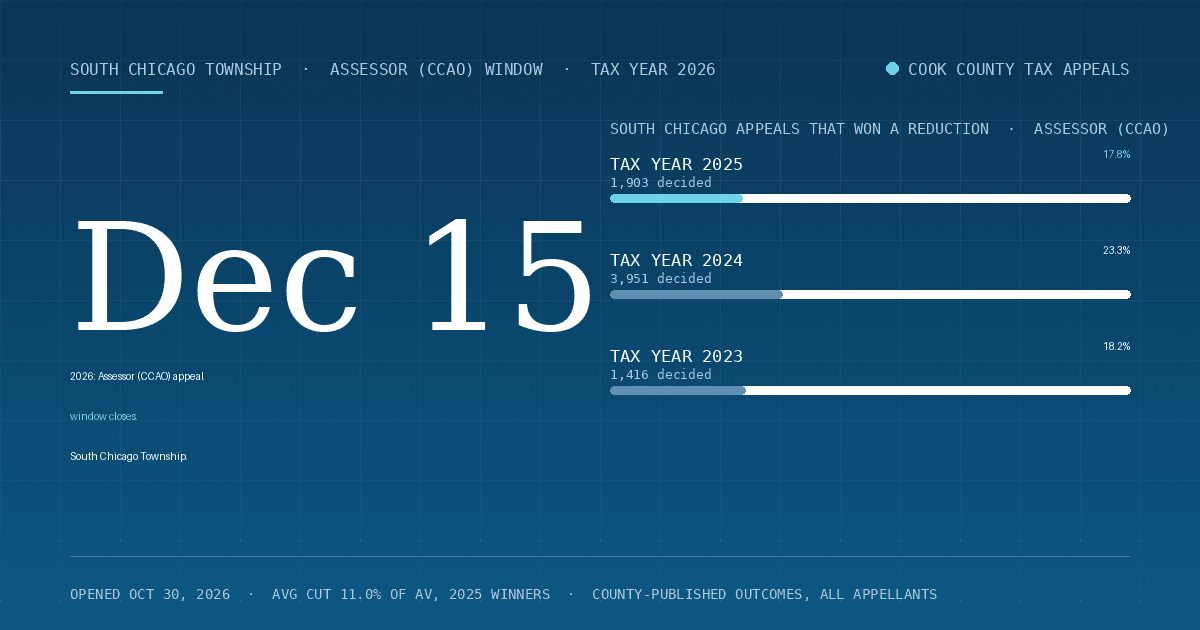
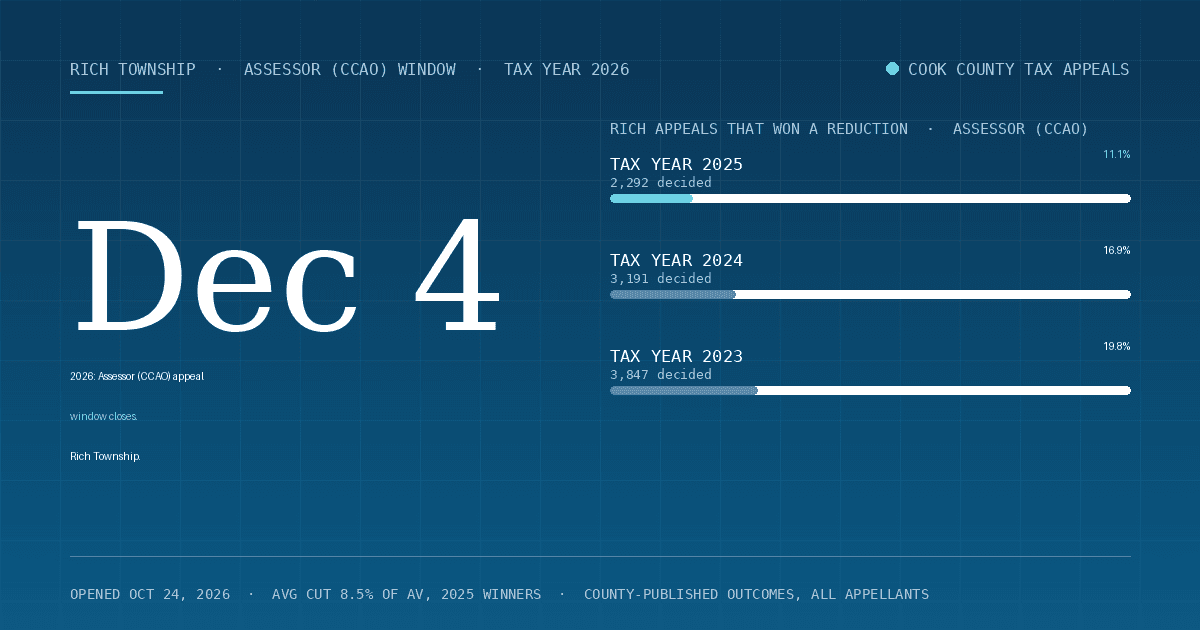
- The window is short — several weeks (42 to 47 days in 2026) from when Lemont "opens." The last-file date is on your reassessment notice and the Assessor's Assessment & Appeal Calendar.
- Filing is free, and in practice an appeal results in either a reduction or no change.
If you own commercial or industrial property in Lemont Township — a retail center along the I-355 corridor, a light-industrial building off IL-53, a mixed-use property in the village of Lemont — 2026 is the year that matters most. It's a reassessment year, and the value the Assessor sets now will drive your tax bills until the next reassessment in 2029.
01 · Why 2026 mattersWhy a reassessment year hits commercial owners hardest
Cook County reassesses on a three-year triennial cycle. Lemont sits in the south and west suburban triad, reassessed in 2026 alongside Worth, Stickney, Orland, Lyons, Oak Park, and the other south/west townships. The next scheduled reassessment is 2029.[1]
For commercial property, the stakes in a reassessment year are higher than for homes, for two reasons. First, the dollar amounts are larger, so a percentage error translates into a bigger number on the bill. Second, the value is built from income assumptions — and when the Assessor revalues the whole triad at once, those assumptions are applied broadly rather than tuned to your specific building. The figure that comes out doesn't reset each year; as the Assessor's office explains, an increased assessment that isn't successfully contested raises your tax for the reassessment year and the years that follow within the triennial.[3]
The point most owners miss
A commercial assessment that's too high in a reassessment year compounds across three years of bills. Catching it in 2026 — rather than waiting — is the difference between correcting one bill and correcting the whole cycle.
02 · The income approachHow Lemont commercial property is valued
Homes are valued mostly on comparable sales. Commercial and industrial property is different: Cook County generally uses an income approach. The Assessor estimates what your property earns — based on its use, market rent, vacancy and collection loss, and operating expenses — to arrive at net operating income, then applies a capitalization rate to convert that income into a value.
That makes a commercial appeal fundamentally different from a residential one. You're usually not arguing "the market went down." You're demonstrating that the Assessor's income assumptions for your specific property don't match how it actually performs. Every input is a place the value can be overstated:
Income-approach inputs — where an assessment goes wrong
| Input the Assessor uses | How it can overstate your value |
|---|---|
| Market rent (per sq ft) | Assumed rent is higher than your actual leases |
| Vacancy / occupancy | Assumes fuller occupancy than the building runs |
| Collection loss | Ignores tenants behind on rent or in default |
| Operating expenses | Understates costs, inflating net income |
| Capitalization rate | A cap rate set too low inflates the value |
Different property types lean on different inputs. A multi-tenant retail or industrial building turns on rent and vacancy. A single-tenant or owner-occupied building turns on market rent and the cap rate. Specialty properties — gas stations, motels, bowling alleys, event spaces, golf courses — are harder to value with generic assumptions, which is exactly why their assessments are worth a close look in a reassessment year.
Even a "no change" is worth reviewing
If your assessment didn't change in the reassessment, that's not proof it's right. If your building's income has fallen, occupancy has dropped, or comparable properties are assessed lower, a flat assessment can still be too high — and still worth appealing.
03 · What winsWhat actually wins a Lemont commercial appeal
Commercial appeals are won on documentation, not frustration. The strongest evidence is the financial record of the property itself, supported by how comparable properties are valued:
Commercial — evidence that wins vs. rarely helps
| Evidence that wins | Evidence that rarely helps |
|---|---|
| Rent roll showing actual rents | "My taxes went up too much" |
| Signed leases below assumed market rent | General complaints about the economy |
| Income-and-expense statements | Your business's profitability |
| Real vacancy and collection-loss figures | Comparison to a different township |
| Assessments of comparable commercial properties | Sentiment without supporting numbers |
Documentation is the difference
Residential appeals can win on comparables alone. Commercial appeals usually require your financials — rent rolls, income-and-expense statements, and leases. The owners who assemble that package early, before the window opens, tend to fare best.
Pre-register your Lemont commercial property and we'll file the moment your window opens.
Lemont's 2026 Assessor window closed September 29, 2026; the Board of Review's Lemont window comes next, after the Assessor certifies the township. Pre-register once, and the day Lemont opens, our team builds the income-approach case from your rent roll and operating statements and files on your behalf. $0 upfront. 25% of first-year savings, only if your assessment is reduced.
04 · The deadline & how to fileThe Lemont deadline and how to file
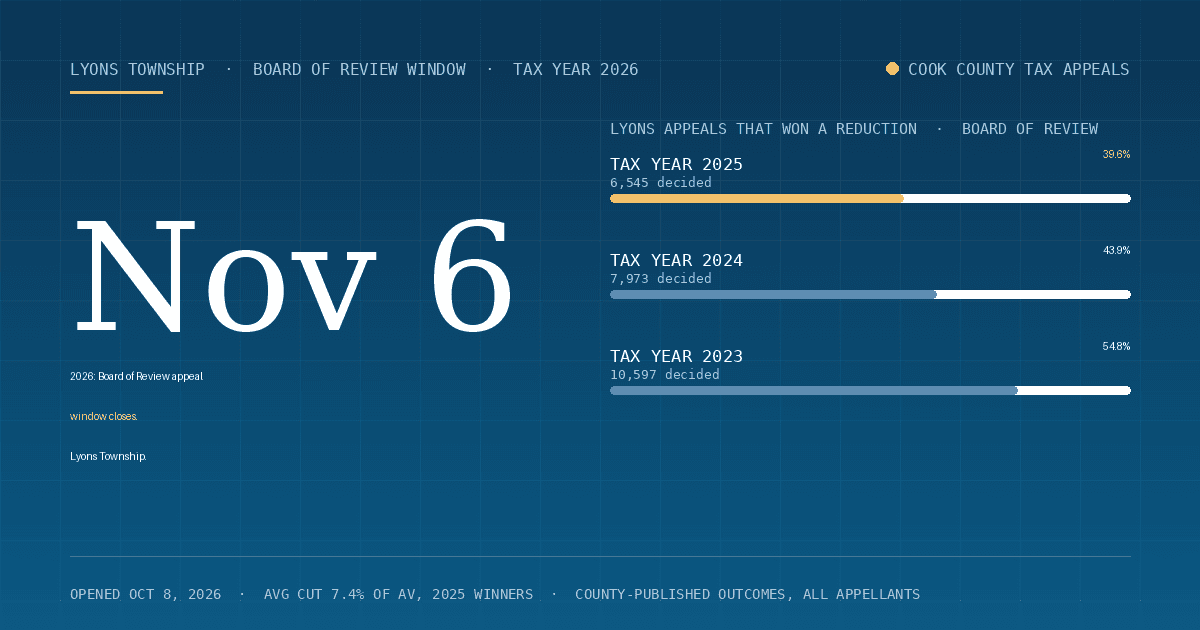
There is no single fixed date each year. Cook County opens appeal windows township by township on a rolling schedule, each Assessor window lasting several weeks (42 to 47 days in 2026). For 2026, south and west suburban owners began receiving reassessment notices in late April, and each township's filing deadline is published as it opens.[2] The reliable place to confirm your date is the Assessor's Assessment & Appeal Calendar, and the deadline is printed on your reassessment notice.
How the Lemont 2026 window works
Filing your commercial appeal step by step
Pull your assessment and PIN
Confirm the proposed 2026 value and the characteristics the Assessor has on record for the parcel — square footage, use class, and building details. Errors here alone can support a reduction.
Check Lemont's window
Confirm Lemont's "open" and "last file" dates on the Assessment & Appeal Calendar, or read the deadline on your reassessment notice.
Assemble your income evidence
Gather your rent roll, signed leases, and a recent income-and-expense statement. These let you show the Assessor's assumed rent, vacancy, or expenses don't match reality.
File with the Assessor before the last-file date
Submit through the Assessor's SmartFile online portal during Lemont's open window, stating clearly why the income-based value is too high and attaching your financials.
File again with the Board of Review
The Board of Review is independent and opens after the Assessor's window. Commercial owners often gain ground here even after a limited reduction — or none — at the Assessor.
Late filings are not accepted
The Assessor and Board of Review do not grant extensions. Once Lemont's window closes, that's it for the year — and in a reassessment year, missing it means living with the new value through 2029. Confirm your date early and have your financials ready before the window opens.
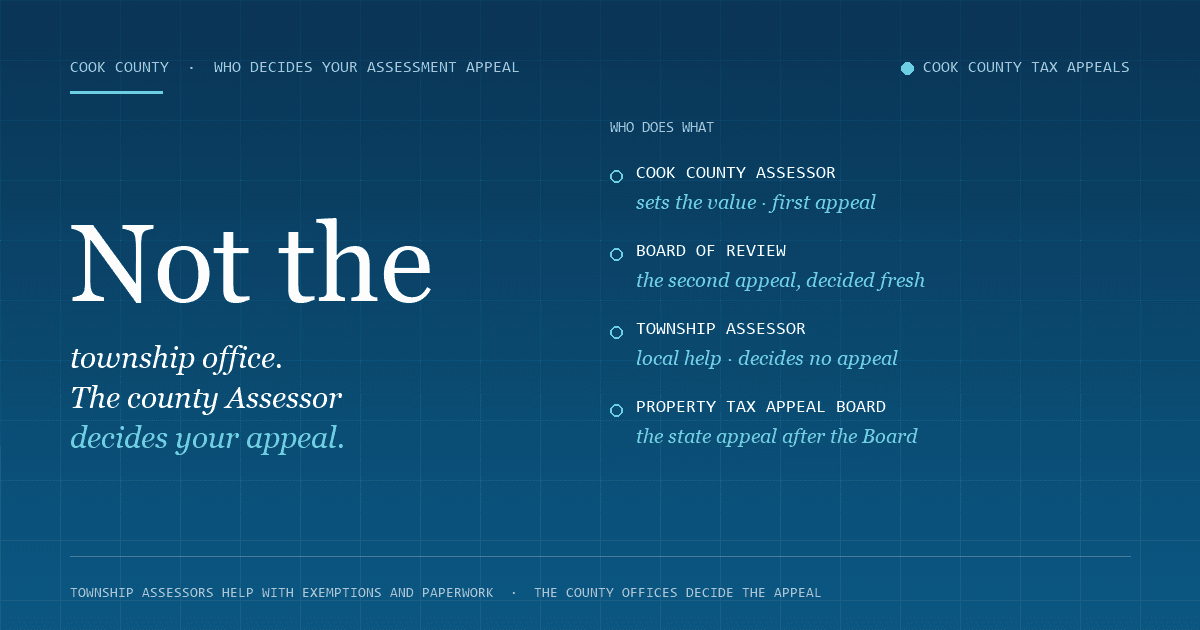
Check the Cook County Assessor's Assessment & Appeal Calendar at cookcountyassessoril.gov under "Assessment Calendar and Deadlines," or read the last page of your reassessment notice. The Board of Review window opens separately, after the Assessor's closes. For larger disputes, the Illinois Property Tax Appeal Board (PTAB) remains available after the Board of Review.
05 · Working with usWorking with us on a Lemont commercial appeal
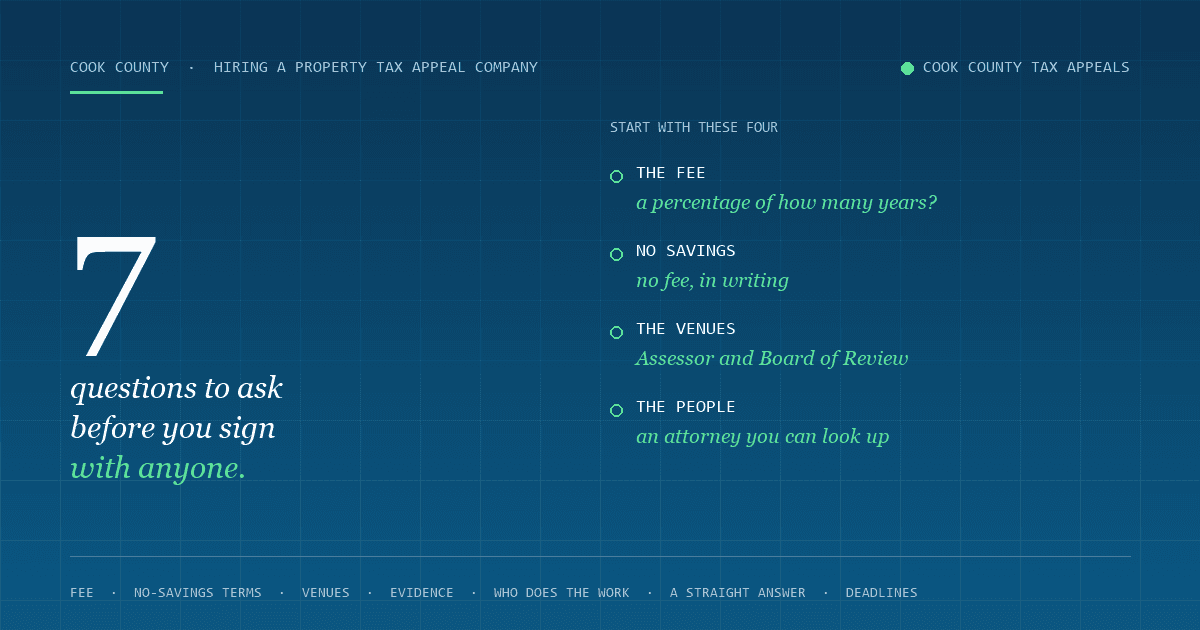
Commercial and industrial appeals reward experience with the income approach and with how the Assessor and Board of Review weigh financial evidence. We review your rent roll and operating statements against the Assessor's assumptions, build the comparable and cap-rate case, and file at both the Assessor and the Board of Review — then escalate to PTAB if the numbers justify it.
We work on contingency: no upfront cost, and we're paid a share of the savings only if the appeal reduces your bill. If your assessment is already fair, the honest answer is to tell you so — and we will.
Frequently asked questions
When is the Lemont Township commercial appeal deadline in 2026?+
How is commercial property valued in Lemont?+
What evidence should I submit for a commercial appeal?+
Why does 2026 matter more than other years for Lemont commercial owners?+
Can I appeal if my commercial assessment didn't change?+
Will appealing raise my assessment?+
What does a commercial appeal cost?+
How long does the appeal process take?+
File in 2026 — it sets your Lemont commercial assessment through 2029
A reassessment year is the single best opportunity to correct an over-assessed commercial property, because the income-based value gets locked in for three years. Cook County Tax Appeals builds the income-approach case from your financials, files across all three tiers (Assessor, Board of Review, and PTAB), tracks Lemont's deadline so you never miss the short filing window, and charges nothing upfront. Our fee is 25% of first-year savings, only if your assessment is reduced.
Sources & verification
Reassessment cycle, the income approach, deadlines, and assessment methods are drawn from the Cook County Assessor's Office. Filing deadlines are set by the Cook County Assessor and Board of Review — always confirm your window before filing.
- Cook County Assessor's Office. "Learn about Reassessments" — 2026 reassessment of the south and west suburbs. cookcountyassessoril.gov/valuation-reports
- Cook County Assessor's Office. "Assessment & Appeal Calendar and Deadlines." cookcountyassessoril.gov
- Cook County Assessor's Office, on the triennial cycle — an uncontested increase raises taxes for the reassessment year and the subsequent years within the triennial.
Lemont commercial is reassessed in 2026. This is the year to get it right.
The income-based value set this year drives your Lemont commercial bill through 2029. We build the case from your rent roll and operating statements, handle all three appeal tiers (Assessor, Board of Review, PTAB), and track your township's short filing window. $0 upfront. 25% of first-year savings, only if your assessment is reduced.