Lake Township Property Tax Appeal Results
In Lake Township in 2025, 502 of 3,859 homeowner appeals ended with a change — a 13.0% success rate, counting each appeal once. Residential classes drove the volume, but commercial and industrial property won at far higher rates. Winning homeowner appeals cut assessed value by about 12.2% on average, evidence that a well-supported appeal can still matter even when most filings don't move.
- 502 of 3,859 Lake Township homeowner appeals won a change — a 13.0% success rate, counting each appeal once (14.8% across all property types).
- Winning homeowner appeals cut assessed value about 12.2% on average; the typical (median) cut was about $2,070.
- Property class shapes the odds: commercial classes like 5-17 (one-story commercial) hit 35.2% and mixed-use (2-12) reached 32.6%, far above the residential classes that drove most of the volume.
- The biggest categories were residential — one-story homes (2-03), small apartment buildings (2-11), and smaller one-story homes (2-02) — clustered well below the commercial classes.
- Most appeals didn't win, but the ones that did cut assessed value enough to lower future tax bills.
What the Lake Township numbers show
This review looks at how property tax appeals turned out across Lake Township, Cook County, spanning residential, multi-family, commercial, and industrial property classes. In Cook County, different property classes follow different assessment rules and appeal patterns — which is exactly why township results vary so much by property type.
For this analysis, a "successful" appeal is any one marked Change — meaning the Assessor adjusted the assessed value after review. A "No Change" result means the value stayed the same.
| Metric | Result |
|---|---|
| Homeowner appeals (each appeal counted once) | 3,859 |
| Successful appeals (marked "Change") | 502 |
| Homeowner success rate | 13.0% |
| Average cut, winning homeowner appeals | ~12.2% |
| Typical (median) cut, winning homeowner appeals | $2,070 |
Overall appeal success rate
Counting each appeal once (a condo building's units, decided together, are one appeal), 502 of 3,859 Lake Township homeowner appeals ended with a "Change" — a 13.0% success rate; across all property types, 673 of 4,543 (14.8%). Most appeals did not produce a change, but a meaningful share did, and even a single successful appeal can lower assessed value enough to affect future tax bills.
That's the practical point: even when the overall rate isn't high, the upside can still matter, because a value change feeds directly into what you pay. The deciding factor is filing a strong appeal with the right support for your property's situation — which is why it pays to review your assessment carefully before deciding whether to file.
Success rate by property class
Outcomes weren't uniform across property types. Cook County class codes identify the property type: many Class 2 codes are residential homes and small residential buildings, Class 3 covers larger multi-family apartments, and Class 5 covers commercial and industrial property. Lake Township's appeal volume was dominated by residential, but commercial and industrial classes posted the strongest success rates.
| Class | What it generally represents | Appeals | Success |
|---|---|---|---|
| 2-03 | One-story residence, 1,000–1,800 sq ft | 1,332 | 11.8% |
| 2-11 | Apartment building, 2–6 units | 784 | 14.9% |
| 2-02 | One-story residence, up to 999 sq ft | 568 | 12.9% |
| 2-05 | Older two+ story, up to 2,200 sq ft | 402 | 8.5% |
| 5-17 | One-story commercial building | 199 | 35.2% |
| 5-90 | Commercial minor improvement | 106 | 30.2% |
| 2-06 | Older two+ story, 2,201–4,999 sq ft | 243 | 9.5% |
| 5-93 | Industrial building | 103 | 23.3% |
| 5-80 | Industrial minor improvement | 45 | 28.9% |
| 2-34 | Split-level residence | 130 | 12.3% |
| 2-12 | Mixed-use, ≤6 units, under 20,000 sq ft | 92 | 32.6% |
| 3-15 | Corridor apartments, 2–3 story | 109 | 14.7% |
| Other | All other classes combined | 656 | 18.4% |
The standouts were commercial and industrial. Class 5-17 (one-story commercial) won 35.2% of its appeals, mixed-use (2-12) reached 32.6%, and commercial and industrial improvement classes (5-90, 5-93, 5-80) landed between about 23% and 30% — well above the residential classes that made up most of the volume. The largest single category, one-story homes (Class 2-03) with 1,332 appeals, won 11.8%, below the 13.0% homeowner rate. Each appeal is counted once in the table, so a multi-parcel filing counts one time.
The likely reason for the gap: commercial and income properties often hinge on income, expense, and vacancy evidence that can clearly support a lower value, while residential mass-appraisal values are harder to move without strong comparable sales. The takeaway isn't "don't appeal a home" — it's that the evidence you bring is what decides the outcome.
What happened to assessed values
A change is only meaningful if value actually comes off. Among Lake Township homeowner appeals that won, assessed value fell about 12.2% on average (about $3,600); the typical (median) cut was about $2,070.
Why it matters: your assessed value is a core input to your property tax bill. When it goes down, your share of the local tax burden can go down too — even though tax rates and local budgets also affect the final number. A lower final value doesn't translate one-for-one into the same percentage drop in taxes, but it can still move an owner into a better position.
Most Lake Township homeowner appeals (about 87%) ended in no change. The opportunity is real but earned: when an appeal succeeds, the value reduction feeds directly into future tax bills — so a careful look at your assessment and comparables before filing is what separates a reduction from a wasted filing.
What these results mean for owners
Three takeaways from the Lake Township numbers:
- Not every appeal leads to a change. The strength of your evidence matters — a realistic expectation going in helps.
- Commercial, industrial, and mixed-use categories had clearly stronger outcomes in this set, which may reflect how values are reviewed for income-producing property types.
- A reduction doesn't have to be huge to matter. Over time, even moderate reductions can help protect cash flow.
The smartest next step is to check whether your current assessed value looks high compared to similar properties, and whether your property details are correct, before you file. Not sure where to start? See the signs your property is overassessed, or check your filing window on our deadlines page.
See if your Lake Township assessment is too high
Enter your address and we'll check your assessment against comparable Lake Township properties — no upfront cost. 25% of first-year savings, only if your assessment is reduced.
Check my assessment →Lake Township appeal FAQ
What counts as a successful appeal?
In this report, a successful appeal means the outcome was marked "Change" — the Assessor adjusted the assessed value after review. A "No Change" result means the value stayed the same.
What was the Lake Township appeal success rate?
In 2025, 502 of 3,859 homeowner appeals resulted in a change, counting each appeal once — a 13.0% success rate (14.8% across all property types). Results varied widely by property class, from about 8.5% on older two-story homes to 35.2% on one-story commercial buildings.
Which property classes performed best?
Commercial and industrial classes led: one-story commercial (5-17) at 35.2%, mixed-use (2-12) at 32.6%, and commercial and industrial improvement classes (5-90, 5-93, 5-80) between about 23% and 30%. The largest residential class, one-story homes (2-03), won 11.8%.
How much did assessed values drop on average?
Among homeowner appeals that won, assessed value fell about 12.2% on average; the typical (median) cut was about $2,070. A lower final value can reduce the taxable value tied to a property, depending on the rest of the local tax calculation.
Where do I file a Lake Township appeal?
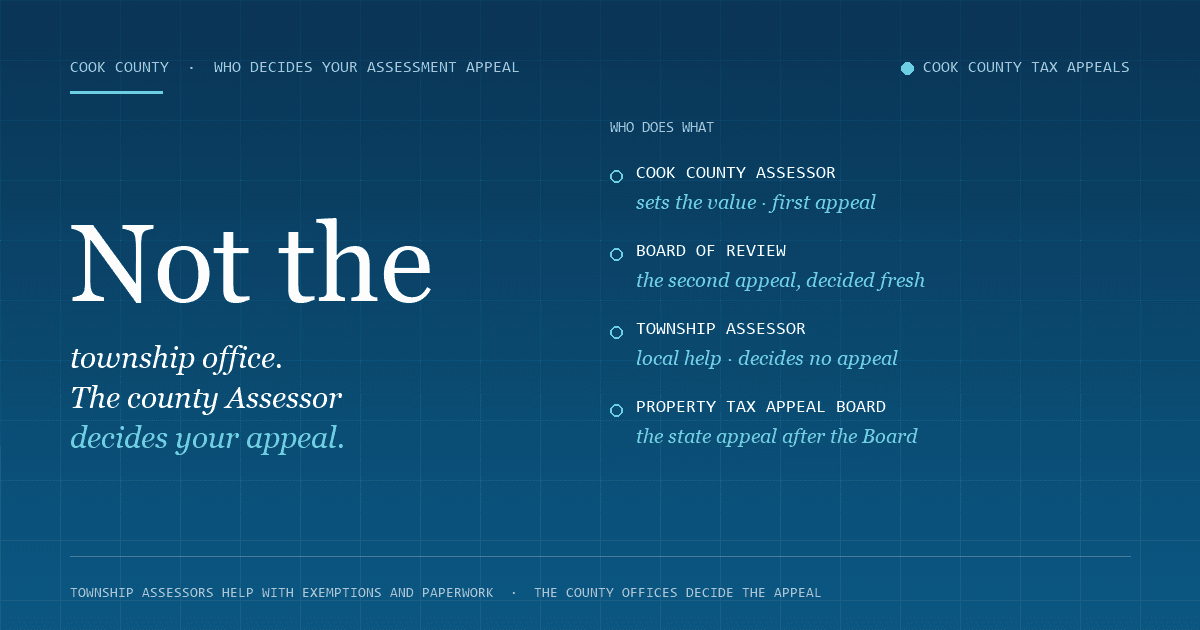
You file through the Cook County Assessor's online appeals system when your township's window is open. The Cook County Board of Review is a separate step with its own deadlines, and you can file there even if the Assessor declined. Check the Assessor or Board of Review, or our deadlines page, for current dates.
What evidence usually helps a Cook County appeal?
Common evidence includes comparable sales, income and expense information for income-producing properties, and corrections to inaccurate property characteristics such as square footage or unit count.
This article summarizes Cook County appeal outcomes for Lake Township by property class and is general information, not legal or tax advice. Figures are drawn from Cook County appeal data; individual results depend on the property and the evidence presented. Filing deadlines are set by the Cook County Assessor and Board of Review — always confirm your window before filing. Representation is subject to a written engagement agreement.