Hyde Park Commercial Property Tax Appeal — Your Income Is the Argument
For the mixed-use buildings of Hyde Park and Kenwood, the retail of Woodlawn and South Shore, and the industrial and specialty property across the township's South Side community areas, the most powerful appeal isn't about square footage — it's about what the property earns. Hyde Park was reassessed in 2024, and the data shows 48.7% of commercial appeals won a reduction, counting each appeal once, typically about $22,900 off the assessed value.
(2024 reassessment)
AV reduction
(2024)
cycle
These figures cover appeals decided on similar buildings, from the Assessor's and the Board of Review's public records. They are not our firm's results, and past results do not guarantee a similar outcome.
The Short Version
- Income property is valued on what it earns. Your rent roll, expenses, vacancy, and the right capitalization rate are the core of a strong commercial or industrial appeal.
- Hyde Park commercial owners in the 2024 reassessment: 48.7% of commercial (Class 5) appeals won a reduction — 366 of 752, counting each appeal once — typically about $22,890 off the assessed value.
- Industrial led. Industrial-style property (Class 5-93) won 65.4%, broad commercial (5-17) won 51.9%, and apartment buildings (3-15) 48.9%.
- Hyde Park was reassessed in 2024 (City of Chicago triad, next 2027), so its values are set for the cycle — but you can appeal every year, not just in reassessment years.
- Commercial property is assessed at 25% of market value (versus 10% for homes), so an inflated value costs more — and a reduction is worth more.
Hyde Park Township covers the South Side lakefront — Hyde Park, Kenwood, Woodlawn, South Shore, South Chicago, and more — a dense mix of mixed-use buildings, retail corridors, apartment stock, and specialty and institutional property. Commercial and industrial owners here face a different reassessment math than homeowners: income property is assessed at a higher level (25% of market value vs. 10% for homes) and its value is driven by economics. That's both where over-valuations appear and where a well-documented appeal does the most good.
01 · Your income is the argumentHow Hyde Park commercial property is valued
Homes are valued mostly on comparable sales. Commercial and industrial property is different — Cook County generally uses the income approach, estimating value from the net income a property can generate. That's good news for owners, because your appeal can rest on hard financial evidence rather than subjective comparisons. The core inputs:
- Actual rents (the rent roll). If your building earns less than the Assessor assumed — below-market leases, concessions, or older rents — that gap supports a lower value.
- Operating expenses. Real expense levels reduce net income, and net income drives value.
- Vacancy and collection loss. Genuine vacancy or unpaid rent lowers effective income.
- Capitalization rate. The rate used to convert income into value matters enormously; the right cap rate for your property type and risk can move the number significantly.
02 · What the data showsWhat the 2024 reassessment showed
Hyde Park was reassessed in 2024, and the appeal results are the clearest guide to what works. Among commercial (Class 5) properties, 48.7% of appeals won a reduction — 366 of 752, counting each appeal once (a filing for several parcels is one appeal) — with a typical (median) winning cut of about $22,890 in assessed value. The strongest results came from the income-heavy classes:
| Class | What it generally represents | Appeals | Success |
|---|---|---|---|
| 5-17 | Commercial — office, retail, warehouse, mixed | 376 | 51.9% |
| 5-93 | Industrial-style / special-use property | 133 | 65.4% |
| 5-97 | Commercial with apartments | 42 | 42.9% |
| 3-15 | Apartment building, 7+ units | 591 | 48.9% |
These figures cover appeals decided on similar buildings, from the Assessor's and the Board of Review's public records. They are not our firm's results, and past results do not guarantee a similar outcome.
The pattern is consistent with the income approach: where owners documented real economics — rents, expenses, vacancy — values moved, and they moved most for the industrial and larger commercial parcels. Apartment buildings (Class 3-15) were a large, robust group too, winning 48.9% across 591 appeals.
03 · What it's worthWhat a reduction is worth
Hyde Park's composite tax rate runs around 6.6% — lower than the suburbs, as City of Chicago rates generally are. Combined with the higher 25% assessment level on commercial property, a reduction still produces real savings:
Illustrative estimate using Hyde Park's state equalization factor and composite rate. At the 2024 typical winning commercial cut of about $22,890, the annual saving would be roughly $4,590. Excludes exemptions; figures vary by tax code. Our fee: 25% of first-year savings, only if your assessment is reduced.
04 · What winsWhat wins a commercial appeal
Commercial appeals are won on documentation, not frustration. The strongest evidence is the financial record of the property itself, supported by how comparable properties are valued:
- A complete income-and-expense package. Rent roll, leases, and operating statements that show the property's true net income.
- Vacancy and collection evidence. Documentation of real vacancy, concessions, or uncollected rent.
- The right capitalization rate. Support for a cap rate appropriate to your property type, location, and risk.
- Comparable evidence where useful. Sales or assessments of similar income properties to reinforce the income conclusion.
Most commercial appeals rest on two arguments, often combined: overvaluation (the Assessor's market value is too high for your income) and lack of uniformity (comparable nearby properties are assessed at lower values). Because commercial cases are evidence-heavy, the Board of Review's second window can matter even more than for homes — it's a separate, independent review if the Assessor doesn't move.
05 · Appeal every yearYou can appeal every year — the 2026 window closed October 8
Hyde Park was reassessed in 2024, so its values are generally set until the next reassessment in 2027. But the right to appeal isn't limited to reassessment years — Cook County lets you challenge your assessed value every year. For commercial property, the off-years are often the best time to act: you now have a full year or two of post-reassessment operating data showing how the property actually performs against the Assessor's model. Hyde Park's 2026 Assessor window ran August 26 to October 8; track the township's next window, the Board of Review's included, on our deadlines page.
06 · How to fileHow to file a commercial appeal
- Pull your PIN and current assessed value from the Cook County Assessor's website or your most recent notice — confirm square footage, use class, and building details.
- Assemble your income documentation — a trailing-12 rent roll, signed leases, and a recent income-and-expense statement, plus cap-rate support and condition photos where relevant.
- Confirm your window on our deadlines page — Cook County opens townships on a rolling schedule, and the windows are short.
- File with the Assessor, then plan for the Board of Review window if the Assessor doesn't lower your value. For larger disputes, the Illinois Property Tax Appeal Board (PTAB) remains available after the Board of Review.
Have Your Hyde Park Commercial Assessment Reviewed
We'll review your assessment against your property's real income and comparable buildings, with no upfront cost. 25% of first-year savings, only if your assessment is reduced. Enter your address or PIN to get started and check your current window.
Check My AssessmentHyde Park Commercial Appeal FAQ
How is commercial and industrial property valued for taxes?
Cook County generally uses the income approach — estimating value from the net income a property generates, based on rents, expenses, vacancy, and a capitalization rate. Commercial and industrial property is also assessed at 25% of market value, versus 10% for homes.
How did commercial appeals do in Hyde Park's 2024 reassessment?
48.7% of commercial (Class 5) appeals won a reduction — 366 of 752, counting each appeal once — typically about $22,890 off the assessed value. Industrial-style property (Class 5-93) won 65.4%, broad commercial (5-17) 51.9%, and apartment buildings (3-15) 48.9% across 591 appeals.
Can I appeal if 2026 isn't a reassessment year for Hyde Park?
Yes. Hyde Park is in the City of Chicago triad, reassessed in 2024 and again in 2027. But Cook County allows an annual appeal every year, and for commercial property the off-years are often the best time to file — you have real operating data to test the Assessor's assumptions. Hyde Park's 2026 Assessor window ran August 26 to October 8, 2026; the Board of Review's Hyde Park window comes next.
Why are commercial properties assessed higher than homes?
In Cook County, commercial and industrial property is assessed at 25% of market value, while residential property is assessed at 10%. That higher ratio means businesses carry a larger share of the tax burden — and that an inflated commercial value costs more.
What evidence wins a commercial appeal?
A complete income-and-expense package (trailing-12 rent roll, signed leases, operating statements), documentation of vacancy or collection loss, support for the right capitalization rate, and comparable sales or assessments where useful. Photos of deferred maintenance or functional obsolescence can persuade where numbers alone don't.
What's the difference between the Assessor and the Board of Review?
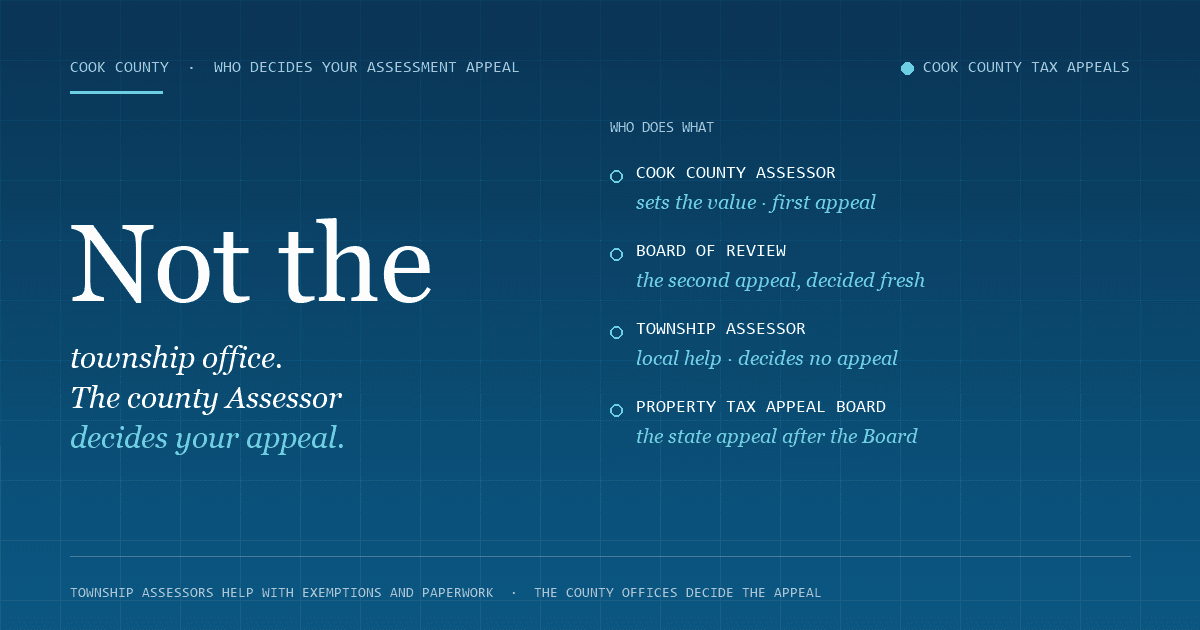
The Assessor sets the assessment and hears the first-level appeal. The Board of Review is a separate agency that re-reviews the assessment independently, on its own township schedule. Many commercial owners file at both levels, and frequently gain additional ground at the Board of Review.
Data & Sources
- Reassessment cycle: Hyde Park Township (code 70) is in the City of Chicago triad, reassessed in 2024 (next 2027). Its 2026 Assessor window ran August 26 to October 8, 2026; annual appeals are available every year.
- 2024 commercial results: Cook County Assessor Appeals dataset (Cook County Data Catalog), Hyde Park Township, tax year 2024 — each appeal counted once (a filing for several parcels is one appeal) — commercial (Class 5) 752 appeals, 366 marked "Change" (48.7%), typical (median) reduction ~$22,890, total assessed-value reduction ~$25.2 million. Class detail: commercial (5-17) 51.9% on 376 appeals; industrial-style (5-93) 65.4% on 133; commercial with apartments (5-97) 42.9% on 42; apartment buildings (3-15) 48.9% on 591.
- Assessment level and formula: Illinois Property Tax Code — commercial and industrial property assessed at 25% of market value; bill = assessed value × state equalization factor × local tax rate − exemptions.
- Tax-saving estimates use Hyde Park's state equalization factor (3.0355 for the 2024 tax year) and a representative composite rate (~6.6%); estimates exclude exemptions and vary by tax code. All data is public and county-wide; no firm-specific results are stated.
Keep Reading
This article covers commercial property tax appeals in Hyde Park Township, Chicago, Cook County, and is general information, not legal or tax advice. Results figures are drawn from public Cook County Assessor appeal data for tax year 2024; individual results depend on the property and the evidence presented. Tax-saving figures are estimates that exclude exemptions and vary by tax code. Filing windows are set by the Cook County Assessor and Board of Review and change through the year — always confirm your current deadline before filing. Representation is subject to a written engagement agreement.