Property taxes in Cook County are based on the assessed value of your property. If you believe that value is too high, the Cook County Assessor's appeal process is your first and most efficient opportunity to challenge it — before the bill is ever calculated.
01 · OverviewUnderstanding the Assessor's appeal process
The Cook County Assessor's Office (CCAO) sets the assessed value for every property in the county. Residential property is assessed at 10% of fair market value; commercial and industrial property is assessed at 25%. That assessed value is the foundation your entire tax bill is built on, so an inflated assessment quietly inflates everything that follows.
The Assessor stage is the first of two independent appeal opportunities each year. It applies to both residential and commercial property and is handled directly through the Assessor's Office — no hearing, no courtroom, just an evidence-based review. If you're not satisfied with the result, a second, separate appeal is available at the Cook County Board of Review.
Appeals are not automatic. You must file during your township's open appeal window and submit evidence that supports a lower value. Filing is free, and you are not required to hire an attorney or agent to file at the Assessor level.
The key idea
You can't appeal your tax bill directly — but you can appeal the assessed value that drives it. Fixing an over-assessment early, at the Assessor stage, is the cleanest way to bring that bill back down to fair.
02 · TimingWhen you can file an appeal
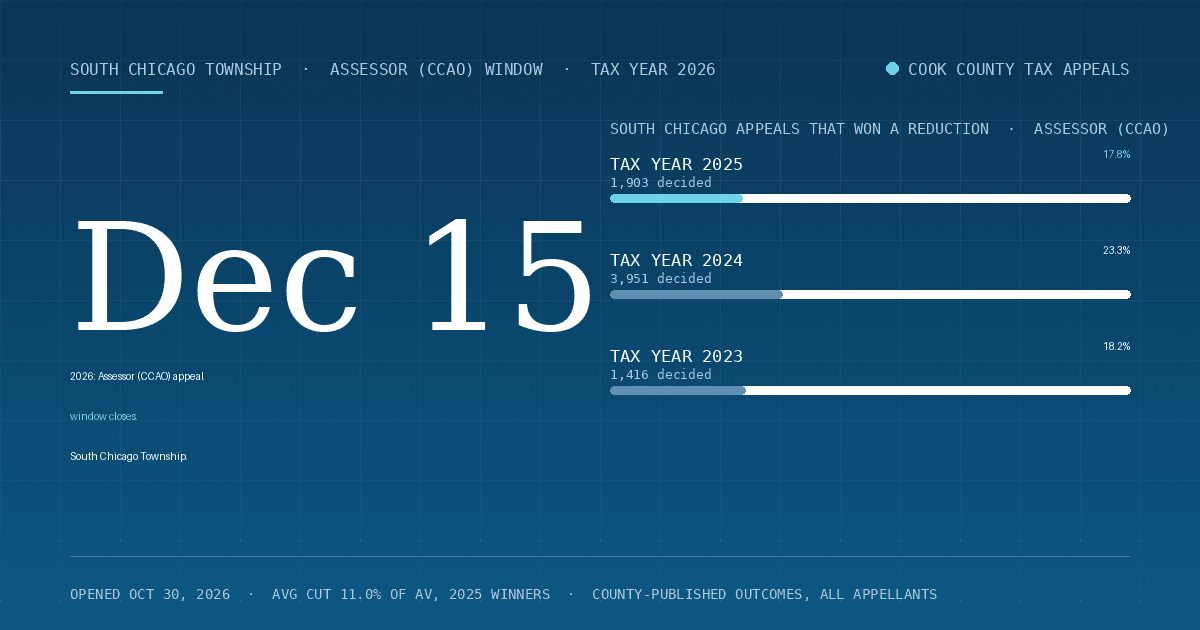
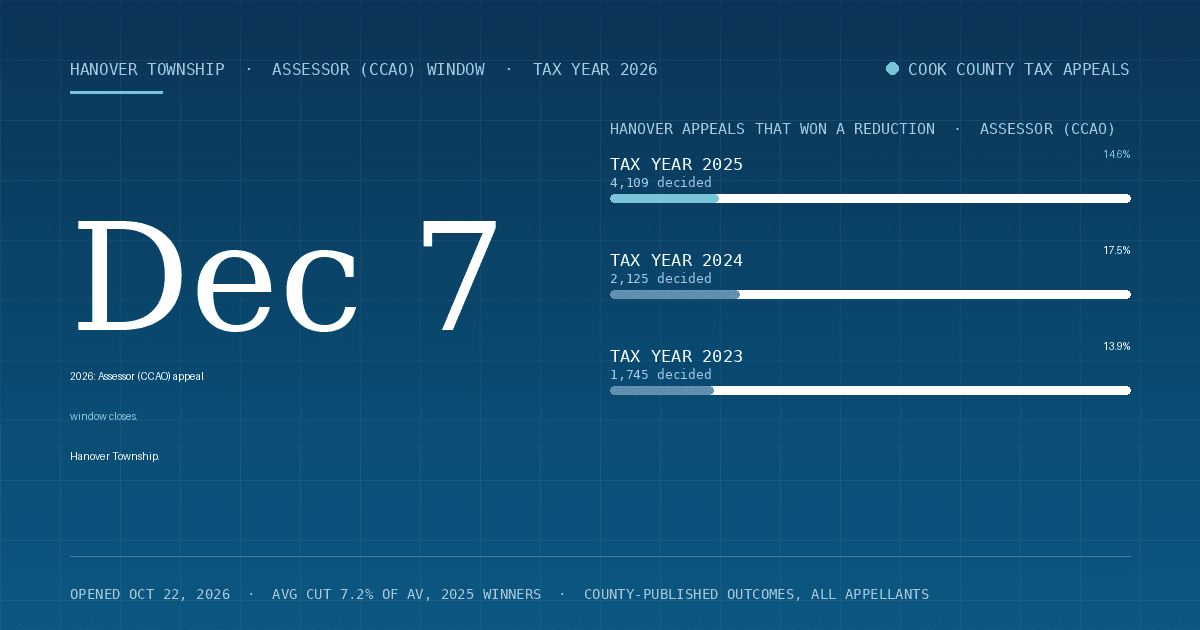
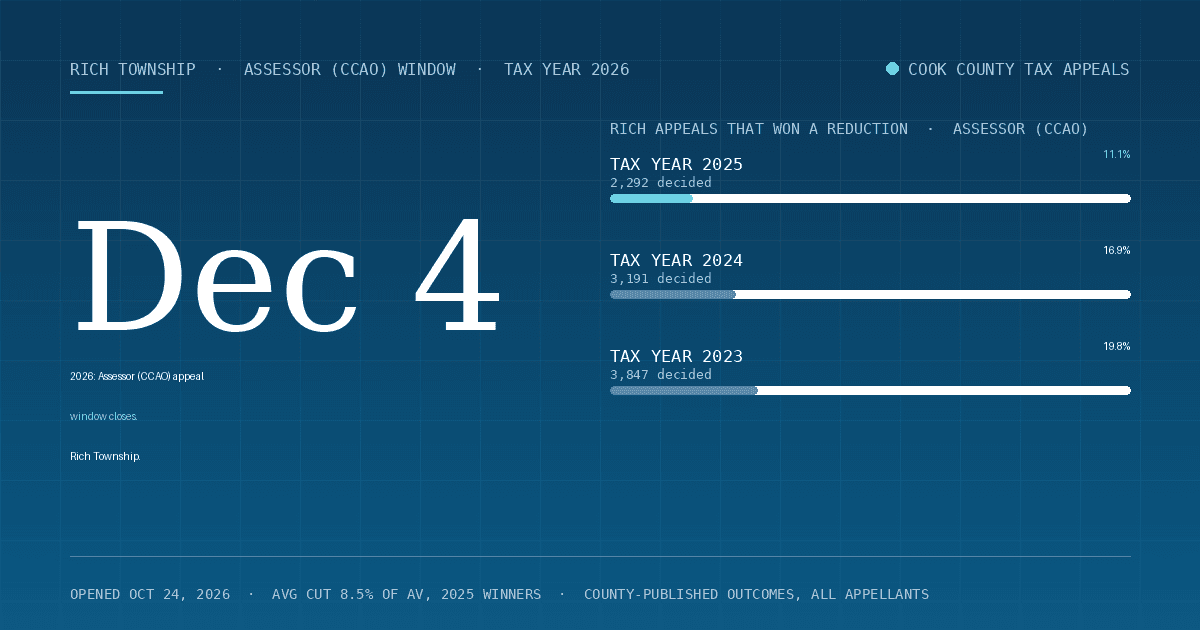
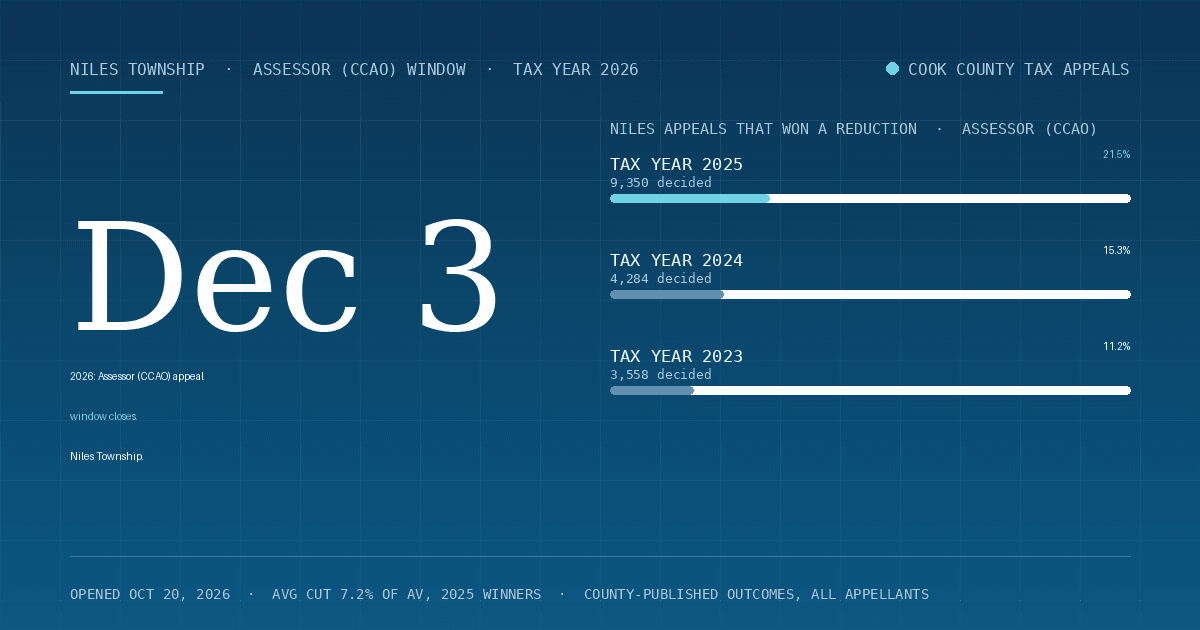
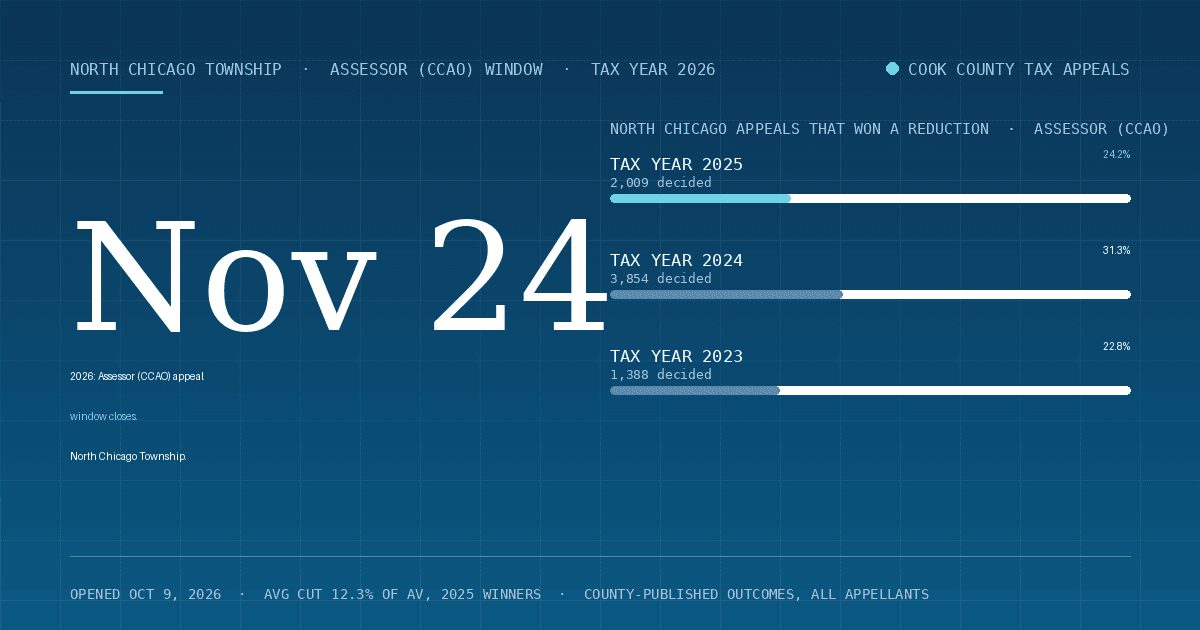
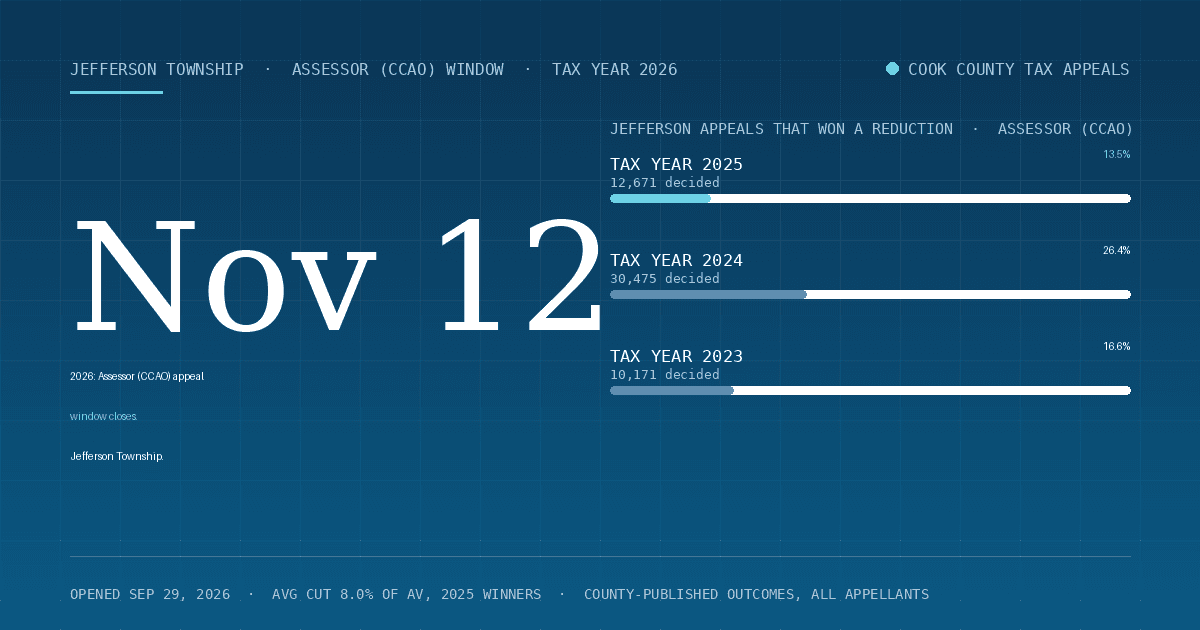
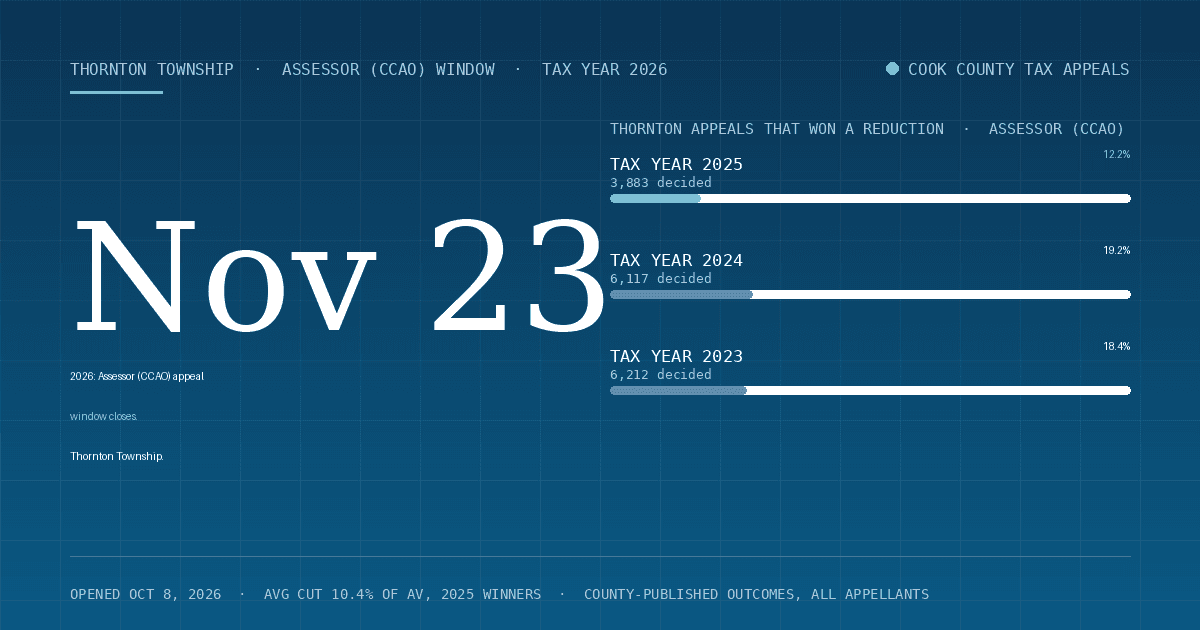
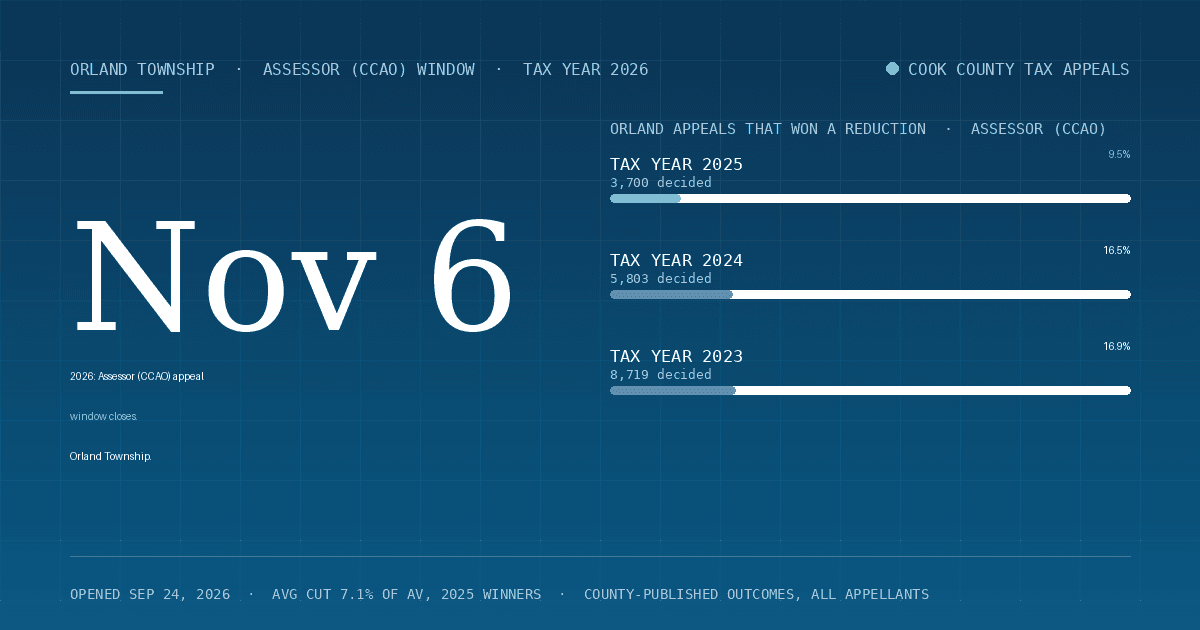
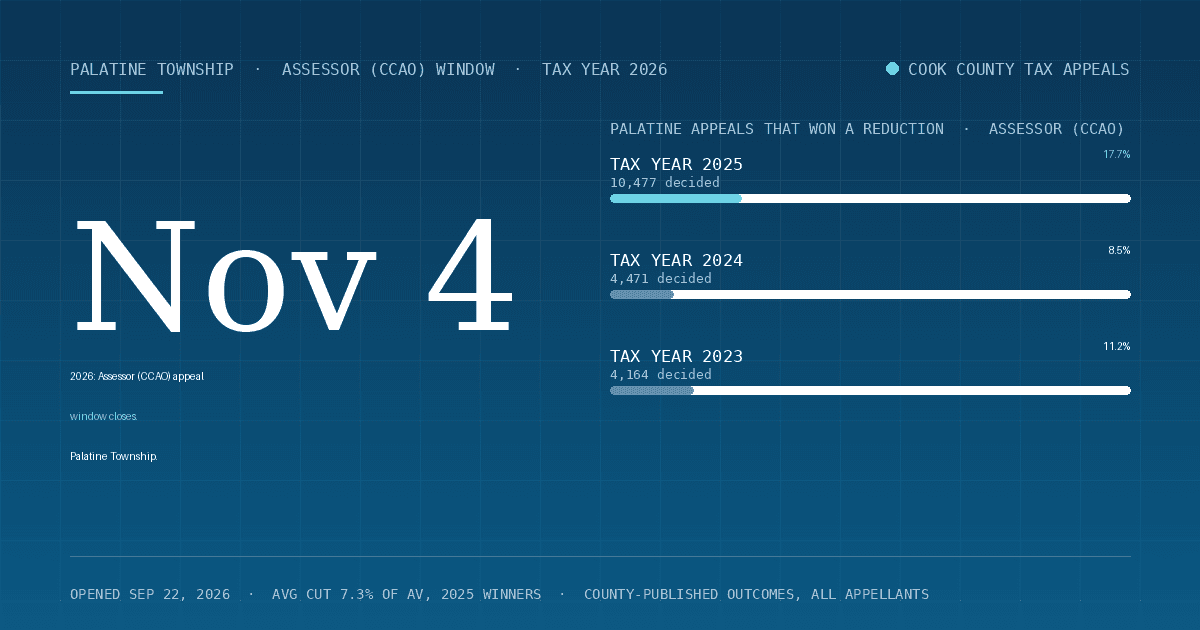
The Assessor opens appeals township by township on a rotating schedule throughout the year. Each township gets a window of several weeks (42 to 47 days in 2026), which opens shortly after reassessment notices are mailed. The last date to file is printed directly on your notice.
You can only file during your township's open period. Miss it, and you'll either wait for the Board of Review window later that year or appeal the following year when your township reopens. Because Cook County reassesses on a three-year (triennial) cycle but Illinois law lets you appeal every year, you never permanently lose the right to challenge an over-assessment — but every year you skip is a year you pay the higher bill.
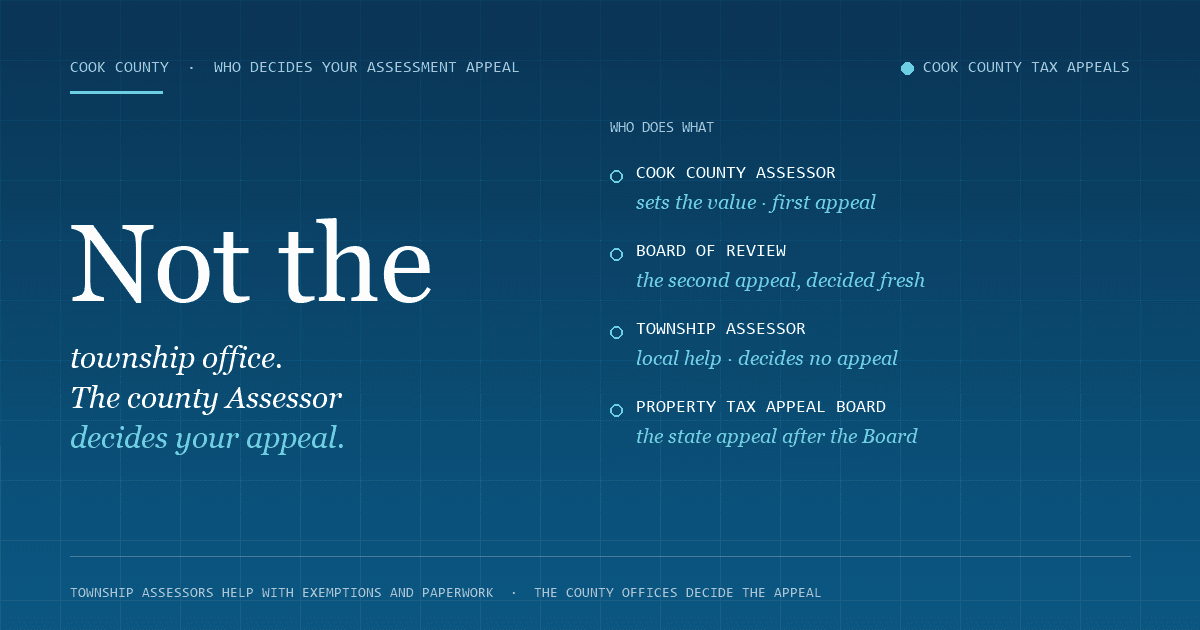
The two-stage appeal year, at a glance
Assessor (CCAO)
The first opportunity. Evidence-based review by the Assessor's analysts. This guide covers this stage.
Board of Review
A separate, independent body. You can file here even if you skipped the Assessor, or if the Assessor result fell short.
PTAB or Circuit Court
The final escalation, after a Board of Review decision — the Illinois Property Tax Appeal Board or a court tax objection.
Many property owners prepare in advance — gathering comparable properties and photos before the window opens — so they're ready to file on day one and leave room to fix any issues before the deadline.
03 · Who & whyWho can file, and the reasons that work
Any property owner in Cook County can file an appeal with the Assessor — homeowners, commercial property owners, and property managers or agents acting on behalf of owners. You don't need an attorney, though anyone filing on behalf of another owner must file online and follow the Assessor's official rules.
The reasons that actually move an assessment
Most successful appeals come down to one argument: the assessed value doesn't reflect fair market value. In practice, that shows up in three forms.
Incorrect property characteristics
Errors in your property's record inflate its value — wrong square footage, an extra bathroom that doesn't exist, a finished basement that isn't, or outdated building details. Correcting the record can lower the assessment on its own.
Lack of uniformity
Your property may be assessed higher than comparable homes nearby. The Assessor's rules require at least three genuine comparables — similar in size, class, age, and location — and they must be arm's-length, not cherry-picked. Strong comps are the single most effective tool in a residential appeal.
Decline in market value
If market conditions have shifted or recent comparable sales come in below your assessed value, your assessment may no longer be accurate. A recent appraisal (prepared within two years of the lien date) can support this.
Let us find your strongest argument.
Enter your PIN and our team identifies whether you have a characteristics, uniformity, or market-value case — then builds the evidence and files it for you. 25% of first-year savings, only if your assessment is reduced.
04 · The processStep by step: how the Assessor appeal works
From notice to decision, the Assessor appeal runs in four stages. Here's what each one involves.
Review your assessment notice
Your reassessment notice lists the value assigned to your property and the property characteristics on file. Read it carefully for errors, and compare your value to similar properties nearby. This notice also prints your last date to file — your deadline.
Gather supporting evidence
Strong appeals rest on documentation. Submit it concurrently with your appeal — the Assessor reviews what you provide, not what you promise to send later.
- At least three recent comparable properties or sales (similar size, class, location)
- Photos showing the property's condition or front elevation
- A recent appraisal, if you have one (within two years of the lien date)
- Property-record corrections, if characteristics are wrong
File during your township's window
The Assessor strongly encourages filing online through its SmartFile portal, and online filing is mandatory for anyone filing on behalf of another owner. You'll need your 14-digit Property Index Number (PIN) to begin, then select a reason for appeal and upload your documents. If you genuinely can't file online, a paper form is available — but online is faster and keeps your evidence together.
The Assessor reviews and decides
After your township's window closes, the Assessor's analysts review every appeal and its evidence, and adjust the assessed value where the evidence supports it. Decisions are typically released after all submissions for that township have been processed.
One common mistake to avoid
Homestead exemptions (homeowner, senior, etc.) are not filed through the assessment appeal process — they're handled separately. Mixing them up is one of the most common reasons a filing stalls.
05 · AfterWhat happens after the Assessor's decision
If your appeal succeeds, your assessed value drops — which can lower the property tax bill that's later calculated from it. If it's denied or only partially adjusted, you're not finished: you can file a second appeal with the Cook County Board of Review, a separate and independent body that conducts its own evidence-based review.
Many owners pursue both stages as a matter of course, because the two bodies apply different standards and a "no change" at the Assessor doesn't prevent a reduction at the Board. And if the Board of Review's decision still falls short, you can escalate to the Illinois Property Tax Appeal Board (PTAB) — within 30 days of the later of the Board's written decision or the date the Board sends its final action on your township to the Assessor — or file a tax objection in the Circuit Court of Cook County.
Tips for a stronger appeal
- Lead with comparable properties. Comps similar in size, location, age, and condition are the most persuasive evidence you can submit.
- Be clear and concise. Present the argument plainly and let the facts that support a lower value do the work.
- Check for record errors. Even small inaccuracies in the property record can move your assessment — correcting them strengthens the case.
- File early in the window. Filing on day one leaves time to gather documents and fix issues before the deadline.
Why the Assessor appeal matters
The Assessor's appeal is often the most efficient opportunity to correct an over-assessment, and resolving it here can reduce the need for further appeals.
Reviewing your assessment every year — even in non-reassessment years — is a small habit that protects a large investment.
Frequently asked questions
Do I have to file my Cook County Assessor appeal online?+
Do I need an attorney to appeal at the Assessor's Office?+
How long is the appeal window?+
What if I miss my township's Assessor deadline?+
What evidence does the Assessor want to see?+
Is the Assessor appeal the same as the Board of Review appeal?+
Final thoughts
The Cook County Assessor's appeal process is a key step in managing your property tax liability. By filing on time, gathering strong evidence, and understanding how the system works, you can present a well-supported appeal — whether you own a home or a commercial building. Reviewing your assessment each year is one of the simplest ways to keep your taxes fair.
If you'd rather not navigate it alone, Cook County Tax Appeals handles the entire process — Assessor, Board of Review, and PTAB — with up-to-date guidance, deadline tracking, and local insight, so you can file with confidence.
Sources & accuracy
Procedural details in this guide reflect the Cook County Assessor's Office published rules and appeal guidance, including the Official Appeal Rules (online filing under Rule 4, no-attorney-required under Rule 5, comparable and appraisal requirements under Rules 14–17), the Assessor's Assessment & Appeal Calendar, and the Illinois Property Tax Appeal Board. Assessment levels (10% residential, 25% commercial), the several-week township windows, and the triennial reassessment cycle are current as of June 2026. Exact deadlines vary by township and year — always confirm your last filing date on your reassessment notice or the Assessor's official calendar before filing.Your first chance to lower your bill starts here.
The Assessor stage is the cleanest place to correct an over-assessment — and the easiest to get wrong on your own. Let us handle the comps, the evidence, and the SmartFile filing, then escalate to the Board of Review and PTAB if it makes sense. No upfront cost; we're paid only if we save you money.