Cook County property tax bills, in brief
- Two installments a year. For tax year 2025, the first was due April 1, 2026 and the second October 1, 2026.
- The first installment is exactly 55% of last year's total tax — an estimate, with no new assessment or exemptions reflected yet.
- The second installment is the "real" bill — it reflects your new assessed value, the current tax rate, and any exemptions and appeal savings. For tax year 2025 it was due October 1, 2026: see Cook County second installment 2025.
- You can pay online for free from a bank account at the Cook County Treasurer's official site, or by mail, at a Chase branch, or in person.
- A missed deadline triggers a 0.75% monthly late charge set by Illinois law — and a pending appeal does not excuse paying on time.
If you own property in Cook County, your tax bill arrives in two installments each year — and they work very differently. Understanding which one is just an estimate, which one reflects your real assessment, and where an appeal actually shows up is the key to making sure you're not overpaying.
01 · The two installmentsHow the two installments work
Cook County splits your annual property tax into two payments, mailed and due at different times of the year by the Cook County Treasurer.[1]
The first installment is essentially a down payment. By law it is exactly 55% of the previous year's total tax — the Treasurer doesn't recalculate anything for it, which is why it can be sent out early. No new assessment, tax rate, or exemption is reflected on it. It's mailed in late winter and due in early spring.
The second installment is the one that's actually calculated from scratch. It reflects your property's new assessed value, the current local tax rate, and any exemptions you qualify for — and it's also where any savings from a successful assessment appeal appear. Because all of that has to be finalized first, the second installment is mailed and due later in the year. This year's second installment, the 2025 bill due October 1, 2026, has its own page: Cook County 2nd installment 2025.
Why the first installment can't be appealed down
Since the first installment is just 55% of last year's number, there's nothing new to contest on it. The place your assessment — and any appeal — changes your bill is the second installment. That's the bill worth paying attention to.
Reading your Cook County property tax bill, line by line
The second-installment bill shows how your tax was worked out, step by step:
- Assessed value. The Assessor's value for your property: 10% of its estimated market value for a home, 25% for most commercial property. This is the line an appeal changes.
- State equalizer. A multiplier the Illinois Department of Revenue sets each year for all of Cook County (3.0300 for the 2025 tax year).
- Equalized assessed value. The assessed value times the equalizer.
- Exemptions. Each exemption you have comes off the equalized value: the Homeowner Exemption takes off $10,000. A missing exemption is the first thing to check.
- Tax rate. The total of the rates of every local government that taxes your property, such as the schools, the city or village, the county and the parks. The bill lists each one. An appeal does not change them.
- Total tax. The taxable value times the tax rate.
- Amount due. The total tax minus your first installment, which was 55% of last year's total.
This year's due dates are in When are Cook County property taxes due?
02 · How to payHow to pay your Cook County bill
The Cook County Treasurer offers several ways to pay, and one of them is completely free.
Pay online for free step by step
Go to the Treasurer's official site
Visit cookcountytreasurer.com — the Cook County Treasurer's official website. This is where bills are viewed and paid; it is separate from the Assessor (who sets values) and from any private firm.
Choose "Pay Online for Free"
Paying directly from your bank account (an e-check) is free. Card payments are also accepted but typically carry a third-party processing fee.
Look up your property by address or PIN
Enter your address or your 14-digit Property Index Number (PIN). The site shows a photo of the property so you can confirm you're paying the right parcel.
Review, then submit before the due date
Confirm the amount and installment, submit, and save the confirmation. Payment must post by the deadline to avoid a late charge.
Ways to pay your Cook County bill
| Method | What to know |
|---|---|
| Online from a bank account | Free e-check at cookcountytreasurer.com |
| Online by debit/credit card | Accepted, but a third-party fee usually applies |
| At a Chase Bank branch | Bring your payment coupon or bill |
| By mail | Check with the payment coupon, postmarked by the due date |
| In person | Treasurer's Office, 118 N. Clark St., Room 112, Chicago |
Pay on time even if you're appealing
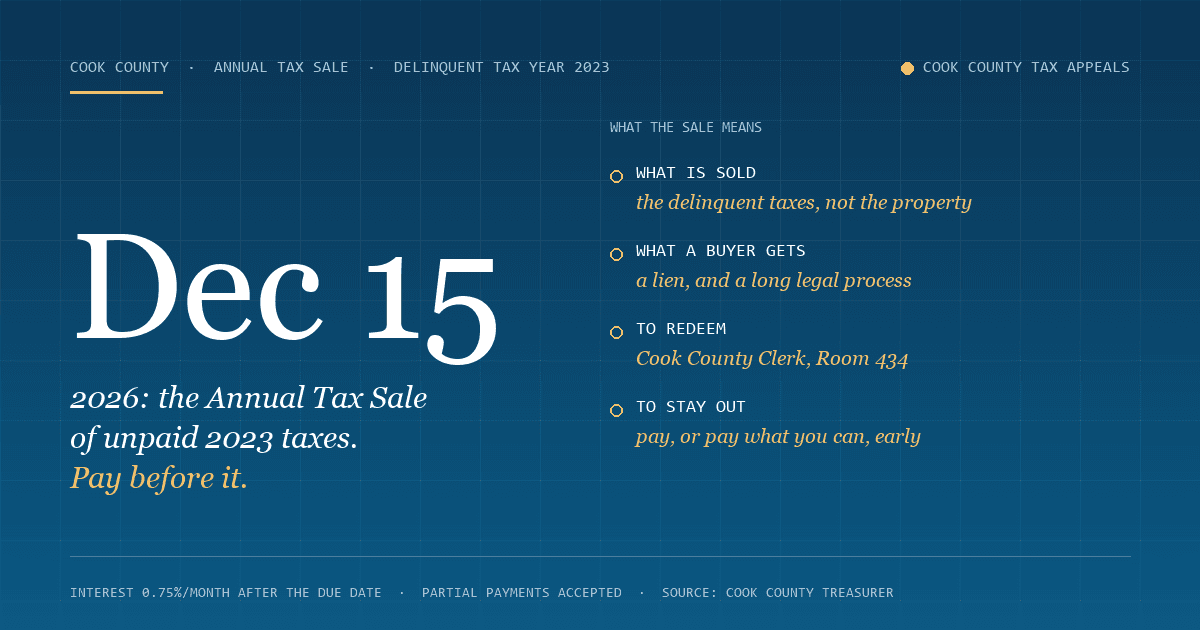
A late payment triggers a 0.75% monthly late charge required by Illinois law, and the charge accrues from the due date. An appeal does not change what is due now, so pay this bill on time. If the appeal succeeds, the savings show on a later bill.
Always confirm your current due dates and balance on the Cook County Treasurer's official site, cookcountytreasurer.com. Due dates can shift year to year — the first installment has historically been due in early March, though it has been moved later in some years.
03 · Refunds & exemptionsRefunds, exemptions, and payment plans
The Treasurer's site does more than take payments. A few tools there can lower what you owe or put money back in your pocket:
- Refund search — if you overpaid or an exemption was applied after you paid, you may be owed a refund. The Treasurer publishes a searchable list of available refunds.
- Exemption check — exemptions reduce the taxable portion of your value and show up on the second installment. Confirm you're receiving every exemption you qualify for.
- Payment plan calculator — if you can't pay in full, the tool helps you build a schedule, including catching up on past-due amounts.
Exemptions vs. appeals — two different savings
An exemption (Homeowner, Senior, Senior Freeze, and others) reduces the taxable portion of your value. An appeal lowers the assessed value itself. They stack — you can claim exemptions and appeal — and both show up on the second installment.
04 · How an appeal lowers your billWhere an appeal actually changes your bill
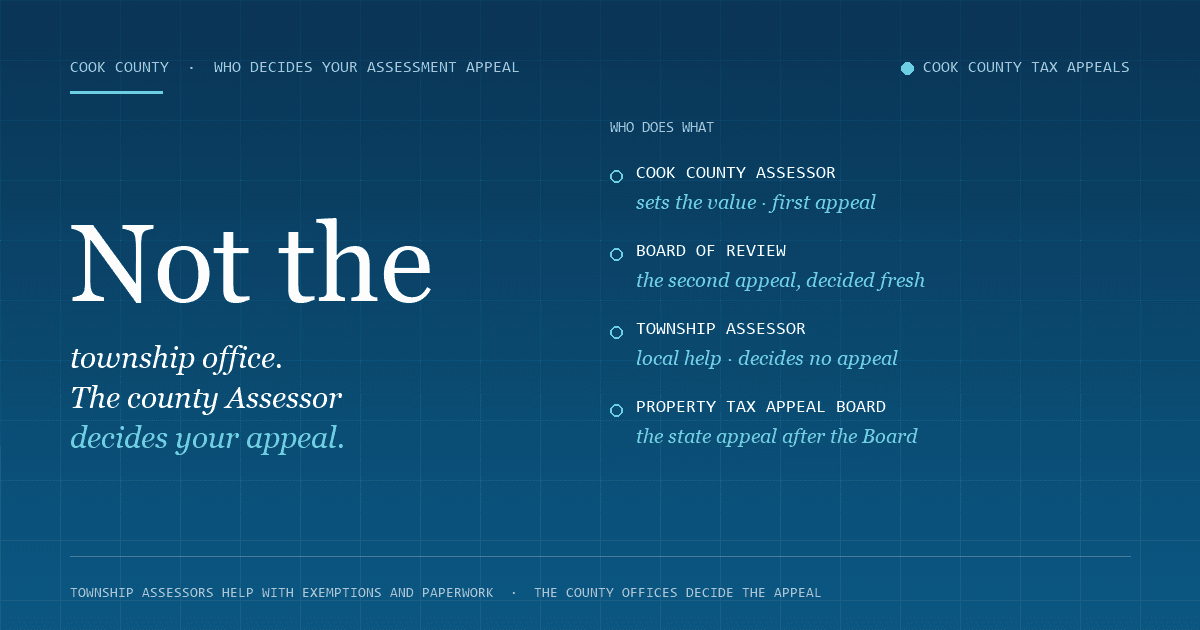
Your tax bill is built from your assessed value. If that value is too high, every bill until your next reassessment is too high. Paying on time does not fix that. Lowering the assessment does, through an appeal at the Cook County Assessor and the Board of Review.
Here's the chain, simplified: the Assessor sets your property's value, exemptions are subtracted, the local tax rate is applied, and the result is your bill. An appeal attacks the first link — the value — and the savings flow through to the second installment. Residential property is assessed at 10% of market value; commercial and industrial at 25%.
What an appeal changes — and what it doesn't
| An appeal can | An appeal can't |
|---|---|
| Lower your assessed value | Change the first installment (it's 55% of last year) |
| Reduce your second-installment bill | Change your tax rate or the state equalizer |
| Carry savings through the triennial cycle | Excuse paying a current bill while it's pending |
| Be filed every year, even off-years | Change the tax rate set by local governments |
Not sure if your value is fair? We'll review it free.
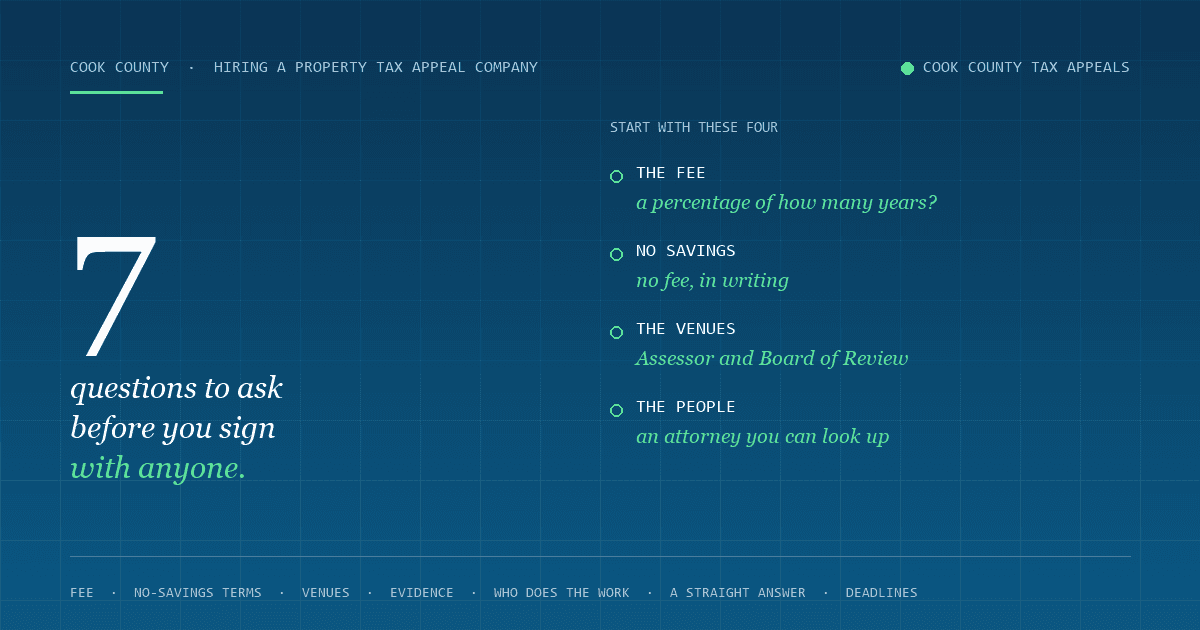
If your assessed value is too high, an appeal can lower your second-installment bill and keep it lower through the cycle. Our team checks your assessment against comparable properties and files on your behalf. $0 upfront. 25% of first-year savings, only if your assessment is reduced.
05 · Working with usWorking with us on a Cook County appeal
Paying your bill is the Treasurer's domain; lowering it is ours. We review your assessment against comparable properties (and, for commercial property, against the income approach), confirm your exemptions are applied, and file at both the Assessor and the Board of Review — escalating to PTAB where the numbers justify it.
We work on contingency: no upfront cost, and we're paid a share of the savings only if the appeal reduces your bill. If your assessment is already fair, the honest answer is to tell you so — and we will.
Frequently asked questions
How many property tax bills does Cook County send each year?+
How is the first installment calculated?+
How do I pay my Cook County property taxes for free?+
What happens if I pay late?+
Do I still have to pay if I've filed an appeal?+
Where do exemptions show up on my bill?+
Does appealing my assessment lower my tax bill?+
Is cookcountytreasurer.com the official payment site?+
Pay at the source — and make sure the bill is right in the first place
Paying on time avoids the late charge, but the bigger savings come from making sure your assessment is fair before the bill is ever calculated. Cook County Tax Appeals reviews your assessment, checks your exemptions and files your appeal, usually at the Assessor and the Board of Review, and at PTAB or the Circuit Court when warranted. Nothing upfront. Our fee is 25% of first-year savings, only if your assessment is reduced.
Sources & verification
Installment structure, the 55% first-installment rule, payment methods, the 0.75% monthly late charge, and exemption timing are drawn from the Cook County Treasurer and Cook County Assessor. Due dates change year to year — always confirm current dates and your balance on the Treasurer's official site.
- Cook County Treasurer's Office — bills, due dates, and payment options. cookcountytreasurer.com
- Cook County Assessor's Office — assessment, exemptions, and the two-installment bill. cookcountyassessoril.gov
- Illinois Property Tax Code — first installment equal to 55% of the prior year's tax and the statutory monthly late charge.
Pay the bill at the source — then make sure it's fair.
Your tax bill is only as fair as your assessment. We review your value, confirm your exemptions, and handle all three appeal tiers (Assessor, Board of Review, PTAB) under one engagement. $0 upfront. 25% of first-year savings, only if your assessment is reduced.